Although marked Scherzo, this movement does not follow scherzo form. It keeps the scherzo’s bright, springy character but is laid out as a rondo: A – B – A – C – A.
A (refrain)
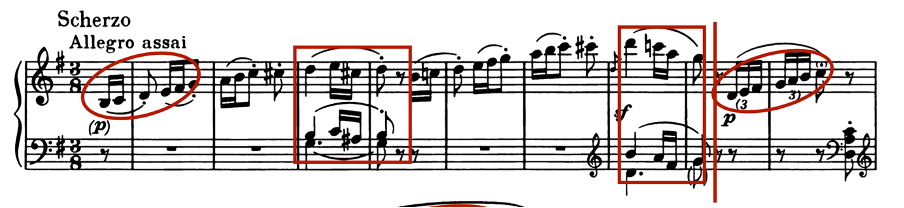
A divides into a – b – a′.
In a, two short motives are combined and developed: a brief ascending figure in 16ths + 8ths (circled in the original), and a leap by a 3rd that resolves (boxed). The pattern is two bars of right-hand single-line ascent followed by two bars of resolving cadence-like motion, then repeated. Because of the very quick tempo, this flies by. It starts in G major; at mm. 7–8 a clear V–I cadence appears, then the music moves to b.
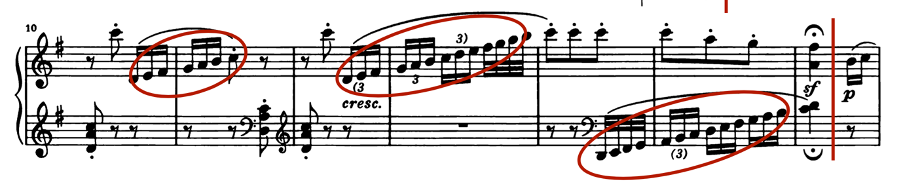
b can be heard as a prolongation of V. Over V, an ascending scale is repeated—a transformation of the earlier motive. Unlike a, whose phrasing broke into three-note cells, b stretches into seven-note spans and uses triplets, heightening the sense of lift. From m. 14 the ascending scale moves to the left hand; at m. 16 a strong half cadence with fermata lands, leading to a′.
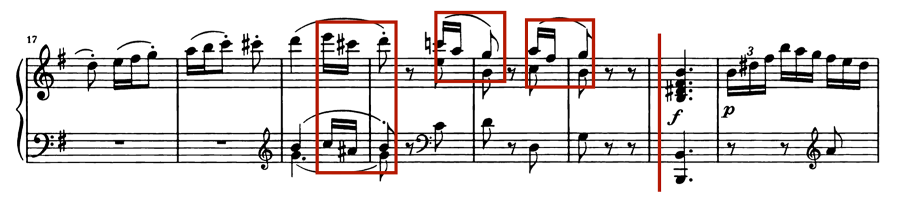
a′ is a compressed reprise of a. The first motive returns an octave higher; then after two bars of ascending scale, the 3rd-leap motive repeats across four bars. At m. 22 a PAC in G closes A and the music proceeds.
B (episode)
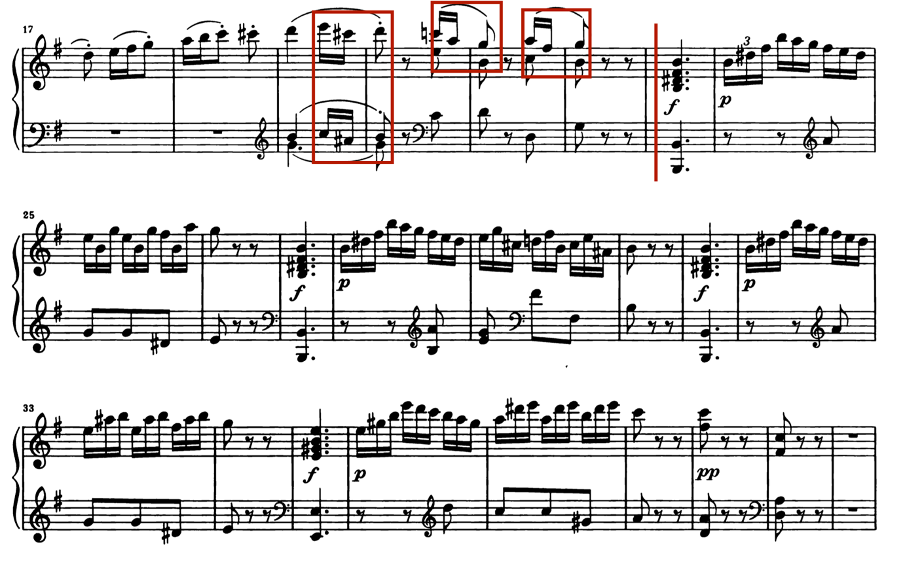
B begins on V of e minor. After a strong, vertical V-chord hit, an arpeggiated “cooling-off” gesture provides contrast. These two ideas alternate to build the section: a 3-bar V plus 1 bar of i, repeated three times. At m. 35 the harmony modulates to a minor, and the same pattern recurs starting on V of a. At m. 38 the i of a minor is reinterpreted as ii of G, effecting a common-chord modulation back to A.
A′
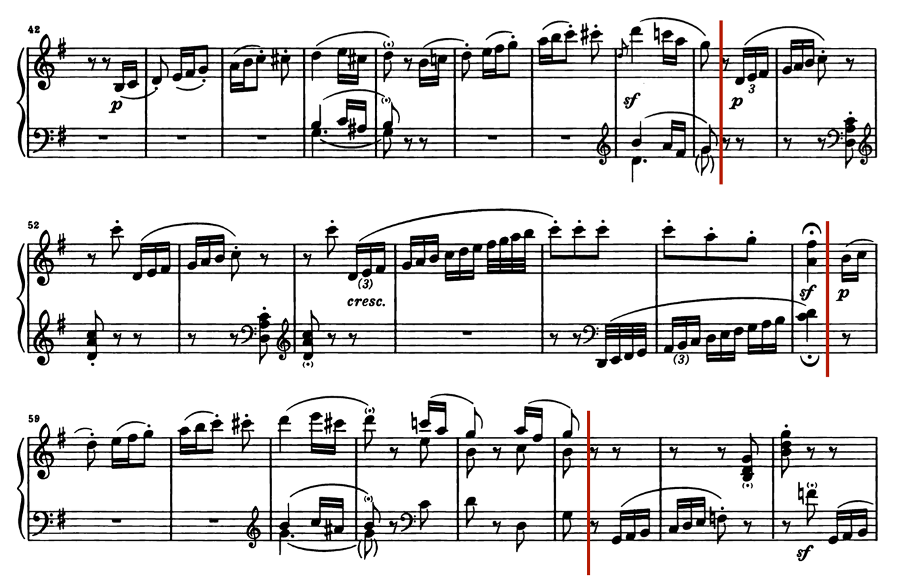
From m. 42, A′ repeats A literally. After the cadence at m. 64, the music immediately flows into a link (transition) that works its motives.
transition
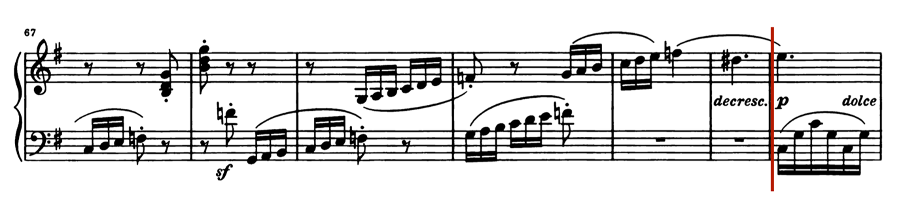
Here I of G is reinterpreted as V of C, yielding a dominant-prolongation in C major. The passage develops the ascending scale and its answering chords from A–b. The scale that had been confined to the left hand now, from mm. 68–71, is taken up in the right hand as well, extending the transition’s reach. Over V7 of C the scale repeats; with the D♯ that forms part of the V+ chord at m. 72, the music passes on to the next section.
C (episode)
C continues directly and begins in C major, cast again as a – b – a′.
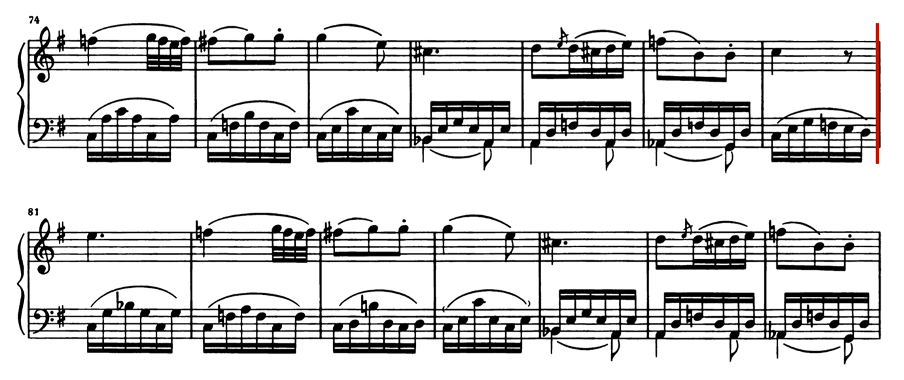
In C–a, the left hand provides an arpeggiated accompaniment, while the right hand carries a cantabile line. The bass descends by seconds down to G; at m. 80 the harmony returns to tonic. From m. 81 to m. 88 the whole span repeats, then moves forward.
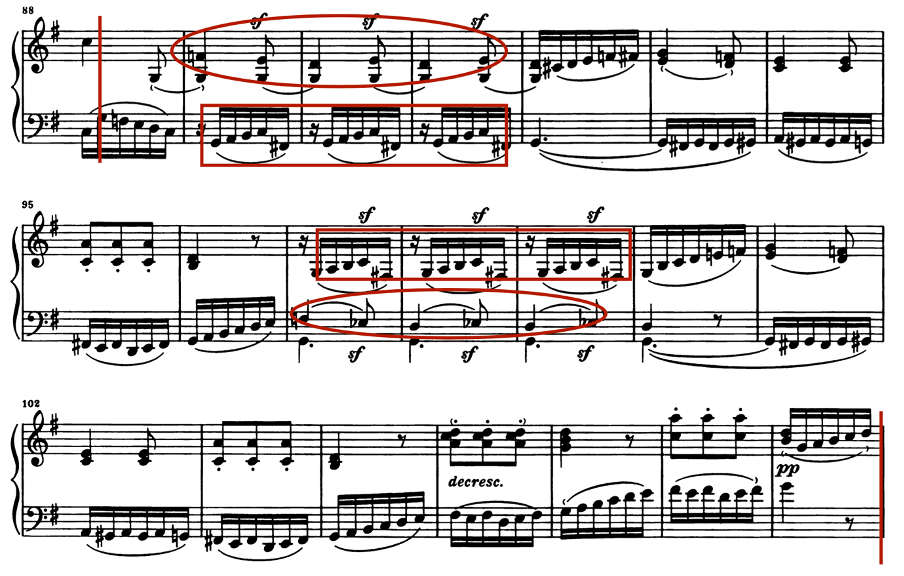
After the I at m. 88, C–b begins. This subsection is centered on V. A new motive drives the development: 16th-note motion around G in the left hand, while the right hand sustains the “lingering” chordal idea in quarters and eighths. Accents are a feature here—sforzandi on weak beats. The 8-bar unit mm. 89–96 is repeated from m. 97 with hands exchanged: what the left hand had played moves to the right, and vice-versa. From m. 101 to m. 108 the previously heard figures are expanded, then the music proceeds to C–a′.
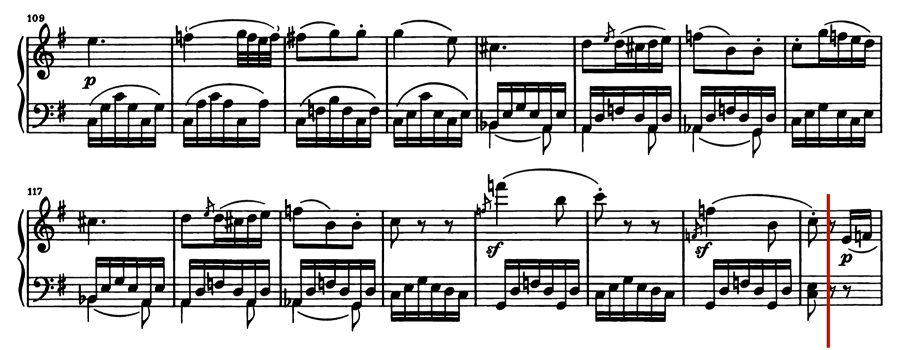
C–a′ repeats C–a. After the cadence at m. 120, V–I is twice reiterated in different registers to underline closure in C, and the C section ends.
transition
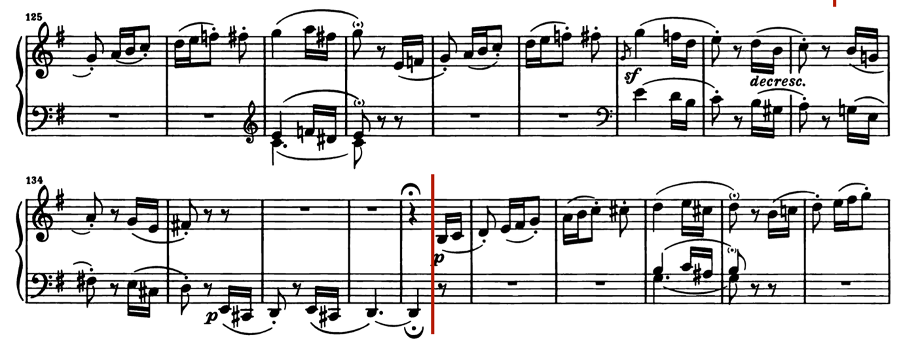
Another transition follows. It looks like the start of A, but, continuing from the previous key, it appears in C major. From m. 131, using descending sequence built from A’s motives, the music naturally reaches V of G, the home dominant. From m. 138 A″ begins.
A″
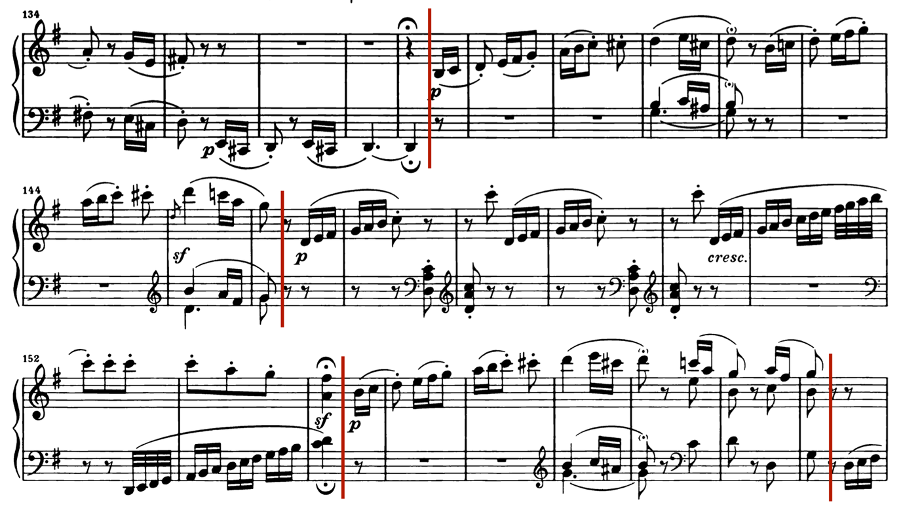
Starting now in the home key, A″ is again a literal reprise of A. After the PAC in G at m. 160, the music turns to a further transition.
transition

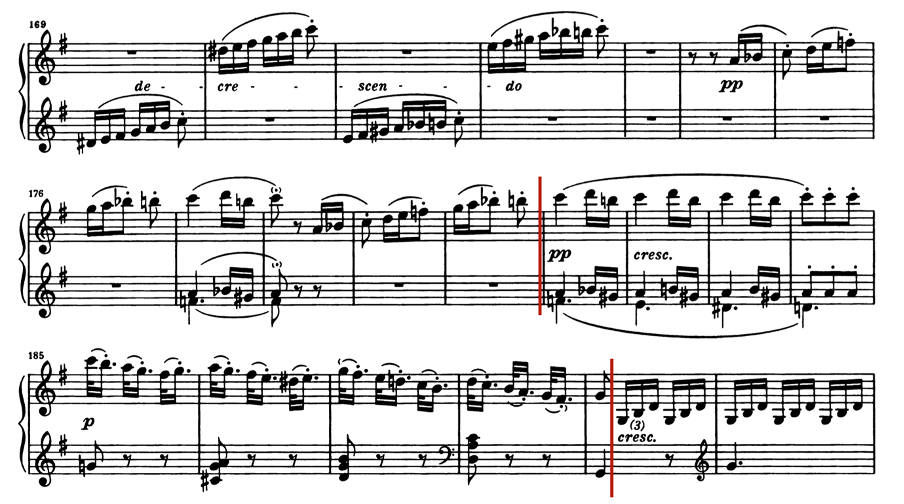
This transition begins exactly like the earlier one at m. 67: left-hand ascending scales are intensified and extended. The scalar writing gradually shifts from diatonic to chromatic, blurring the sense of key. From m. 181 the harmony reclarifies toward G; at m. 188 a firm V7 sounds, and with the I at m. 189—a PAC—the music passes straight into the Coda.
Coda
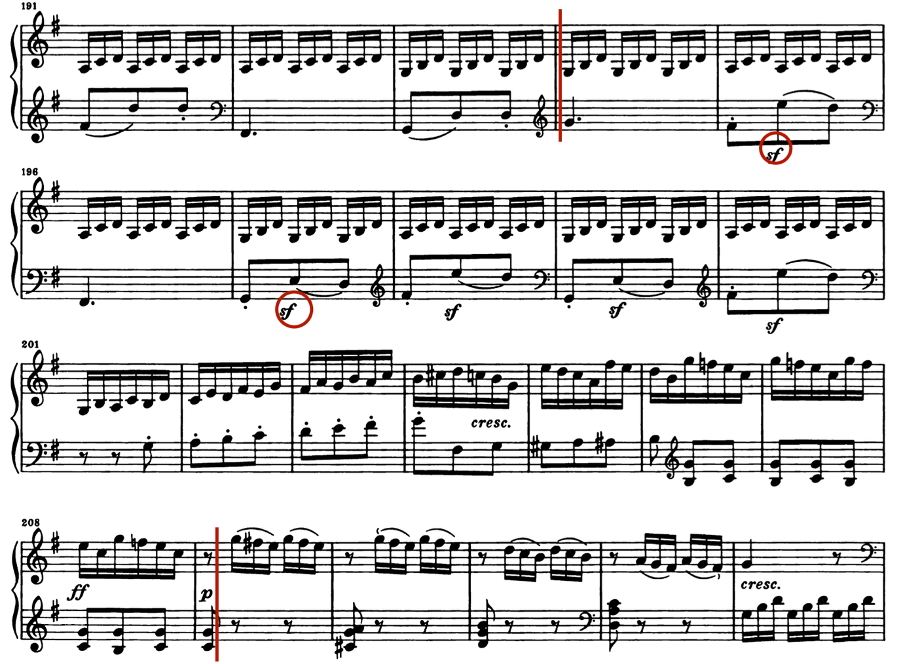
The Coda can be parsed as a – a′ – a″. Its texture highlights right-hand triplet-16ths accompaniment against a left-hand melodic line. mm. 189–193 form the first phrase; from m. 194 it repeats, now adding sforzandi on inner beats in the left hand. From m. 197 the left-hand figure grows more prominent; from m. 201 both hands’ activity changes: the left hand ascends in eighth-note scales, while the right abandons triplet 16ths for straight 16ths, creating a sense of renewed start. From m. 206 the subdominant is stressed, then motion proceeds to Dominant and back to I, replaying the Coda’s opening.
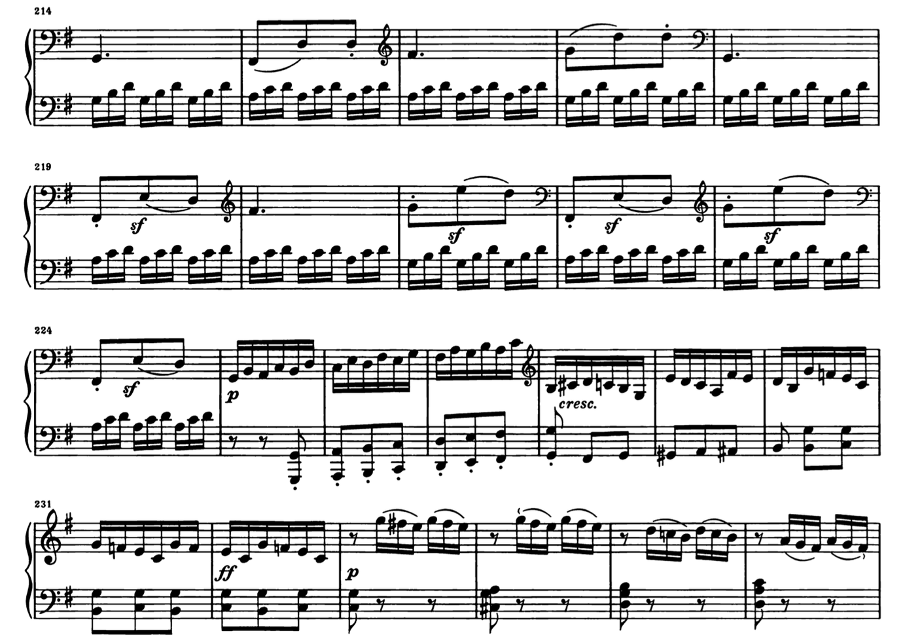
The earlier RH triplet-16th accompaniment now moves to the LH, while the melodic line formerly in the left hand moves to the right—a role reversal. From m. 225 the reprise is heightened: the left hand climbs in octaves, a more developed variant of the earlier version. The structure follows Coda–a, and V7 at m. 236 resolves to I at m. 237, leading into the final part of the Coda.
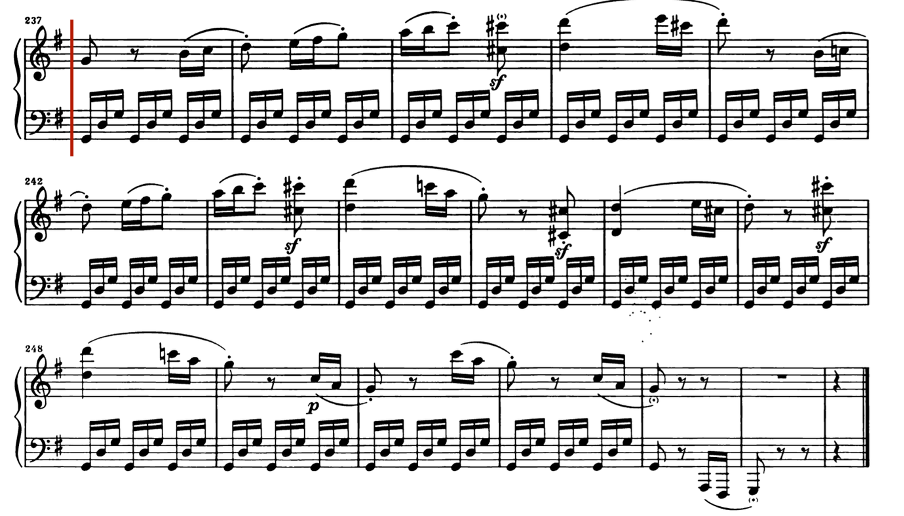
Keeping the left-hand accompaniment, the closing part unfolds over a tonic pedal. The left hand spreads I-chord tones without change, while the right hand reuses motives from A (the refrain). From m. 248 G-centered figures leap across octaves; at m. 252 that figure appears alone in the low bass, and the movement comes to its close.





Although marked Scherzo, this movement does not follow scherzo form. It keeps the scherzo’s bright, springy character but is laid out as a rondo: A – B – A – C – A.
A (refrain)
A divides into a – b – a′.
In a, two short motives are combined and developed: a brief ascending figure in 16ths + 8ths (circled in the original), and a leap by a 3rd that resolves (boxed). The pattern is two bars of right-hand single-line ascent followed by two bars of resolving cadence-like motion, then repeated. Because of the very quick tempo, this flies by. It starts in G major; at mm. 7–8 a clear V–I cadence appears, then the music moves to b.
b can be heard as a prolongation of V. Over V, an ascending scale is repeated—a transformation of the earlier motive. Unlike a, whose phrasing broke into three-note cells, b stretches into seven-note spans and uses triplets, heightening the sense of lift. From m. 14 the ascending scale moves to the left hand; at m. 16 a strong half cadence with fermata lands, leading to a′.
a′ is a compressed reprise of a. The first motive returns an octave higher; then after two bars of ascending scale, the 3rd-leap motive repeats across four bars. At m. 22 a PAC in G closes A and the music proceeds.
B (episode)
B begins on V of e minor. After a strong, vertical V-chord hit, an arpeggiated “cooling-off” gesture provides contrast. These two ideas alternate to build the section: a 3-bar V plus 1 bar of i, repeated three times. At m. 35 the harmony modulates to a minor, and the same pattern recurs starting on V of a. At m. 38 the i of a minor is reinterpreted as ii of G, effecting a common-chord modulation back to A.
A′
From m. 42, A′ repeats A literally. After the cadence at m. 64, the music immediately flows into a link (transition) that works its motives.
transition
Here I of G is reinterpreted as V of C, yielding a dominant-prolongation in C major. The passage develops the ascending scale and its answering chords from A–b. The scale that had been confined to the left hand now, from mm. 68–71, is taken up in the right hand as well, extending the transition’s reach. Over V7 of C the scale repeats; with the D♯ that forms part of the V+ chord at m. 72, the music passes on to the next section.
C (episode)
C continues directly and begins in C major, cast again as a – b – a′.
In C–a, the left hand provides an arpeggiated accompaniment, while the right hand carries a cantabile line. The bass descends by seconds down to G; at m. 80 the harmony returns to tonic. From m. 81 to m. 88 the whole span repeats, then moves forward.
After the I at m. 88, C–b begins. This subsection is centered on V. A new motive drives the development: 16th-note motion around G in the left hand, while the right hand sustains the “lingering” chordal idea in quarters and eighths. Accents are a feature here—sforzandi on weak beats. The 8-bar unit mm. 89–96 is repeated from m. 97 with hands exchanged: what the left hand had played moves to the right, and vice-versa. From m. 101 to m. 108 the previously heard figures are expanded, then the music proceeds to C–a′.
C–a′ repeats C–a. After the cadence at m. 120, V–I is twice reiterated in different registers to underline closure in C, and the C section ends.
transition
Another transition follows. It looks like the start of A, but, continuing from the previous key, it appears in C major. From m. 131, using descending sequence built from A’s motives, the music naturally reaches V of G, the home dominant. From m. 138 A″ begins.
A″
Starting now in the home key, A″ is again a literal reprise of A. After the PAC in G at m. 160, the music turns to a further transition.
transition
This transition begins exactly like the earlier one at m. 67: left-hand ascending scales are intensified and extended. The scalar writing gradually shifts from diatonic to chromatic, blurring the sense of key. From m. 181 the harmony reclarifies toward G; at m. 188 a firm V7 sounds, and with the I at m. 189—a PAC—the music passes straight into the Coda.
Coda
The Coda can be parsed as a – a′ – a″. Its texture highlights right-hand triplet-16ths accompaniment against a left-hand melodic line. mm. 189–193 form the first phrase; from m. 194 it repeats, now adding sforzandi on inner beats in the left hand. From m. 197 the left-hand figure grows more prominent; from m. 201 both hands’ activity changes: the left hand ascends in eighth-note scales, while the right abandons triplet 16ths for straight 16ths, creating a sense of renewed start. From m. 206 the subdominant is stressed, then motion proceeds to Dominant and back to I, replaying the Coda’s opening.
The earlier RH triplet-16th accompaniment now moves to the LH, while the melodic line formerly in the left hand moves to the right—a role reversal. From m. 225 the reprise is heightened: the left hand climbs in octaves, a more developed variant of the earlier version. The structure follows Coda–a, and V7 at m. 236 resolves to I at m. 237, leading into the final part of the Coda.
Keeping the left-hand accompaniment, the closing part unfolds over a tonic pedal. The left hand spreads I-chord tones without change, while the right hand reuses motives from A (the refrain). From m. 248 G-centered figures leap across octaves; at m. 252 that figure appears alone in the low bass, and the movement comes to its close.