Beethoven composed Piano Sonata No. 10 between 1798–1799. It is dedicated to Josepha von Braun and consists of three movements. The first movement is in a conventional sonata form at a quick Allegro in 2/4.
Exposition — mm. 1–63
First Theme
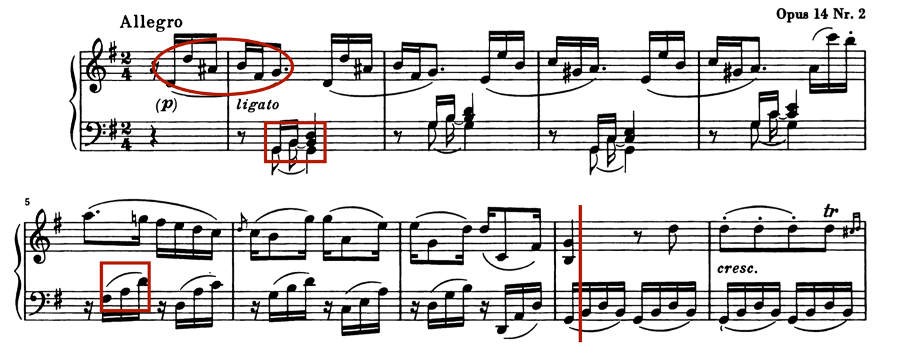
The first theme begins in G major and is a single sentence made by combining two phrases. In the opening bar one can identify two components: in the right hand, a leaping sixteenth-note figure; in the left hand, a chord-building pattern. The first four bars are built from repetitions of this motive. In the bass, the note G is used as a pedal, prolonging the tonic. Another hallmark is a rest on the first beat of the motive, which throws the accent onto the weak beat—a foreshadowing of the syncopation that will appear in the next phrase. From m. 5 new elements enter: in the left hand the ties disappear, leaving pure arpeggiation. From here the bass begins to change. In m. 6 the earlier syncopation appears and is sequenced; at m. 8 a perfect authentic cadence (PAC) closes the first theme.
Transition
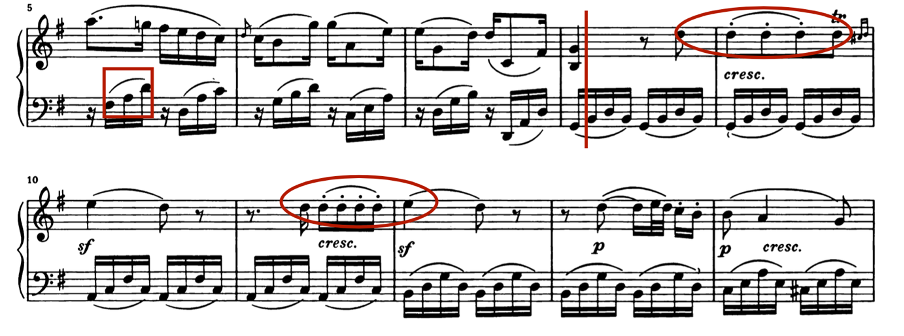
The transition begins straight out of I in G major. Its main motives are the slur–staccato repeated-note figure and a left-hand Alberti bass. At m. 14, via the chromatic move C–C♯, the music naturally modulates to D major, the tonic’s dominant.
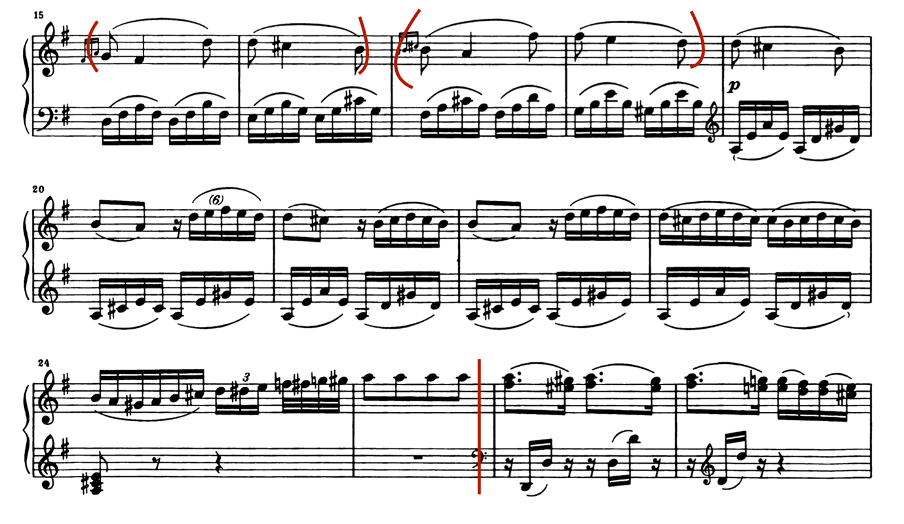
From m. 15 a new pattern is heard in sequence; the left-hand accompaniment continues unchanged. From m. 20 the front half of that sequence is fragmented and sextuplets are added to accelerate the music. From the end of m. 22 the sextuplet activity is intensified, reaching the climax of the transition. At m. 24 there is a chromatic ascent and a one-bar settling gesture, then the music moves to the second theme. From mm. 19–24 an A pedal keeps stressing V of D; since the second theme also begins in D major (the dominant of the first theme), this passage prepares it.
Second Theme
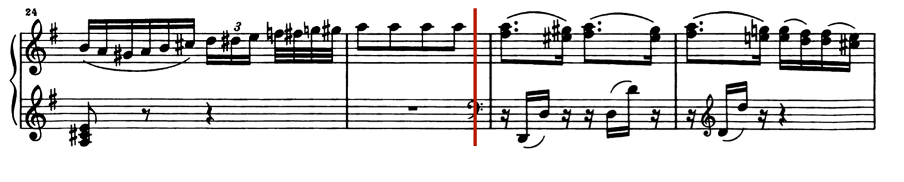
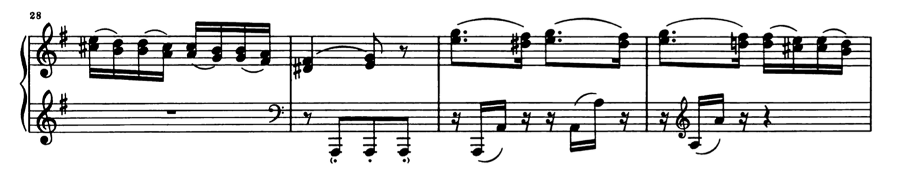
The second theme follows immediately. Its first sentence consists of a four-bar motive and its repeat. There is little large-scale harmonic change: the first four bars sit on I, the next four on V. In the right hand the chief material is the progression of 3rds; in the left hand Beethoven develops the “sixteenth-rest then weak-beat entry” figure that was prominent in the first theme.
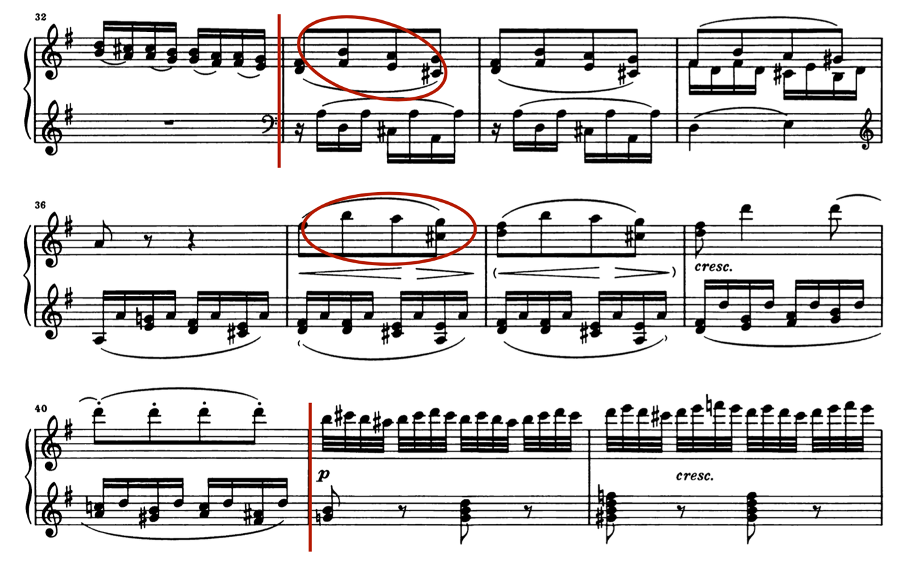
The next sentence proceeds with a new motive. The left-hand accompaniment can be heard as a developed variant of the previous sentence’s left hand: it begins with a sixteenth-rest, then a leaping accompanimental pattern that grows progressively. In the right hand, a leap followed by a stepwise descent is repeated. After the first two bars, inner voices are added and the line is taken up an octave, giving a more developed impression. At m. 39 the previously used syncopation appears on the eighth-note level; at m. 40 the slur–staccato repeated-note device returns and the music moves to the next sentence. The key remains D major; the stepwise bass continues, and with no large harmonic shifts the passage faithfully projects I.
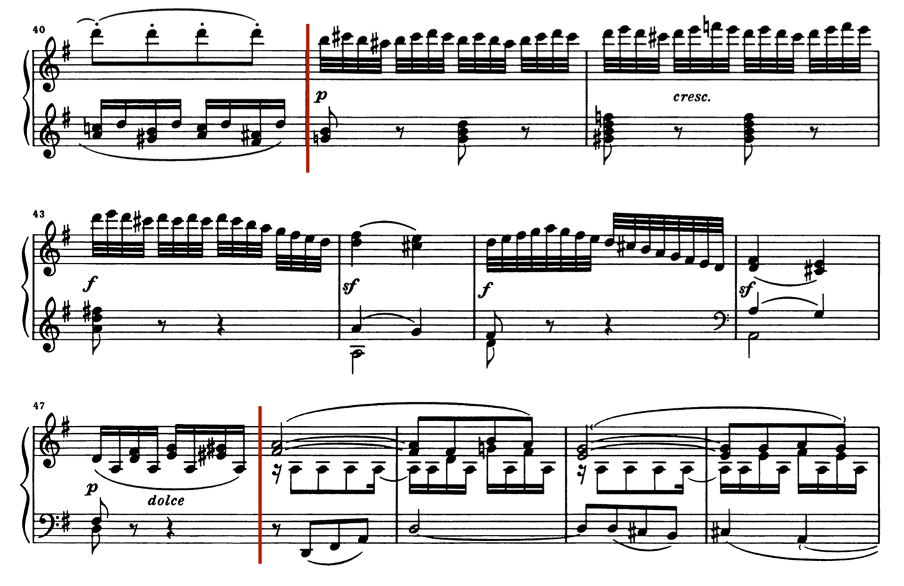
The continuation now makes the rapid thirty-second-note motion its main element. With a typical Subdominant–Dominant–Tonic progression there is a first cadence, then, using the tail material, a brief V–I closes the span and the music proceeds.
Closing Theme
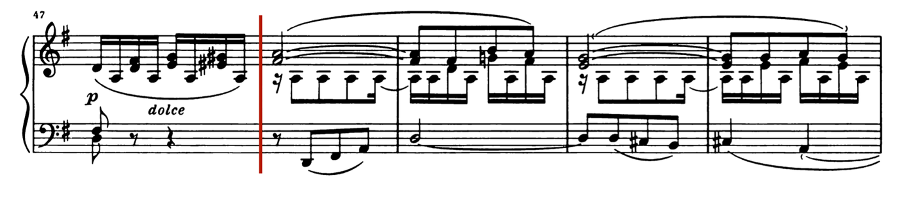
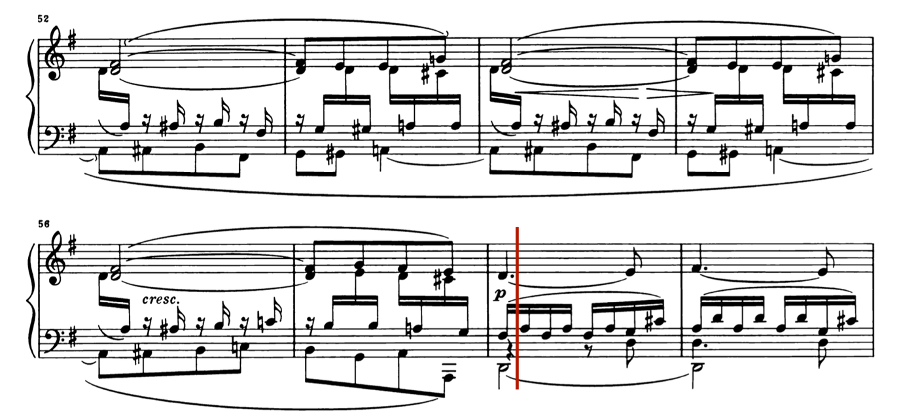
After the cadence in D major, a closing theme begins. Overall it retains many features of the first theme. The left-hand writing lengthens the first theme’s sixteenth-note arpeggio into eighths; the inner-voice syncopation likewise reuses material from the first theme. The closing theme proceeds by repeating a two-bar motive and slightly varying it. Through the typical progression I – vi – ii⁶ – V – I, it ends with a PAC.
Codetta
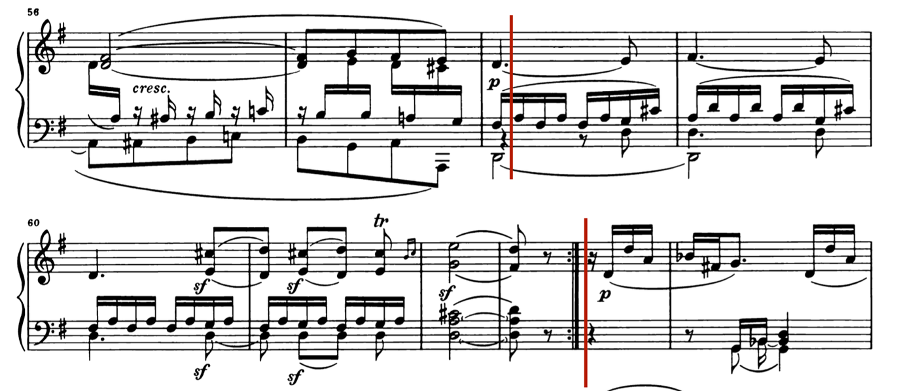
A short six-bar codetta follows. As a tonic prolongation, it proceeds over a D pedal, gathers earlier motions, and reinforces the cadence.
Development
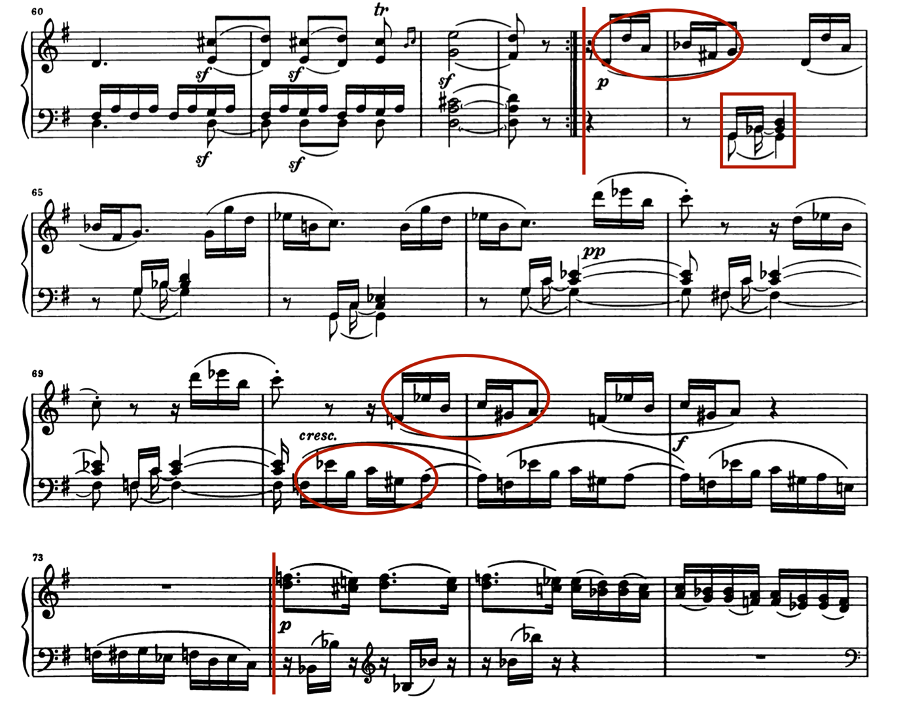
The development opens by restating the first theme in g minor and working its motive by repetition. It advances in short phrases and, registrally, uses octave leaps to intensify the sense of growth. From m. 70 the music moves to B♭ major, the relative major of g minor. The bass maintains an F pedal, functioning as V of B♭, and the music proceeds to the next subsection.

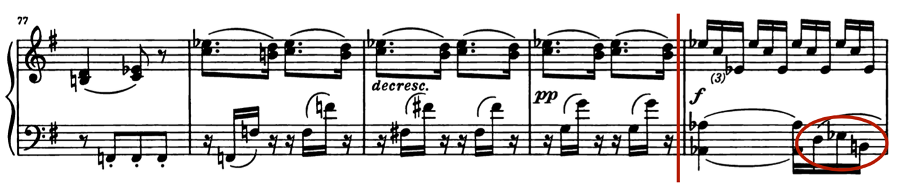
It begins on I of B♭ and develops motive(s) from the second theme. Over seven bars the second-theme motive becomes increasingly fragmented and accelerated, then the music turns to a new span. In this process the bass rises chromatically—F–F♯–G–A♭—moving the harmony to E♭ major.
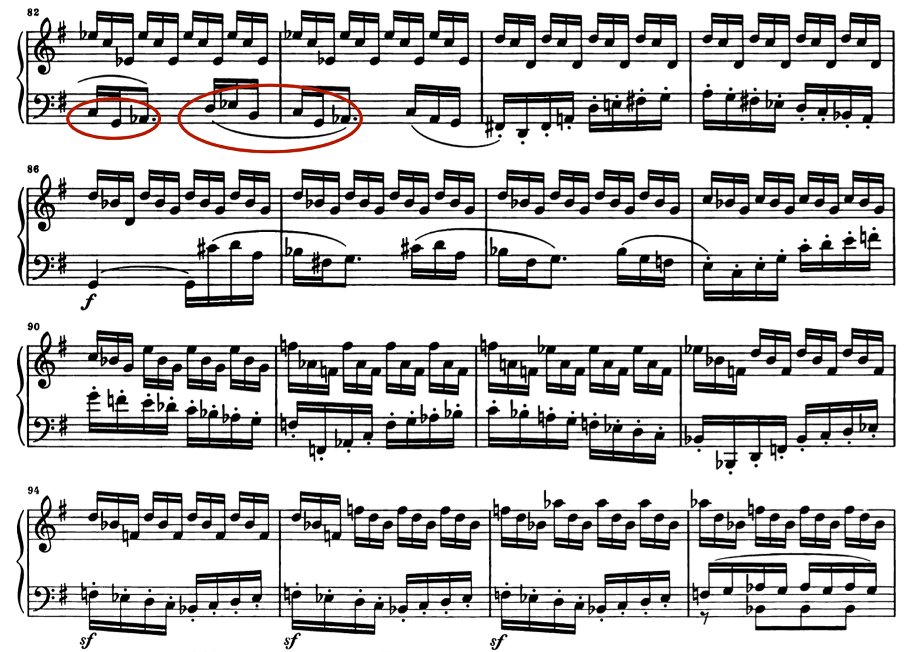
Next, a right-hand triplet accompaniment with a left-hand melody carries the discourse. The left-hand figure is the same motive that the right hand presented in the first theme of the exposition. Despite the brilliant figuration, the harmonic change is modest, giving the passage stability. The subdominant and dominant are emphasized continually, and the bass uses pedals frequently. With the same process the music runs on to m. 97, where a fermata prepares the next move.
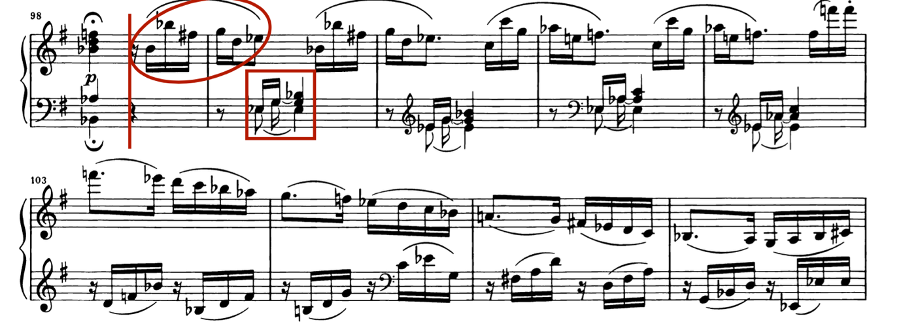
After a V⁷ over the fermata and a half cadence in E♭, the first theme is restated in E♭ major. From m. 103 a sequential descent from the high register leads to g minor. Over a D pedal (the dominant), F♯ enters at m. 105; by way of V of g minor, the music modulates back to the original key with the same tonic letter—G major.
Retransition
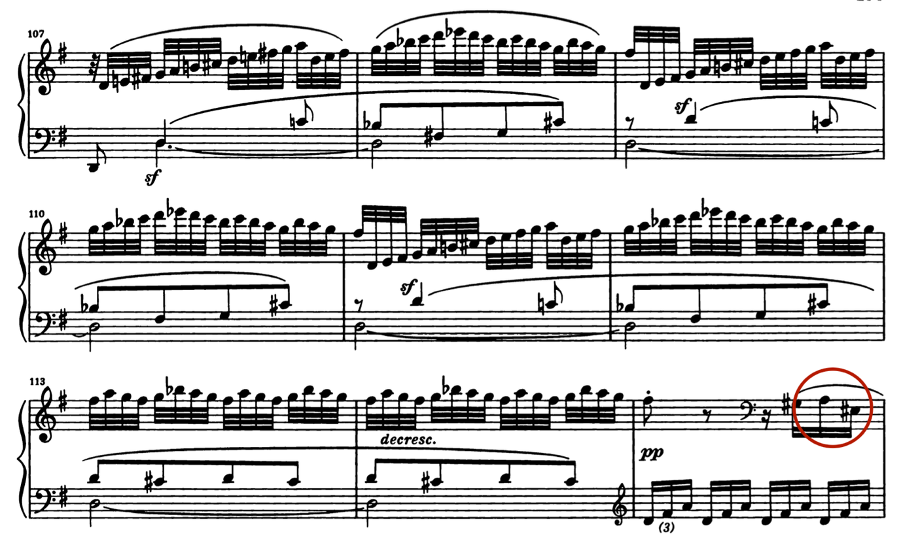
Over V a retransition appears, divisible into two parts. The first uses the thirty-second-note figure heard in the second theme. The left-hand inner voice can be viewed as an inverted form of the pattern used in the second sentence of the second theme.
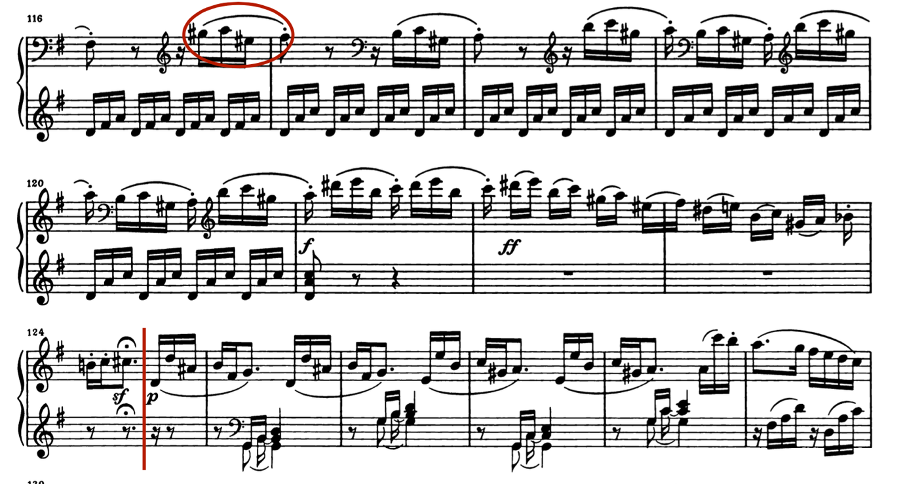
The next part places the triplet accompaniment from the development in the left hand and fragments of the first theme in the right. The D pedal persists. By m. 121 the first-theme motive is pared down to only a semitone (2nd) motion; through this process a half cadence at m. 124 ushers in the recapitulation.
Recapitulation
First Theme
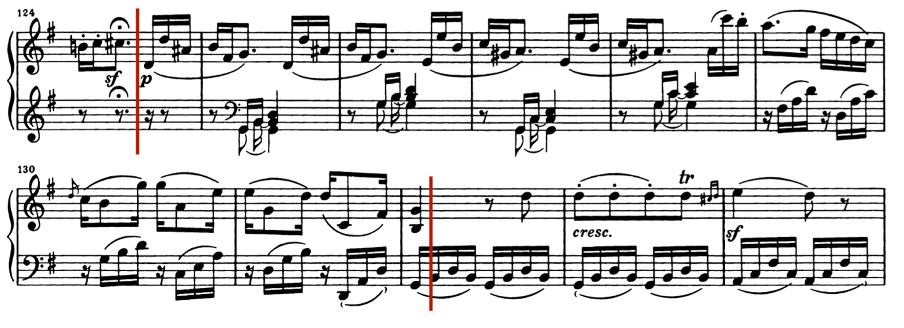
The first theme in the recapitulation proceeds exactly as in the exposition.
Transition
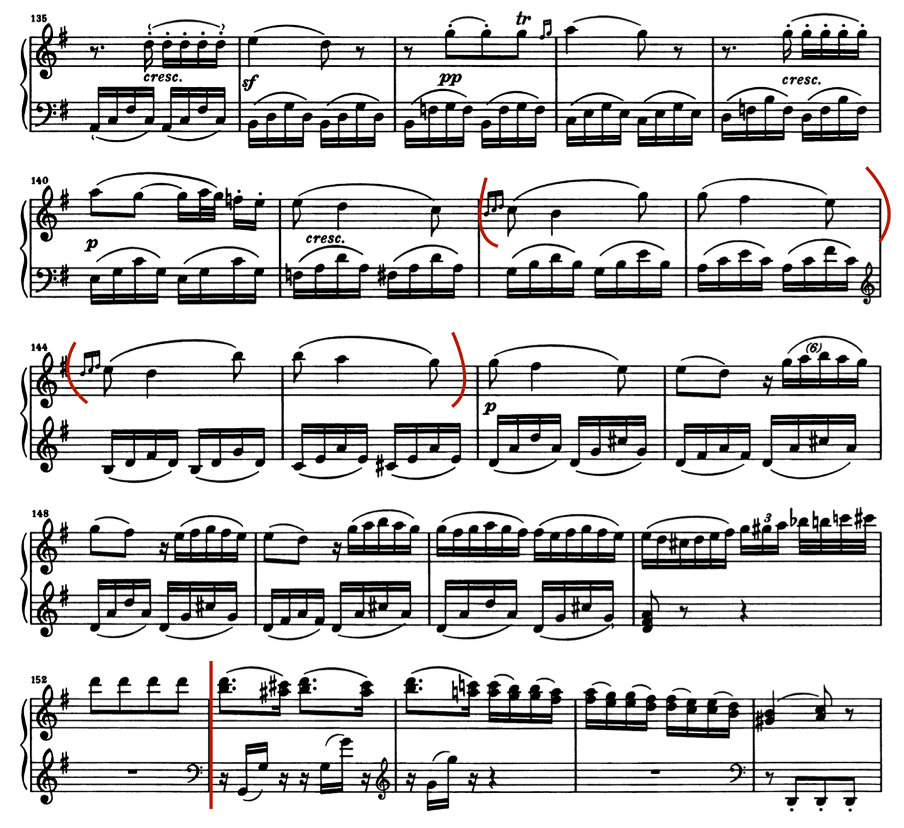
The transition likewise begins similarly. A difference: at the final goal (m. 151), to restate the second theme in the tonic, a V of G major appears.
Second Theme
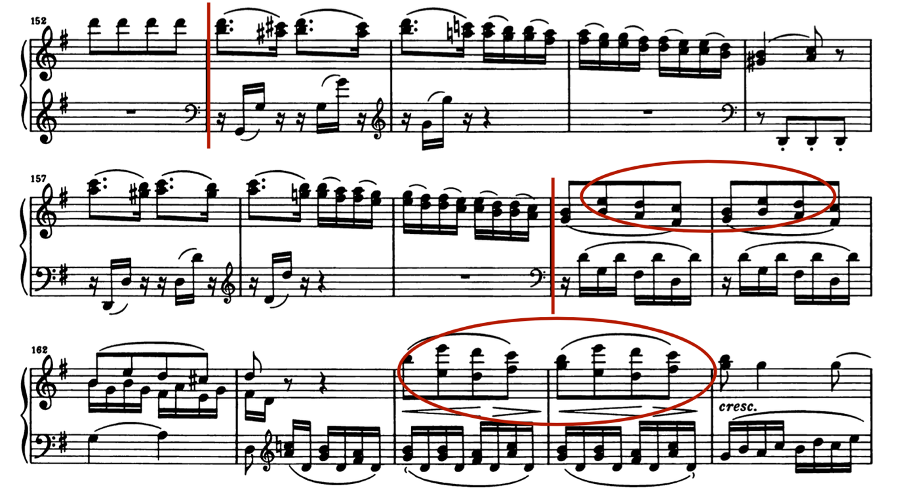
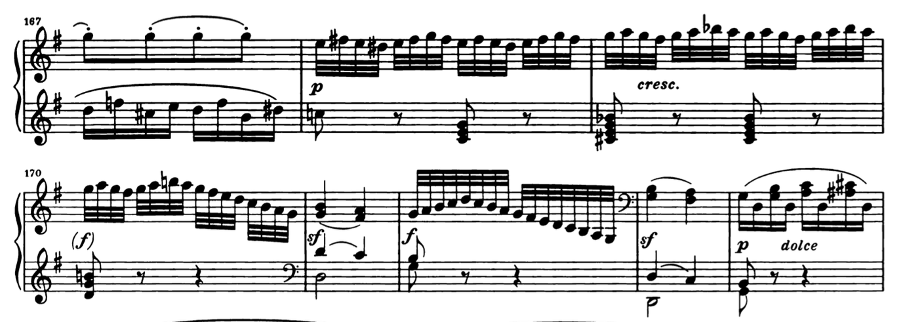
Unlike the exposition, the second theme now appears in the home key, G major. Otherwise, it runs much like the exposition, with a few locally expanded spots.
Closing Theme
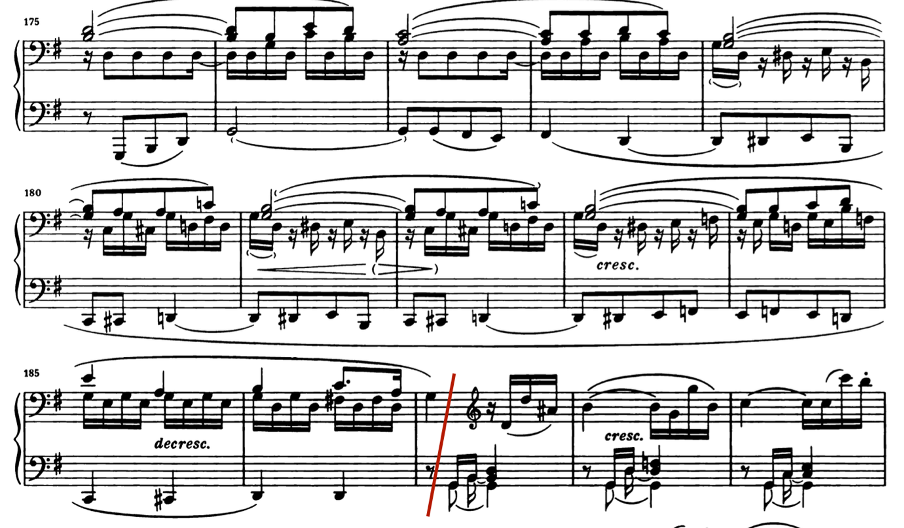
The closing theme, too, changes little apart from the key (now G major). A dominant pedal is used and emphasized. With the cadence at m. 187, the music moves to the coda.
Coda
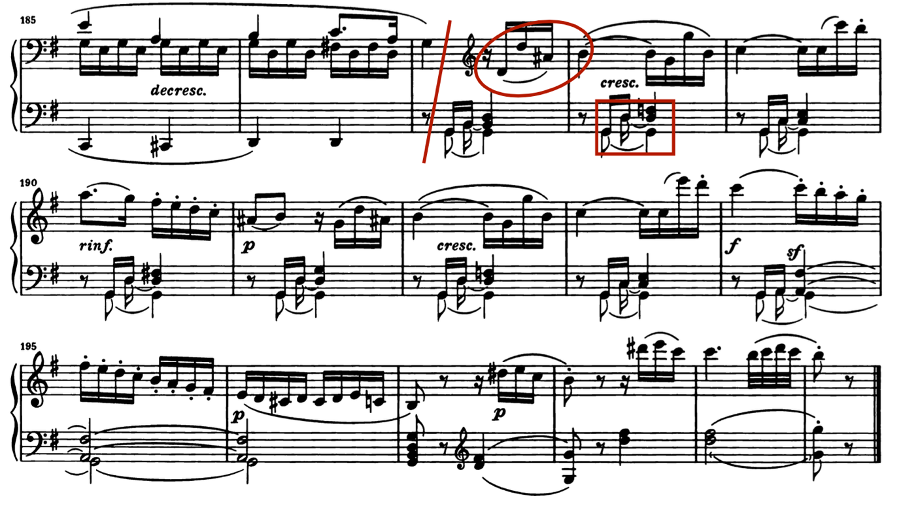
The coda develops the first theme’s motive, proceeding over a tonic pedal. The sforzando at m. 194 is the strongest dynamic peak; thereafter the writing tapers off. At m. 200 the piece ends with an imperfect authentic cadence (IAC).





Beethoven composed Piano Sonata No. 10 between 1798–1799. It is dedicated to Josepha von Braun and consists of three movements. The first movement is in a conventional sonata form at a quick Allegro in 2/4.
Exposition — mm. 1–63
First Theme
The first theme begins in G major and is a single sentence made by combining two phrases. In the opening bar one can identify two components: in the right hand, a leaping sixteenth-note figure; in the left hand, a chord-building pattern. The first four bars are built from repetitions of this motive. In the bass, the note G is used as a pedal, prolonging the tonic. Another hallmark is a rest on the first beat of the motive, which throws the accent onto the weak beat—a foreshadowing of the syncopation that will appear in the next phrase. From m. 5 new elements enter: in the left hand the ties disappear, leaving pure arpeggiation. From here the bass begins to change. In m. 6 the earlier syncopation appears and is sequenced; at m. 8 a perfect authentic cadence (PAC) closes the first theme.
Transition
The transition begins straight out of I in G major. Its main motives are the slur–staccato repeated-note figure and a left-hand Alberti bass. At m. 14, via the chromatic move C–C♯, the music naturally modulates to D major, the tonic’s dominant.
From m. 15 a new pattern is heard in sequence; the left-hand accompaniment continues unchanged. From m. 20 the front half of that sequence is fragmented and sextuplets are added to accelerate the music. From the end of m. 22 the sextuplet activity is intensified, reaching the climax of the transition. At m. 24 there is a chromatic ascent and a one-bar settling gesture, then the music moves to the second theme. From mm. 19–24 an A pedal keeps stressing V of D; since the second theme also begins in D major (the dominant of the first theme), this passage prepares it.
Second Theme
The second theme follows immediately. Its first sentence consists of a four-bar motive and its repeat. There is little large-scale harmonic change: the first four bars sit on I, the next four on V. In the right hand the chief material is the progression of 3rds; in the left hand Beethoven develops the “sixteenth-rest then weak-beat entry” figure that was prominent in the first theme.
The next sentence proceeds with a new motive. The left-hand accompaniment can be heard as a developed variant of the previous sentence’s left hand: it begins with a sixteenth-rest, then a leaping accompanimental pattern that grows progressively. In the right hand, a leap followed by a stepwise descent is repeated. After the first two bars, inner voices are added and the line is taken up an octave, giving a more developed impression. At m. 39 the previously used syncopation appears on the eighth-note level; at m. 40 the slur–staccato repeated-note device returns and the music moves to the next sentence. The key remains D major; the stepwise bass continues, and with no large harmonic shifts the passage faithfully projects I.
The continuation now makes the rapid thirty-second-note motion its main element. With a typical Subdominant–Dominant–Tonic progression there is a first cadence, then, using the tail material, a brief V–I closes the span and the music proceeds.
Closing Theme
After the cadence in D major, a closing theme begins. Overall it retains many features of the first theme. The left-hand writing lengthens the first theme’s sixteenth-note arpeggio into eighths; the inner-voice syncopation likewise reuses material from the first theme. The closing theme proceeds by repeating a two-bar motive and slightly varying it. Through the typical progression I – vi – ii⁶ – V – I, it ends with a PAC.
Codetta
A short six-bar codetta follows. As a tonic prolongation, it proceeds over a D pedal, gathers earlier motions, and reinforces the cadence.
Development
The development opens by restating the first theme in g minor and working its motive by repetition. It advances in short phrases and, registrally, uses octave leaps to intensify the sense of growth. From m. 70 the music moves to B♭ major, the relative major of g minor. The bass maintains an F pedal, functioning as V of B♭, and the music proceeds to the next subsection.
It begins on I of B♭ and develops motive(s) from the second theme. Over seven bars the second-theme motive becomes increasingly fragmented and accelerated, then the music turns to a new span. In this process the bass rises chromatically—F–F♯–G–A♭—moving the harmony to E♭ major.
Next, a right-hand triplet accompaniment with a left-hand melody carries the discourse. The left-hand figure is the same motive that the right hand presented in the first theme of the exposition. Despite the brilliant figuration, the harmonic change is modest, giving the passage stability. The subdominant and dominant are emphasized continually, and the bass uses pedals frequently. With the same process the music runs on to m. 97, where a fermata prepares the next move.
After a V⁷ over the fermata and a half cadence in E♭, the first theme is restated in E♭ major. From m. 103 a sequential descent from the high register leads to g minor. Over a D pedal (the dominant), F♯ enters at m. 105; by way of V of g minor, the music modulates back to the original key with the same tonic letter—G major.
Retransition
Over V a retransition appears, divisible into two parts. The first uses the thirty-second-note figure heard in the second theme. The left-hand inner voice can be viewed as an inverted form of the pattern used in the second sentence of the second theme.
The next part places the triplet accompaniment from the development in the left hand and fragments of the first theme in the right. The D pedal persists. By m. 121 the first-theme motive is pared down to only a semitone (2nd) motion; through this process a half cadence at m. 124 ushers in the recapitulation.
Recapitulation
First Theme
The first theme in the recapitulation proceeds exactly as in the exposition.
Transition
The transition likewise begins similarly. A difference: at the final goal (m. 151), to restate the second theme in the tonic, a V of G major appears.
Second Theme
Unlike the exposition, the second theme now appears in the home key, G major. Otherwise, it runs much like the exposition, with a few locally expanded spots.
Closing Theme
The closing theme, too, changes little apart from the key (now G major). A dominant pedal is used and emphasized. With the cadence at m. 187, the music moves to the coda.
Coda
The coda develops the first theme’s motive, proceeding over a tonic pedal. The sforzando at m. 194 is the strongest dynamic peak; thereafter the writing tapers off. At m. 200 the piece ends with an imperfect authentic cadence (IAC).