The second movement is in A–B–A′ compound ternary form. It can be regarded as a movement that replaces a minuet or scherzo.
A
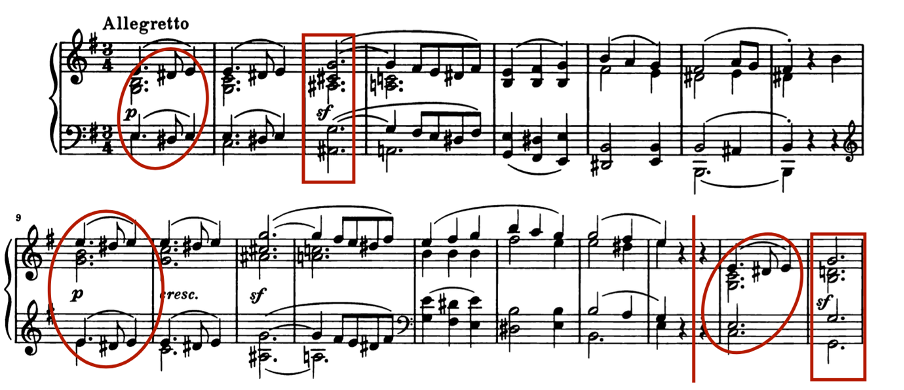
Begins in E minor. The A section itself divides into a–b–a′. Strictly speaking, A–b does not introduce wholly new material; rather, it continues to work with the same motive, expanding it and driving the discourse forward. The core motive (circled in the original) is a neighbor-note figure built from dotted quarter – eighth – quarter. In the first sentence the motive appears twice, after which a different figure follows. The continuation forms a four-bar unit that develops the initially stated figure. When the motive returns at m. 9, it is re-stated an octave higher, giving an expanded feel. The 1–8 phrase is then repeated one octave higher; whereas an HC closed m. 8, at m. 16 a V7–I perfect authentic cadence closes the opening part.
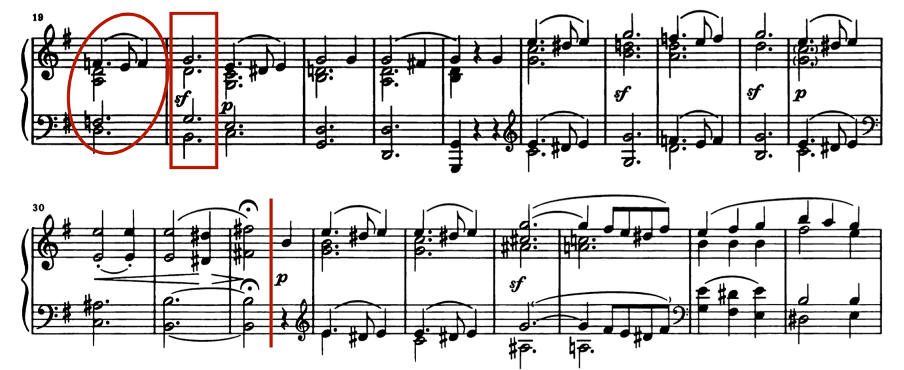
The next span begins in C major, a third-related key to the tonic. The governing motive remains the same; however, unlike A–a, which repeated the motive twice before moving on, A–b sounds it only once and then resolves into the following harmony. The writing consists of progressions that firmly establish C major. The 8-bar phrase + repeat format matches A–a. Again, the repeated phrase is taken up an octave. At m. 30, following an It.+6 in E minor the harmony moves to V, and the music returns to the home key.
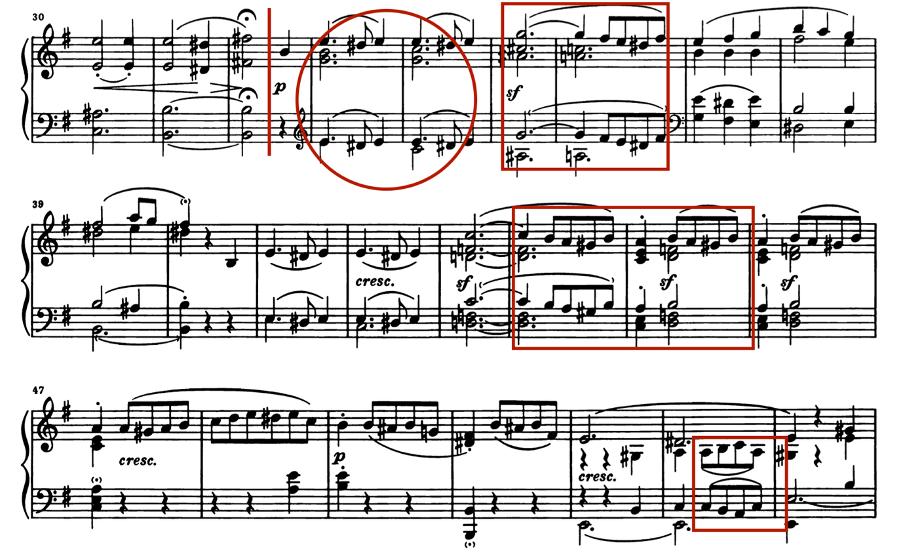
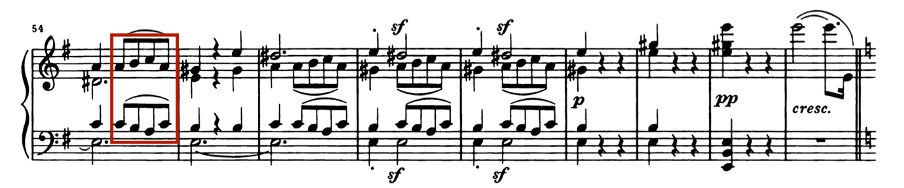
A–a′ begins as a reprise of the opening. In contrast with A–a, the first phrase now starts higher; after the first 8 bars, the next phrase returns an octave lower. The boxed motive is employed more extensively. From m. 44 the motive is repeated, and its eighth-note figure becomes the main propulsive force of the subsequent phrases. A cadence in E minor occurs at mm. 50–51, and the music turns to the codetta. The inner-voice pattern that drives this codetta is likewise derived from the boxed motive. From m. 51 to m. 61 a tonic pedal supports repeated statements of the same figure, which then ascend to the close. At this point the use of G♯ lends a major-tonic coloration; a Picardy third is heard, although C is not sharpened, so a minor coloration still remains.
B
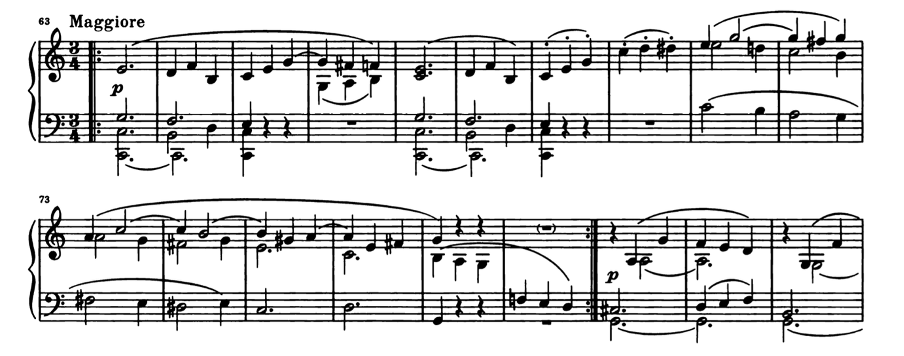
The B section has the character of a scherzo-like Trio and divides into B–a, B–b, B–a′. It starts, as briefly previewed in A–b, in C major, giving a clear character contrast with the minor A. In the first 4-bar unit the melody is stated legato; in the next it returns under slur-staccato, slightly altered. After the first 8-bar phrase, the next 8-bar phrase features the inner voices of left and right hands descending in parallel thirds. Above this, the soprano line is tied across the beat, so that natural accents fall on weak beats.
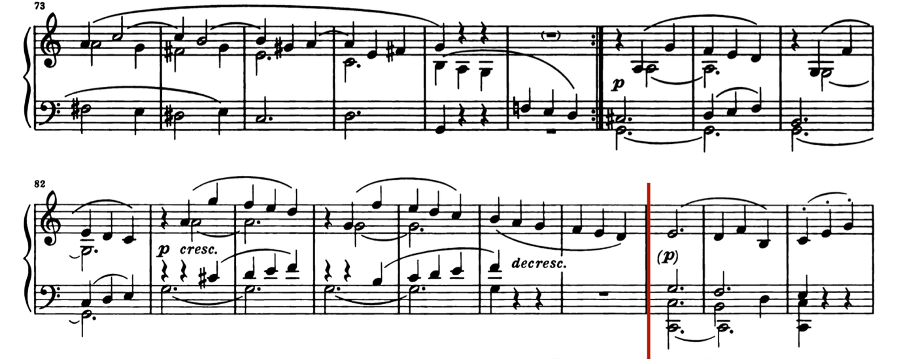
B–b unfolds over a G pedal, continuing seamlessly from what preceded it. The weak-beat accents are stressed further by placing a rest on the strong beat and beginning phrases on the weak beat. At points the soprano is taken up by an inner voice as well. This G-pedal continues to m. 88; through V–I motion the music proceeds to B–a′.
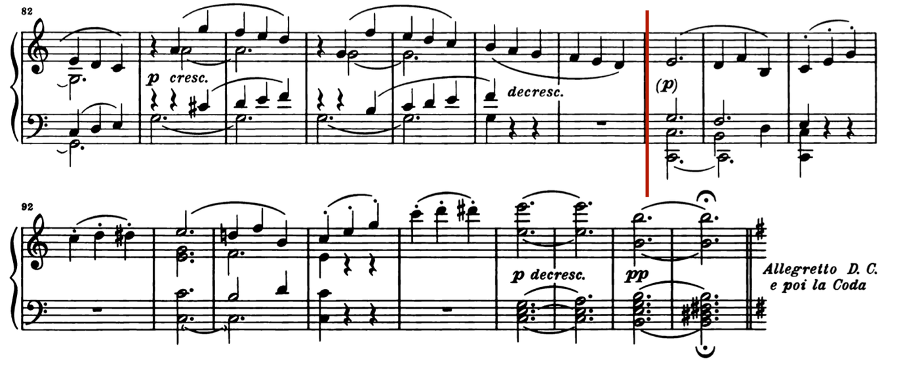
B–a′ is a brief reprise of B–a. Only the second, staccato-ornamented sub-phrase is presented once, and the section closes. The I chord at m. 97 is reharmonized as VI of E minor, followed immediately by an I6–4–V half cadence; the movement then returns to A.
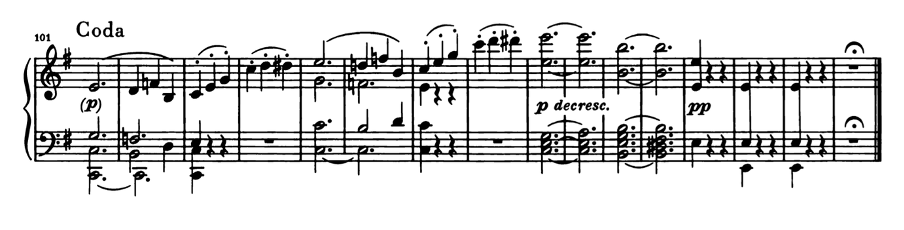
After A is heard once more, a coda follows. A phrase from the B section is repeated once, after which the tonic is reiterated three times pianissimo, and the movement closes quietly.





The second movement is in A–B–A′ compound ternary form. It can be regarded as a movement that replaces a minuet or scherzo.
A
Begins in E minor. The A section itself divides into a–b–a′. Strictly speaking, A–b does not introduce wholly new material; rather, it continues to work with the same motive, expanding it and driving the discourse forward. The core motive (circled in the original) is a neighbor-note figure built from dotted quarter – eighth – quarter. In the first sentence the motive appears twice, after which a different figure follows. The continuation forms a four-bar unit that develops the initially stated figure. When the motive returns at m. 9, it is re-stated an octave higher, giving an expanded feel. The 1–8 phrase is then repeated one octave higher; whereas an HC closed m. 8, at m. 16 a V7–I perfect authentic cadence closes the opening part.
The next span begins in C major, a third-related key to the tonic. The governing motive remains the same; however, unlike A–a, which repeated the motive twice before moving on, A–b sounds it only once and then resolves into the following harmony. The writing consists of progressions that firmly establish C major. The 8-bar phrase + repeat format matches A–a. Again, the repeated phrase is taken up an octave. At m. 30, following an It.+6 in E minor the harmony moves to V, and the music returns to the home key.
A–a′ begins as a reprise of the opening. In contrast with A–a, the first phrase now starts higher; after the first 8 bars, the next phrase returns an octave lower. The boxed motive is employed more extensively. From m. 44 the motive is repeated, and its eighth-note figure becomes the main propulsive force of the subsequent phrases. A cadence in E minor occurs at mm. 50–51, and the music turns to the codetta. The inner-voice pattern that drives this codetta is likewise derived from the boxed motive. From m. 51 to m. 61 a tonic pedal supports repeated statements of the same figure, which then ascend to the close. At this point the use of G♯ lends a major-tonic coloration; a Picardy third is heard, although C is not sharpened, so a minor coloration still remains.
B
The B section has the character of a scherzo-like Trio and divides into B–a, B–b, B–a′. It starts, as briefly previewed in A–b, in C major, giving a clear character contrast with the minor A. In the first 4-bar unit the melody is stated legato; in the next it returns under slur-staccato, slightly altered. After the first 8-bar phrase, the next 8-bar phrase features the inner voices of left and right hands descending in parallel thirds. Above this, the soprano line is tied across the beat, so that natural accents fall on weak beats.
B–b unfolds over a G pedal, continuing seamlessly from what preceded it. The weak-beat accents are stressed further by placing a rest on the strong beat and beginning phrases on the weak beat. At points the soprano is taken up by an inner voice as well. This G-pedal continues to m. 88; through V–I motion the music proceeds to B–a′.
B–a′ is a brief reprise of B–a. Only the second, staccato-ornamented sub-phrase is presented once, and the section closes. The I chord at m. 97 is reharmonized as VI of E minor, followed immediately by an I6–4–V half cadence; the movement then returns to A.
After A is heard once more, a coda follows. A phrase from the B section is repeated once, after which the tonic is reiterated three times pianissimo, and the movement closes quietly.