The first movement is in sonata form, as is typical for a Classical first movement. Sonata No. 9 was written in 1798 and later arranged in 1801 as a string quartet in F major. It is dedicated to Countess Josefa von Braun, one of Beethoven’s patrons.
Exposition
First Theme
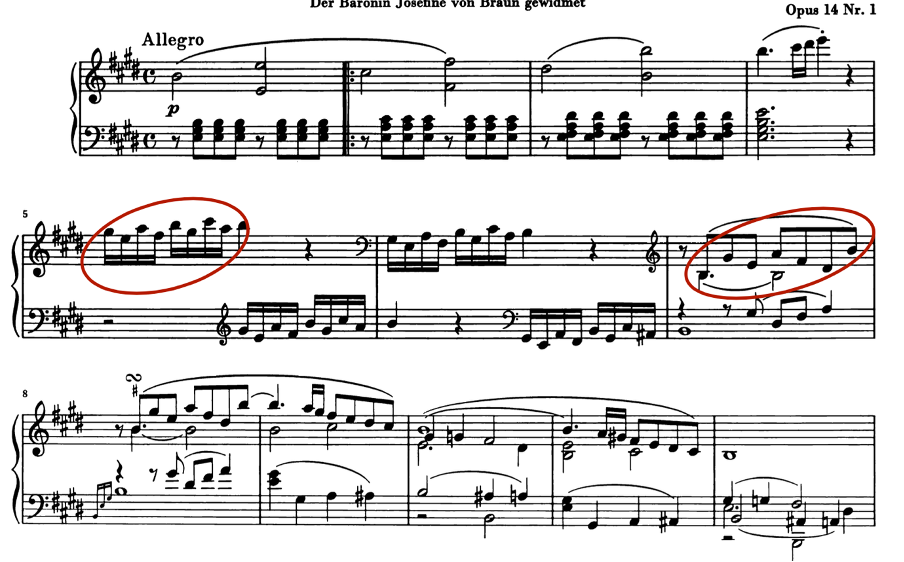
The first theme begins in E major. Its main materials are: a right-hand phrase leaping by fourths and a left-hand accompaniment that strikes repeated chords after an eighth-rest on the strong beat. For the first four bars there is an E pedal, over which the harmony outlines I–IV–ii–V–I. Beginning at m. 5, a sixteenth-note arpeggiated figure appears and alternates between the hands, adding propulsion. From m. 7, the arpeggio slows to eighth notes, producing a more flowing character; this can be understood as an expansion of the preceding motive. From here a four-part texture appears and each voice starts to move independently, giving the span a more extended feel.
Transition
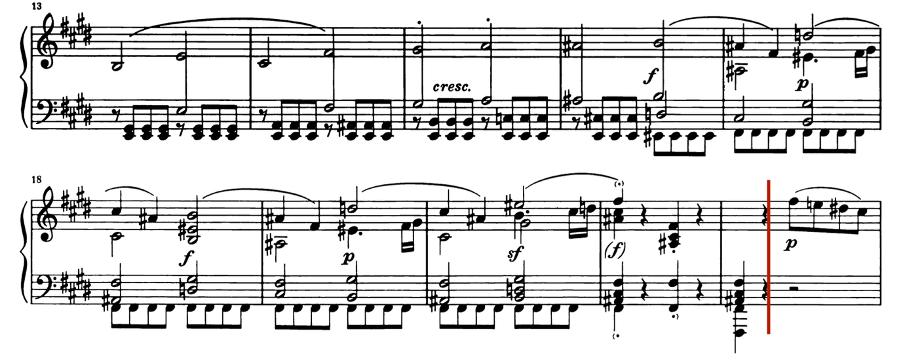
The transition starts at m. 13 with a return of the main subject, now sequentially rising chromatically rather than copied literally; a crescendo heightens the sense of growth. The E-pedal remains in the bass while the line continues ascending. Passing E♯ at m. 13, the music modulates to F♯ major at m. 14. The independent movement of the four voices stands out here; the left-hand accompaniment that had formerly repeated a single pitch is varied. Alternations of piano and forte create dynamic tension.
Second Theme
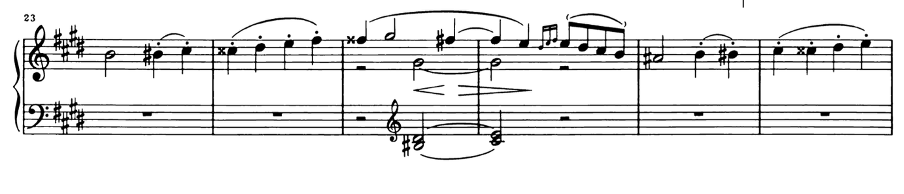
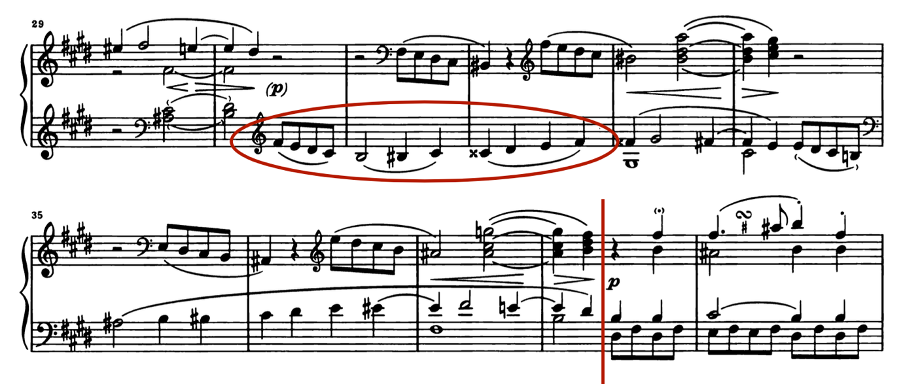
As in a standard sonata in a major key, the second theme begins in the dominant, B major. In clear contrast to the first theme, it is first stated as monody (single-line melody). Within that line Beethoven plants slur-staccato articulation, grace notes, and stepwise descending eighth notes, then develops these elements. From m. 30 the theme moves to the left hand unchanged, while the right hand decorates it with descending stepwise eighths—fragments of the theme itself. The pattern then repeats. Note that the melody presented staccato in mm. 23–24 appears legato when transferred to the left hand from m. 33—a detail worth noting.
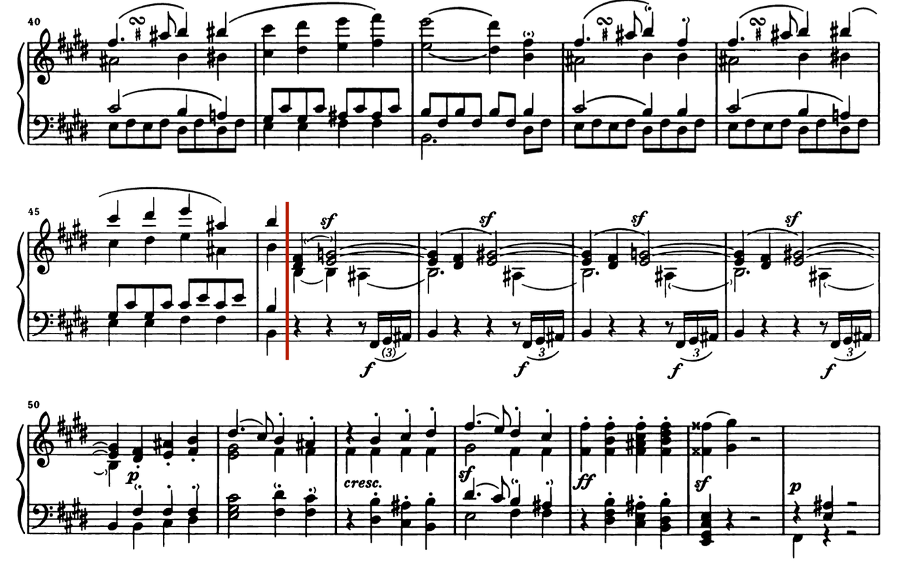
A new left-hand accompaniment now adds momentum, alternating outer and inner parts. The right hand presents short legato phrases under slurs. The same figuration repeats, and at m. 46 there is a PAC in B major. The material that follows functions as a closing theme with a coda-like character. Over a B pedal, the left hand emphasizes B with sixteenth-note triplets; the right hand likewise reinforces B by repeating A♯–B. From m. 50 a four-part homorhythmic texture appears, moving together mostly in quarter notes without complex rhythm. At mm. 50–51 another V–I cadence leads into the codetta.
Codetta
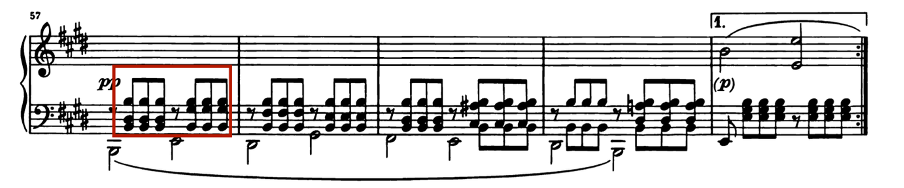
A four-bar codetta closes the exposition. The first-theme accompaniment type—eighth-rest then repeated chords—returns and points ahead to the development, during which the harmony naturally finds its way back to E major.
Development
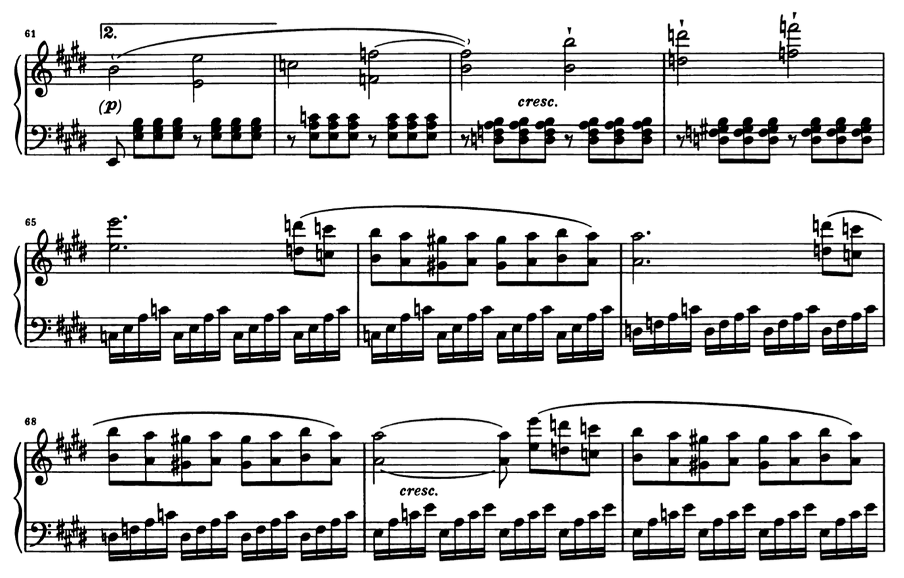
The development reinterprets I of E major as V of a minor, and thus moves immediately to A minor. It begins with the first theme: the left-hand pattern and the right-hand fourth-leaps both return as before. From m. 65 a new sixteenth-note arpeggio accompaniment appears in the outer hand and drives the whole development. In the right hand the pattern is stated three times unchanged in interval content, while the bass line ascends stepwise beginning on C.
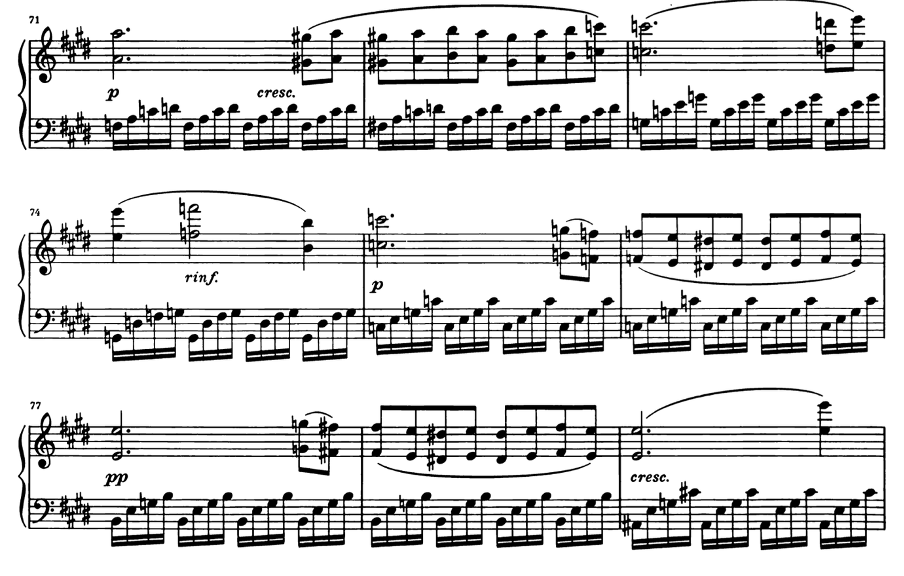
Small changes are then added to the right-hand figure. The previously ascending bass reaches G, which is then used as V of C, and the music modulates to C major to begin a new phrase. Now, although the right hand keeps repeating the same figure, the left hand no longer ascends: instead a descending bass appears—a point of contrast with the earlier passage.
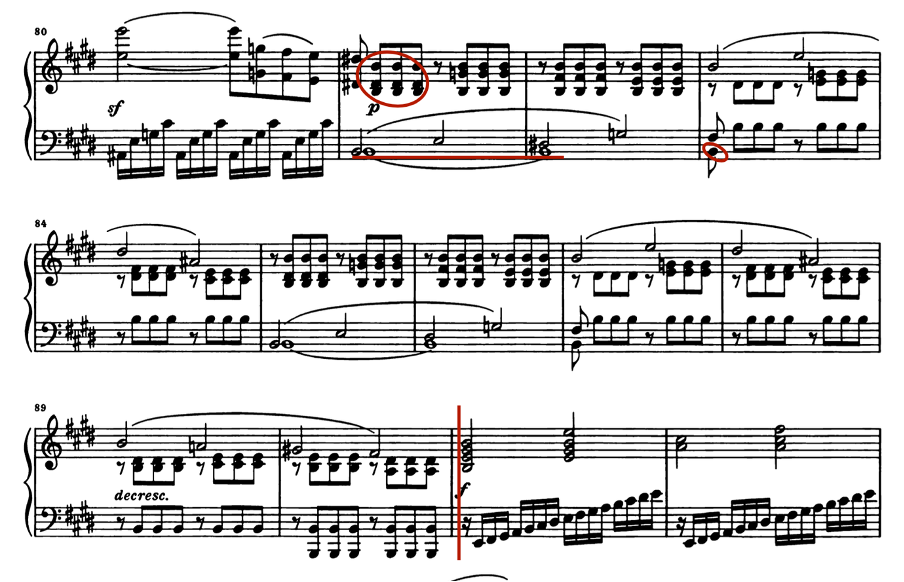
Through A♯ in the left hand the harmony moves to B, which in turn functions as V of E; this naturally returns the music to the home key and prepares the recapitulation. From mm. 81–90 a dominant pedal is prominent. The first-theme accompaniment is placed in the right hand and developed to help lead into the recapitulation. From m. 85 the accompaniment shifts to an inner voice, while the soprano takes the fourth-leaping line—further stamping the first theme on the listener’s ear and making the approach to the recap unmistakable.
Recapitulation
First Theme
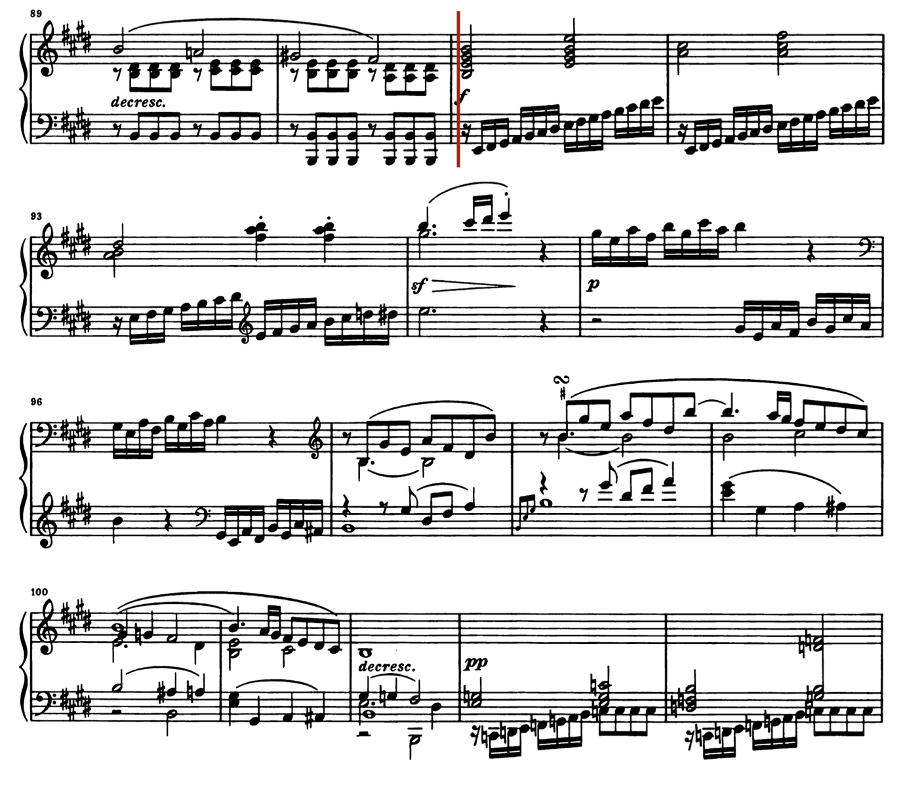
The recapitulation returns in E major. The leaps by fourth are as before, but now the chords are fuller and the music begins forte, making a much stronger impression than in the exposition. The left hand no longer uses repeated-chord accompaniment; instead it runs upward in sixteenth-note scale patterns—an overall expansion relative to the exposition. From m. 94 the music proceeds as before, then moves to the transition; at m. 103, when the first theme reappears again, it is likewise given with full chords and sixteenth-note scales—pp in dynamics, yet expanded in figuration.
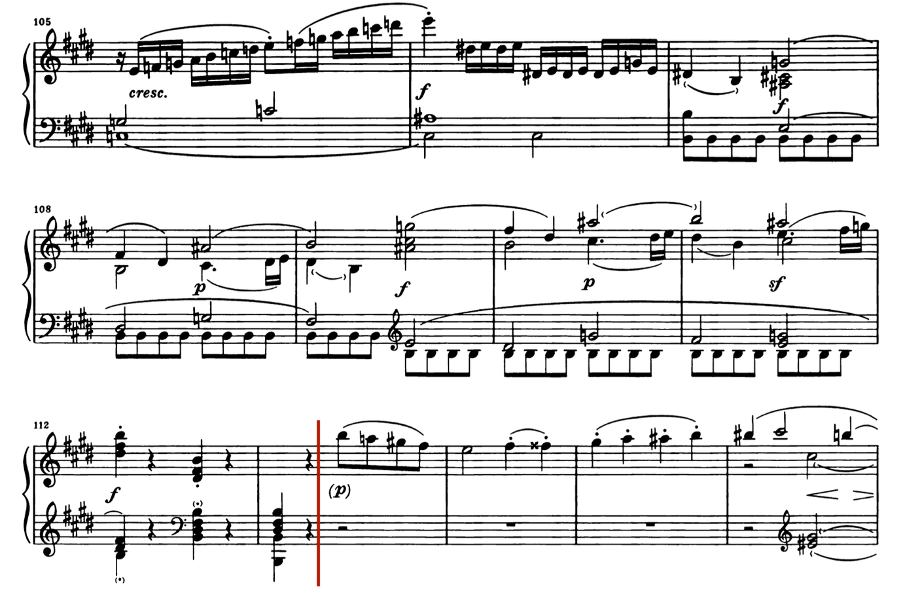
Before the second theme, the transition is more extended than before: the ascending sixteenth-note scale is not merely a subject cue but is actively developed. Through mm. 105–106 the music pushes forward over a German augmented-sixth, and V appears at m. 107, then is prolonged until m. 113, just before the second theme—parallel to the exposition’s design.
Second Theme
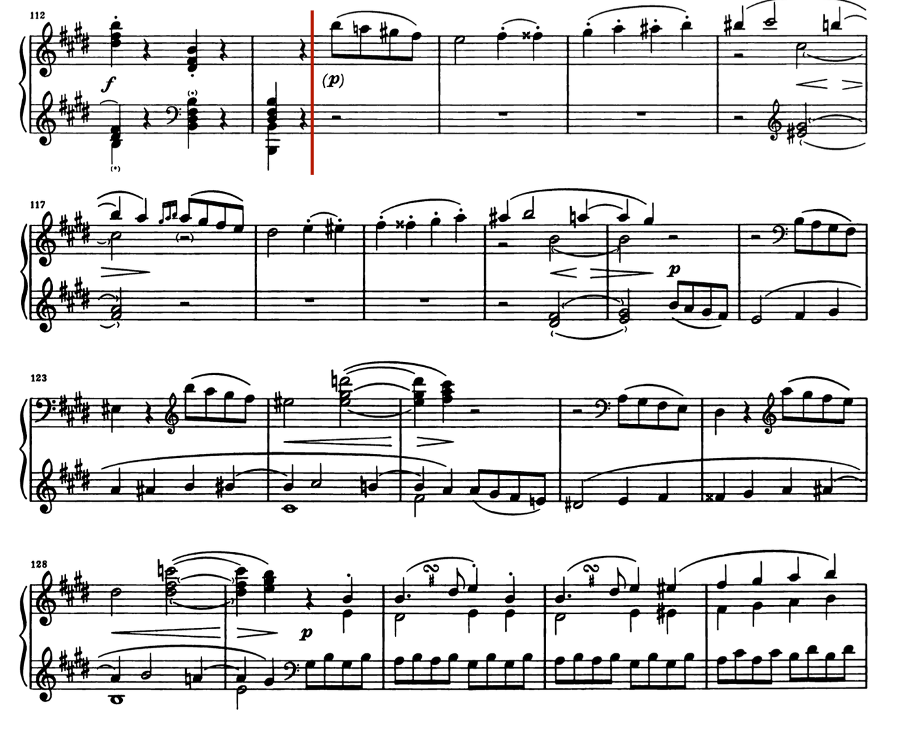
As in a conventional recapitulation, the second theme is now restated in the tonic (E major) and otherwise follows the expositional layout closely.
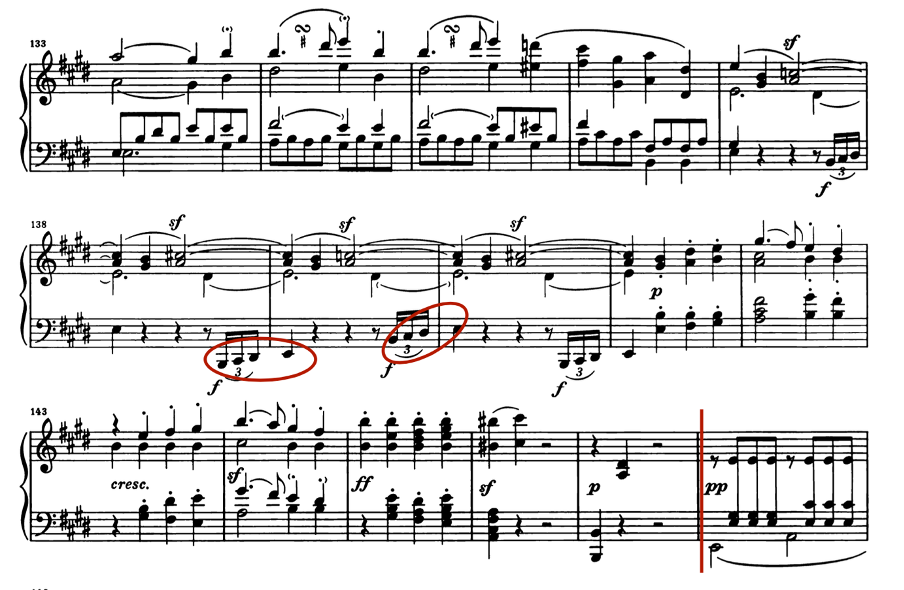
The latter part of the second theme likewise proceeds analogously. A small difference: in mm. 137–140 the left-hand triplet sixteenths cross octaves as decorations—not heard in the exposition. At m. 147 a V7 appears, and with I at m. 148 the music passes into the coda.
Coda
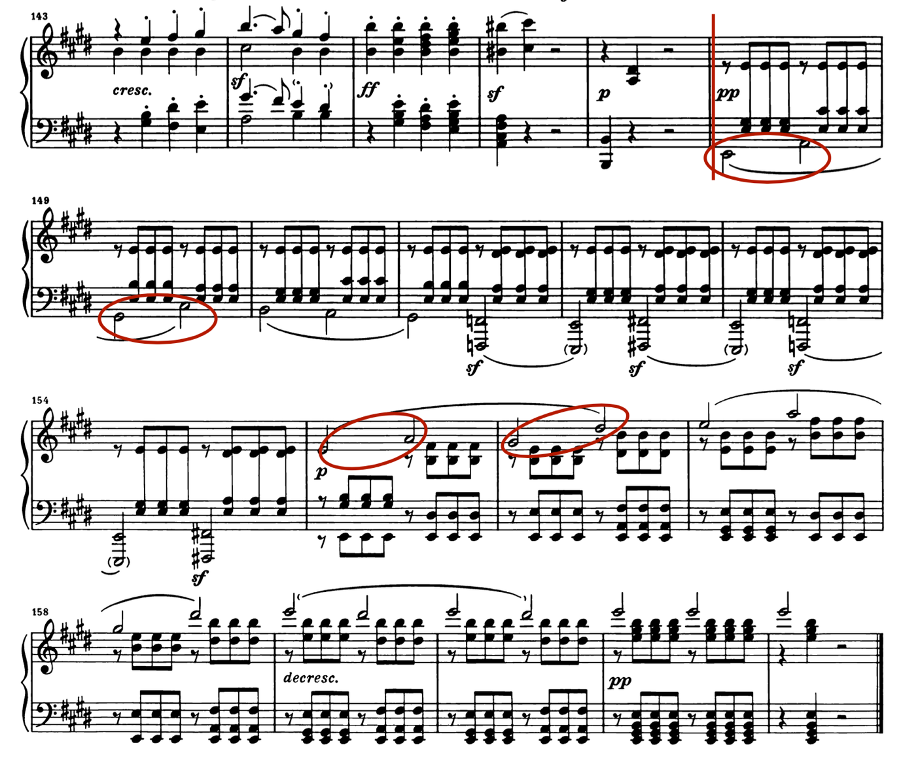
The coda develops first-theme materials. The post-rest repeated-chord accompaniment from the first theme drives the entire coda. The bass line at the opening of the coda spells out the first theme’s fourth-leaping melody; at m. 155 that melody rises to the soprano, expanding registrally. Starting in the low register, the coda climbs gradually to the high register, showing a clear sense of expansion. In contrast to that registral ascent, the dynamics do not culminate in a big forte: instead they dim from p through decrescendo to pp, and the movement comes to a quiet close.





The first movement is in sonata form, as is typical for a Classical first movement. Sonata No. 9 was written in 1798 and later arranged in 1801 as a string quartet in F major. It is dedicated to Countess Josefa von Braun, one of Beethoven’s patrons.
Exposition
First Theme
The first theme begins in E major. Its main materials are: a right-hand phrase leaping by fourths and a left-hand accompaniment that strikes repeated chords after an eighth-rest on the strong beat. For the first four bars there is an E pedal, over which the harmony outlines I–IV–ii–V–I. Beginning at m. 5, a sixteenth-note arpeggiated figure appears and alternates between the hands, adding propulsion. From m. 7, the arpeggio slows to eighth notes, producing a more flowing character; this can be understood as an expansion of the preceding motive. From here a four-part texture appears and each voice starts to move independently, giving the span a more extended feel.
Transition
The transition starts at m. 13 with a return of the main subject, now sequentially rising chromatically rather than copied literally; a crescendo heightens the sense of growth. The E-pedal remains in the bass while the line continues ascending. Passing E♯ at m. 13, the music modulates to F♯ major at m. 14. The independent movement of the four voices stands out here; the left-hand accompaniment that had formerly repeated a single pitch is varied. Alternations of piano and forte create dynamic tension.
Second Theme
As in a standard sonata in a major key, the second theme begins in the dominant, B major. In clear contrast to the first theme, it is first stated as monody (single-line melody). Within that line Beethoven plants slur-staccato articulation, grace notes, and stepwise descending eighth notes, then develops these elements. From m. 30 the theme moves to the left hand unchanged, while the right hand decorates it with descending stepwise eighths—fragments of the theme itself. The pattern then repeats. Note that the melody presented staccato in mm. 23–24 appears legato when transferred to the left hand from m. 33—a detail worth noting.
A new left-hand accompaniment now adds momentum, alternating outer and inner parts. The right hand presents short legato phrases under slurs. The same figuration repeats, and at m. 46 there is a PAC in B major. The material that follows functions as a closing theme with a coda-like character. Over a B pedal, the left hand emphasizes B with sixteenth-note triplets; the right hand likewise reinforces B by repeating A♯–B. From m. 50 a four-part homorhythmic texture appears, moving together mostly in quarter notes without complex rhythm. At mm. 50–51 another V–I cadence leads into the codetta.
Codetta
A four-bar codetta closes the exposition. The first-theme accompaniment type—eighth-rest then repeated chords—returns and points ahead to the development, during which the harmony naturally finds its way back to E major.
Development
The development reinterprets I of E major as V of a minor, and thus moves immediately to A minor. It begins with the first theme: the left-hand pattern and the right-hand fourth-leaps both return as before. From m. 65 a new sixteenth-note arpeggio accompaniment appears in the outer hand and drives the whole development. In the right hand the pattern is stated three times unchanged in interval content, while the bass line ascends stepwise beginning on C.
Small changes are then added to the right-hand figure. The previously ascending bass reaches G, which is then used as V of C, and the music modulates to C major to begin a new phrase. Now, although the right hand keeps repeating the same figure, the left hand no longer ascends: instead a descending bass appears—a point of contrast with the earlier passage.
Through A♯ in the left hand the harmony moves to B, which in turn functions as V of E; this naturally returns the music to the home key and prepares the recapitulation. From mm. 81–90 a dominant pedal is prominent. The first-theme accompaniment is placed in the right hand and developed to help lead into the recapitulation. From m. 85 the accompaniment shifts to an inner voice, while the soprano takes the fourth-leaping line—further stamping the first theme on the listener’s ear and making the approach to the recap unmistakable.
Recapitulation
First Theme
The recapitulation returns in E major. The leaps by fourth are as before, but now the chords are fuller and the music begins forte, making a much stronger impression than in the exposition. The left hand no longer uses repeated-chord accompaniment; instead it runs upward in sixteenth-note scale patterns—an overall expansion relative to the exposition. From m. 94 the music proceeds as before, then moves to the transition; at m. 103, when the first theme reappears again, it is likewise given with full chords and sixteenth-note scales—pp in dynamics, yet expanded in figuration.
Before the second theme, the transition is more extended than before: the ascending sixteenth-note scale is not merely a subject cue but is actively developed. Through mm. 105–106 the music pushes forward over a German augmented-sixth, and V appears at m. 107, then is prolonged until m. 113, just before the second theme—parallel to the exposition’s design.
Second Theme
As in a conventional recapitulation, the second theme is now restated in the tonic (E major) and otherwise follows the expositional layout closely.
The latter part of the second theme likewise proceeds analogously. A small difference: in mm. 137–140 the left-hand triplet sixteenths cross octaves as decorations—not heard in the exposition. At m. 147 a V7 appears, and with I at m. 148 the music passes into the coda.
Coda
The coda develops first-theme materials. The post-rest repeated-chord accompaniment from the first theme drives the entire coda. The bass line at the opening of the coda spells out the first theme’s fourth-leaping melody; at m. 155 that melody rises to the soprano, expanding registrally. Starting in the low register, the coda climbs gradually to the high register, showing a clear sense of expansion. In contrast to that registral ascent, the dynamics do not culminate in a big forte: instead they dim from p through decrescendo to pp, and the movement comes to a quiet close.