Like many other first movements, this one is in sonata form and marked Presto in cut time (2/2). With a total of 344 measures, it is a large-scale piece. A notable feature is its short development, roughly about half the length of the exposition/recapitulation.
Exposition — mm. 1–124
First Theme
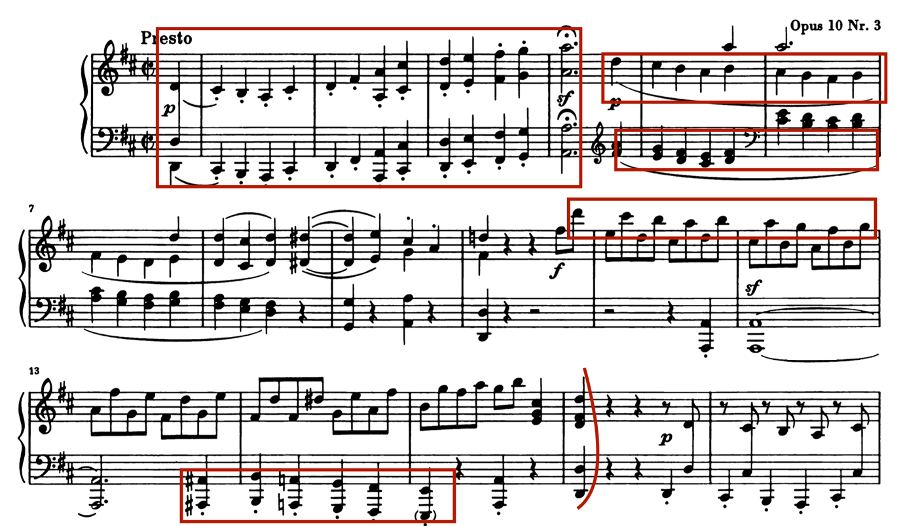
The first theme begins in D major. Its hallmark is a sequentially moving motive exploited in varied ways: first as a hands-in-unison staccato, then expanded in octaves between the hands. After a four-bar half cadence, the continuation places legato motion in the inner voices of both hands. From m. 11 the right hand plays eighth-note leaps by sixths; the top melodic line at the same time traces a contour similar to the motive’s directional motion. In m. 14 the left hand briefly presents a retrograde-inversion fragment of the motive’s opening. Eight-bar units with perfect authentic cadences (PACs) appear successively, the phrase divisions are clear, and the motive is deployed in multiple guises.
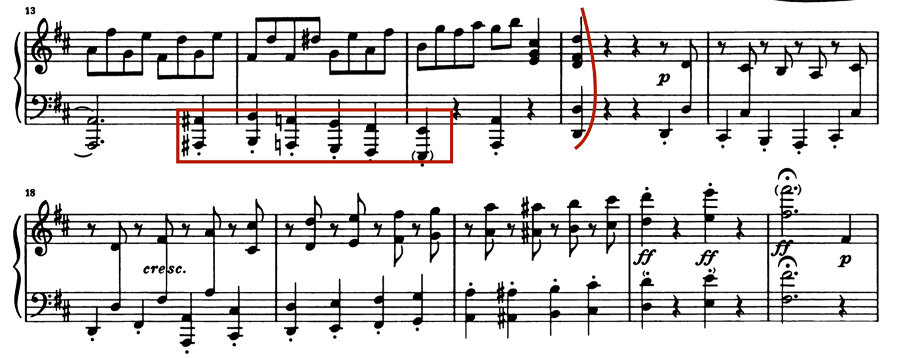
The motive of the first theme is then repeated, now with hands crossing. Instead of stopping on A, the line continues ascending to F♯. The same thematic idea returns and expands on repetition.
Transition
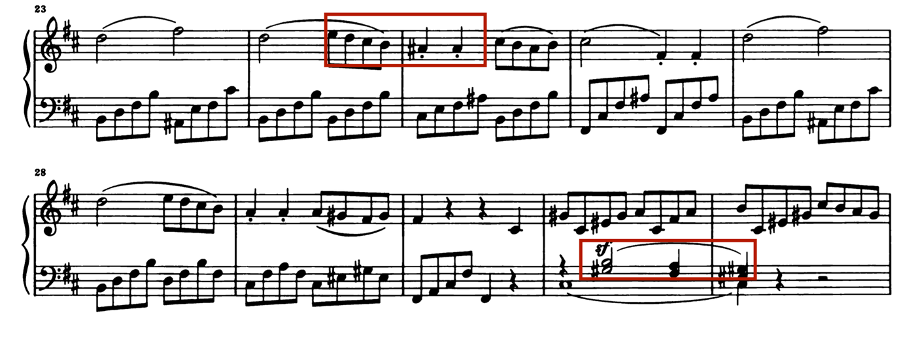
A transition follows, beginning in B minor and forceful enough in character to feel almost like a second theme. The two boxed fragments here later become the materials that drive the second theme.
The descending melody and the left hand’s inner-voice line with weak-beat sforzandi foreshadow what will be heard in the second theme. The transition faithfully carries out its role of ushering in the new area. Compared with the first theme—whose early bars showed a right-hand melody over a left-hand accompaniment—the opening of this transition flows quite plainly. From m. 28 the modulation begins naturally, moving to F♯ minor.
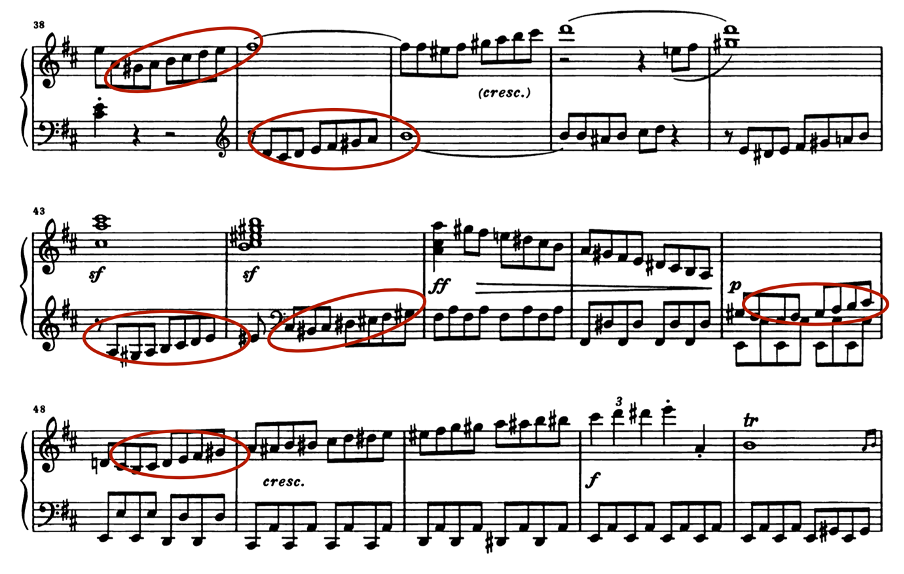
At m. 38 a right-hand melody appears that is traded between the hands as it unfolds. This figure is used continuously, expanded, and driven upward to E. After passing through B minor, the harmony reaches A major—the key of the second theme—where V is articulated and the music proceeds to the second theme.
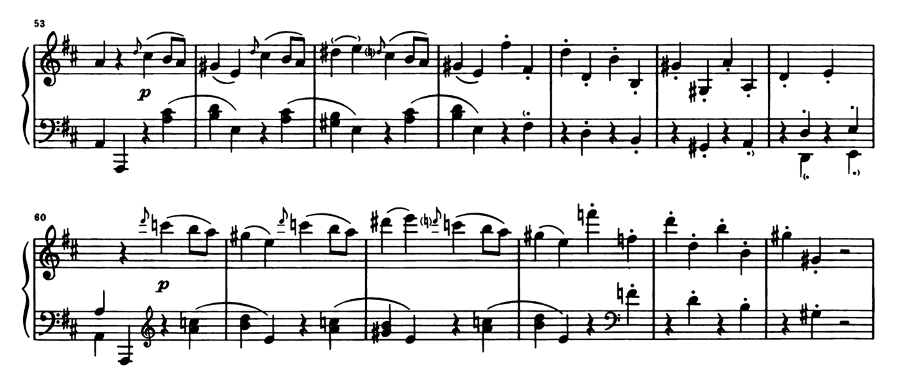
The second theme begins in A major. It consists of successive short phrases. The staccato that featured in the first theme returns as a principal material. A striking detail is that its phrases are not in regular eight-bar units but in seven-bar spans. An A-major phrase is followed by another in A minor.
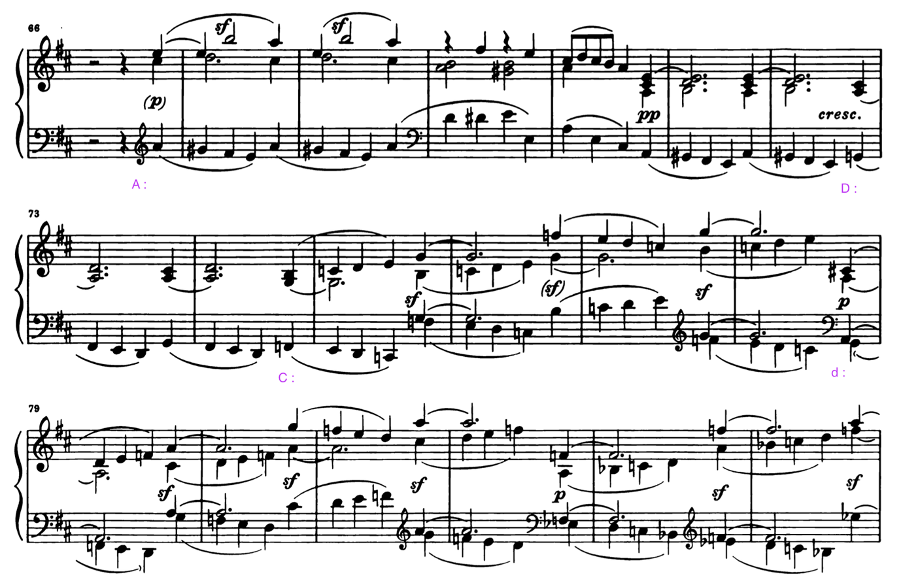
The second theme then moves on to a transition. Its most salient feature is the organic polyphonic interplay of the voices. Up to the vertical-chord arrival at m. 87, every phrase begins on the weak beat—another characteristic trait. The writing can be parsed in four-beat units, and syncopated elements appear. The keys move by phrases—from A major to D major, C major, and d minor—adding forward momentum without any large change to the figuration. Compared with the first-theme transition, this span is considerably more extended.
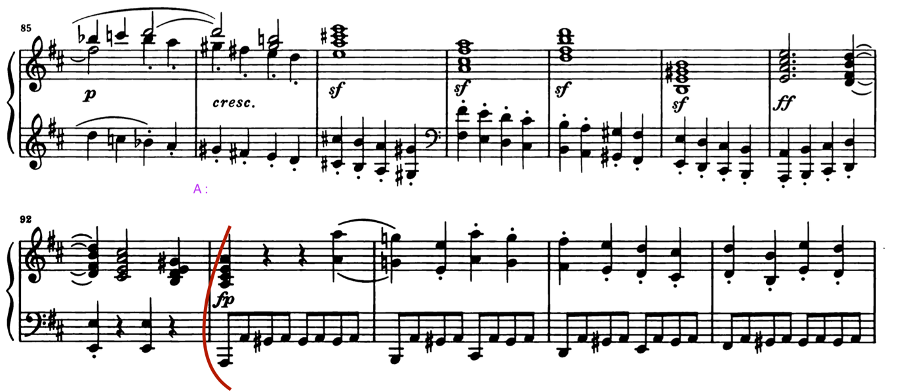
From m. 87 the voices consolidate into two parts, and a simpler figuration drives toward cadence. The left hand’s octave staccato and the weak-beat syncopated figure just before the cadence can be heard as reuses of earlier materials.
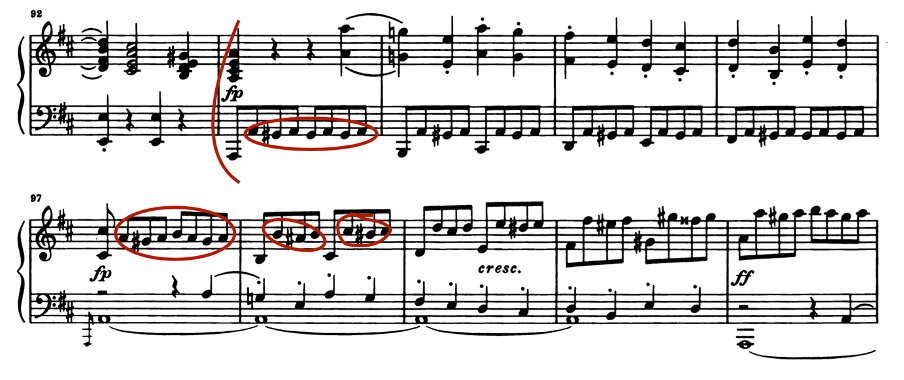
After a PAC in A major at m. 93, a codetta follows. Up to m. 105 the music moves over a tonic pedal, strongly underscoring the cadence. In the right hand a steady octave-staccato figure is heard. The left-hand accompaniment shifts to the right hand from m. 97; it is gradually fragmented, adding a sense of speed. At the same time, the right-hand staccato likewise moves to the left-hand inner voice, so that the motives cross between the hands.
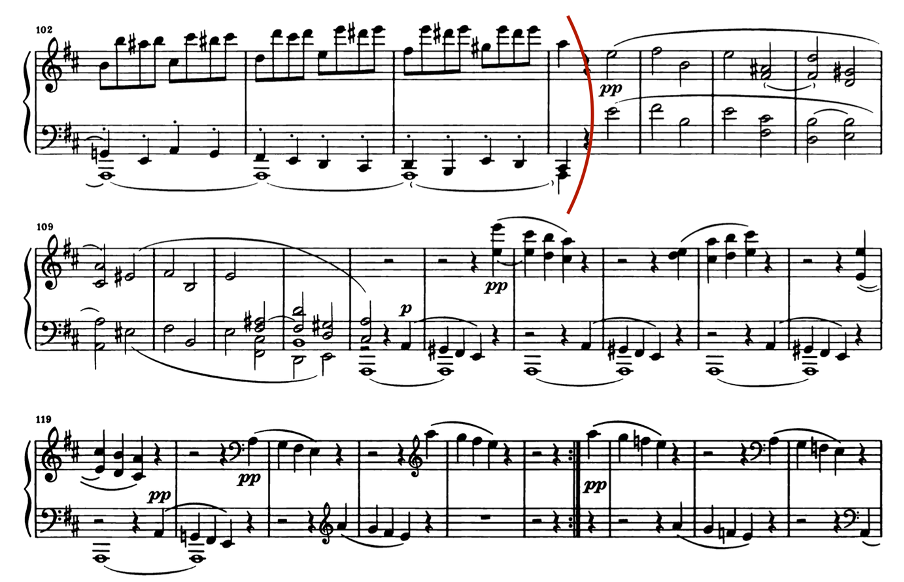
From m. 106 a new type of phrase appears. Proceeding in half-note units, it confirms the drive toward cadence in A major, repeating the idea twice in different registers. Thereafter, over I, a motive derived from the second theme’s descending line appears alternately in the two hands. This span smoothly supports the connection to the development.
Development
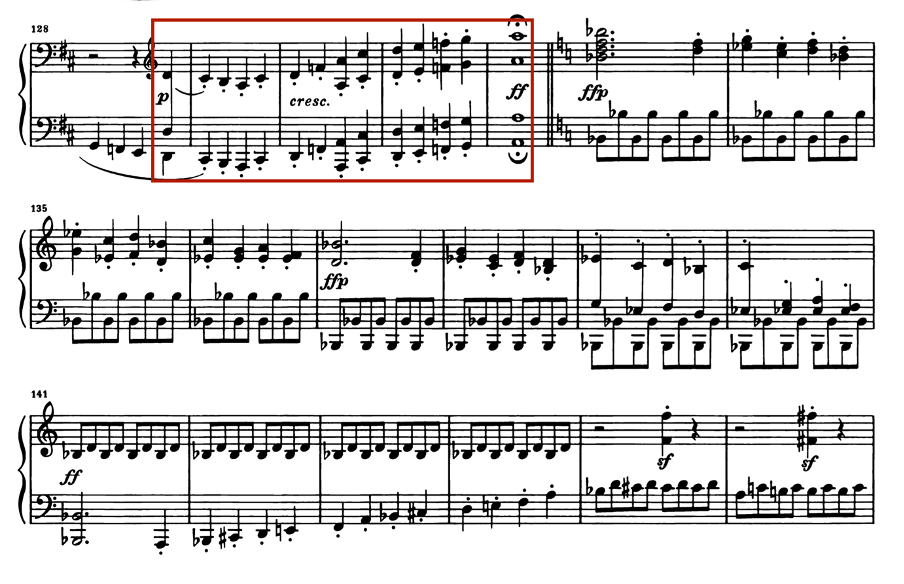
The development totals 59 measures, making it smaller than the exposition and recapitulation. It begins by developing the descending line heard at the end of the exposition, then restates the first theme’s opening phrase in d minor. After a fortissimo half cadence, the harmony modulates immediately to B♭ major, where a new theme is introduced: the left hand plays octaves as accompaniment, while the right hand presents a phrase that seems to compress the second theme’s codetta (formerly half-note values) into quarter notes with added staccato—a transformed version. After the first sentence, the material is repeated an octave lower.
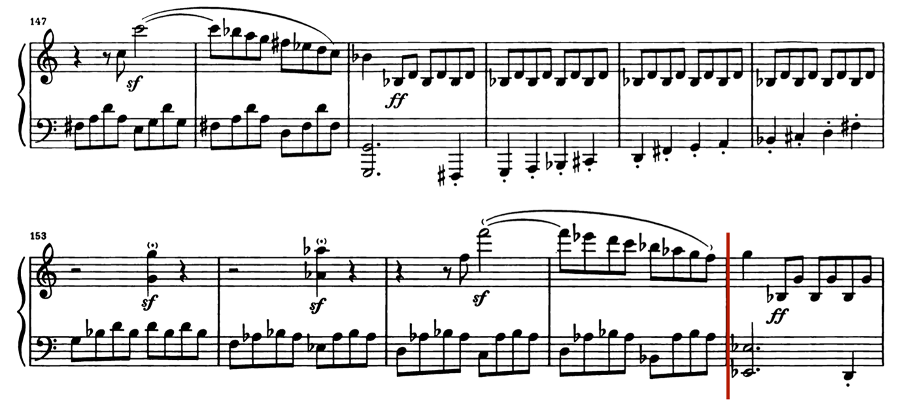
In the next phrase the hands exchange roles: the right hand now plays the eighth-note accompaniment, and the left-hand bass draws an ascending melody. The phrase is repeated twice. From m. 154, with the entry of A♭, the harmony moves to E♭ major; at m. 157 a cadence in E♭ is articulated.
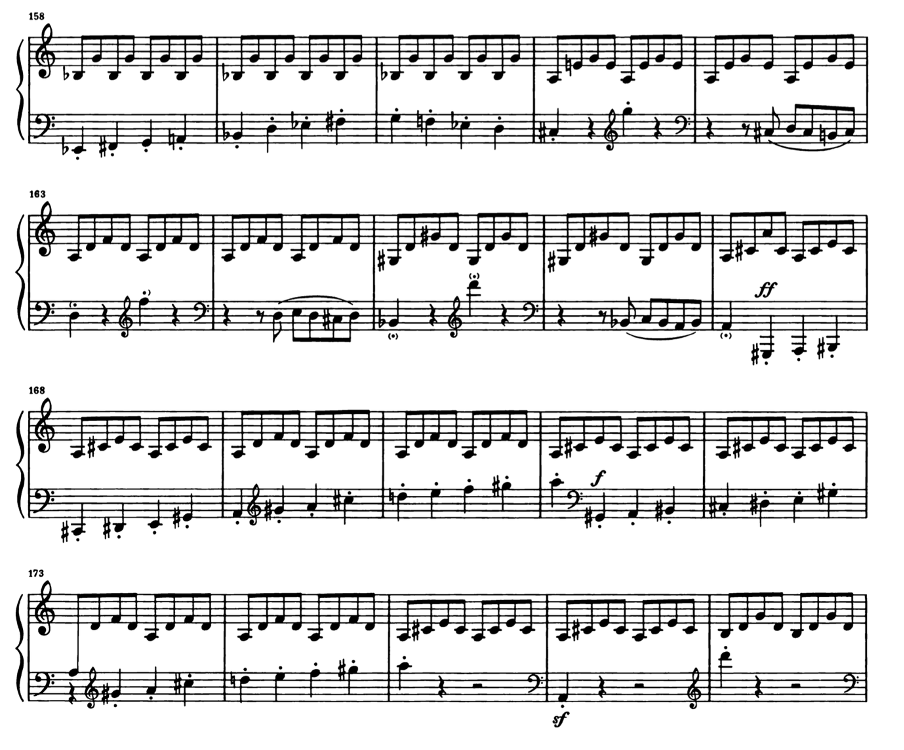
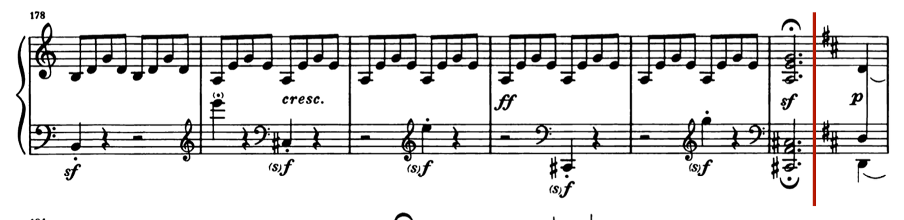
This continues as an extension of what preceded: the right-hand accompaniment and the left-hand staccato melody go on unchanged. At m. 161 the music returns to D major, preparing the recapitulation. Here many pitches serve to stress the dominant of D: G♯ appears persistently, and at m. 165 an Italian augmented-sixth is heard—devices that highlight the dominant and clarify the move toward the recap. It resembles a retransition, yet rather than sitting on V, the music repeats motions toward V, the actual V appearing only briefly. At m. 182, with sforzando, an inverted dominant appears—another distinctive touch.
Recapitulation
First Theme
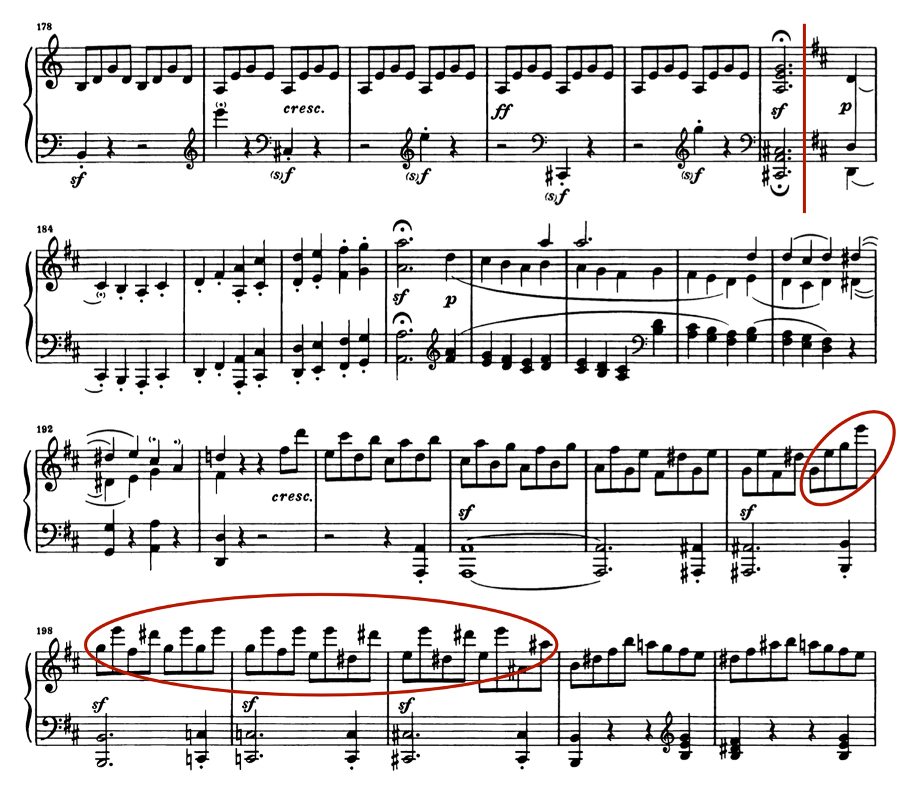
The recapitulation reproduces the exposition closely. From m. 197, however, differences appear: the upward octave climb from low to high is omitted; instead, the immediately preceding progression is repeated once more in the upper register, then V–I in e minor is reiterated before the music moves on to the transition.
Transition
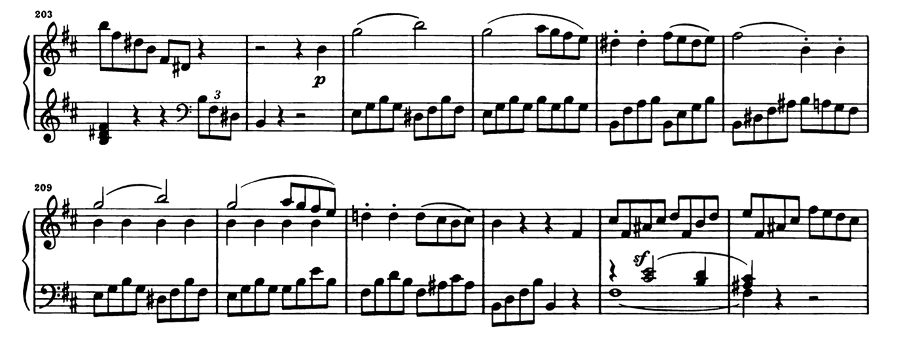
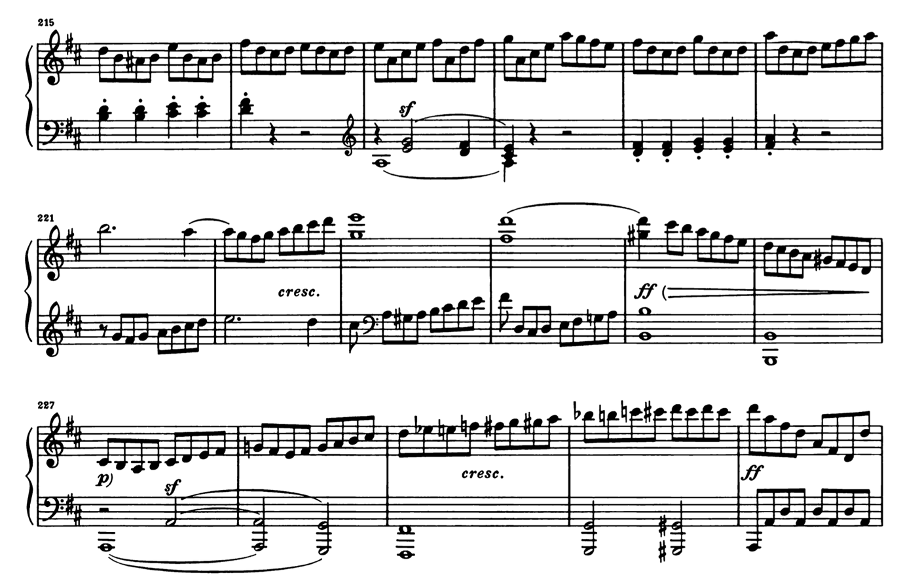
The recap’s transition begins in e minor, unlike the exposition’s, which began in b minor. Because the second theme in a recapitulation typically begins in the tonic, the preceding transition, as in the exposition, seems to stand in a second-related key to the second theme.
Second Theme
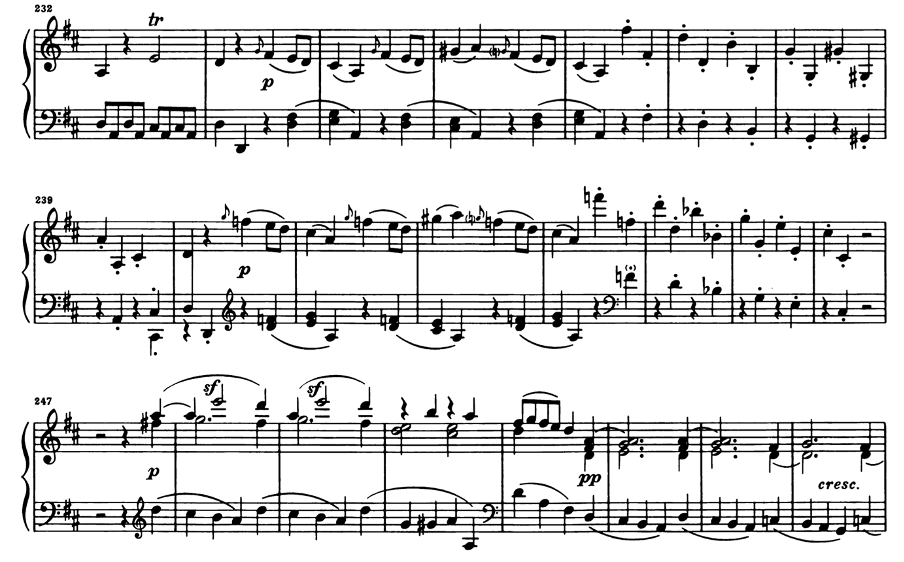
The second theme is now restated in the tonic D major; apart from the key, it closely resembles its exposition counterpart.
Transition (following the second theme)
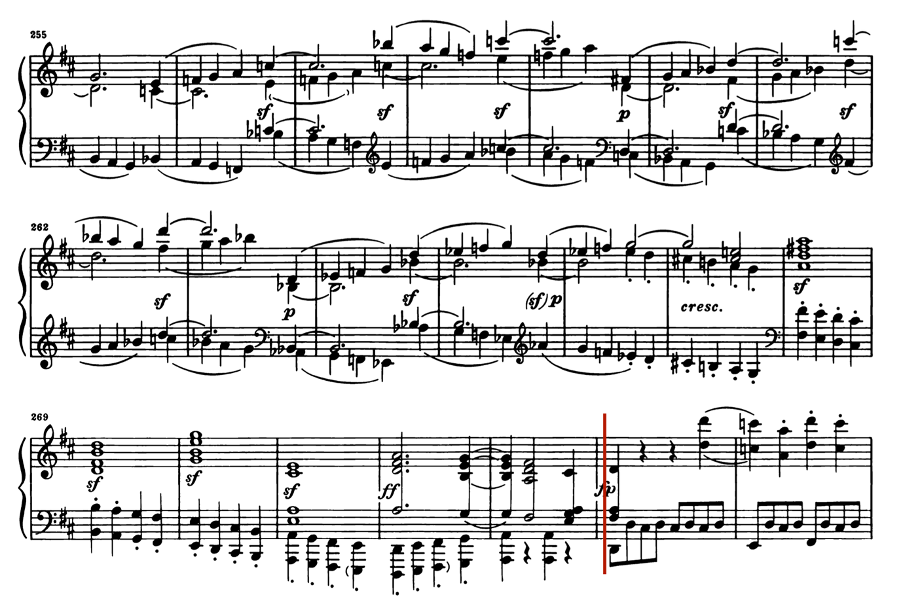
The ensuing transition likewise matches the exposition in shape, apart from the key.
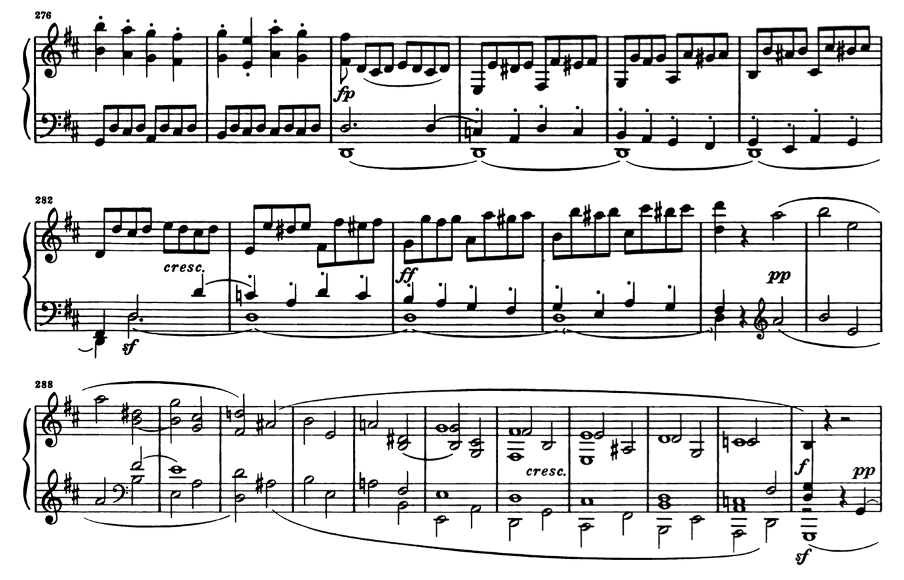
As before, the music proceeds over a tonic pedal. In the two phrases beginning at m. 286, differences emerge: in the exposition the two cadences occurred in A major, the second theme’s key, whereas in the recap they occur once in D major and once in G major.
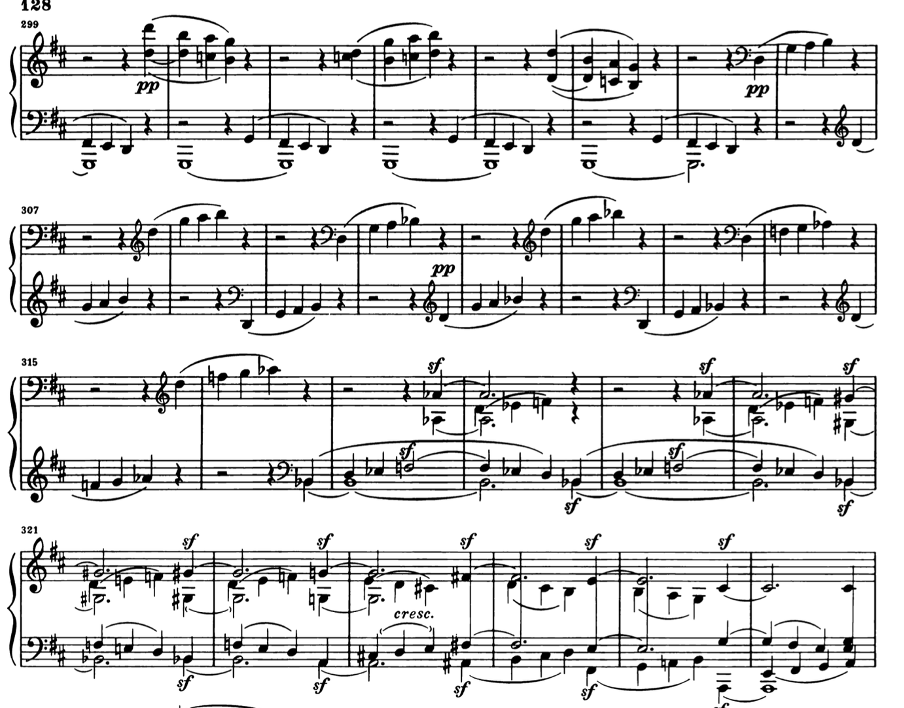
The next span is more developed than its expositional model: voice-leading activity among the parts is more strongly emphasized. Starting in G major, the harmony adds one flat at a time, modulating to B♭ major and then to E♭ major. At m. 320, with A♭ and G♯ as enharmonic pivots, the music returns to D major.
Coda
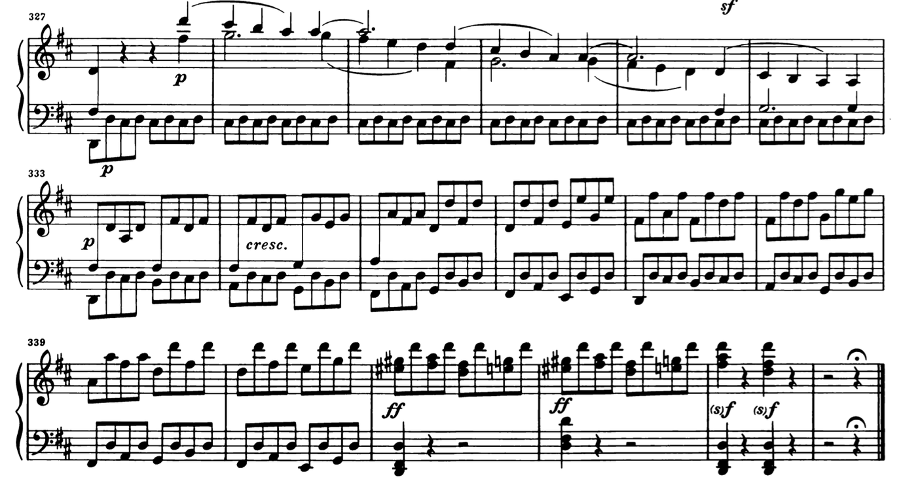
At m. 327 a PAC ushers in the coda. It begins with fragments of the second theme, then passes to a rapid two-hand eighth-note passage. Throughout the coda, materials of the first theme are used most prominently; after a swift, driving course, the movement closes with strength.





Like many other first movements, this one is in sonata form and marked Presto in cut time (2/2). With a total of 344 measures, it is a large-scale piece. A notable feature is its short development, roughly about half the length of the exposition/recapitulation.
Exposition — mm. 1–124
First Theme
The first theme begins in D major. Its hallmark is a sequentially moving motive exploited in varied ways: first as a hands-in-unison staccato, then expanded in octaves between the hands. After a four-bar half cadence, the continuation places legato motion in the inner voices of both hands. From m. 11 the right hand plays eighth-note leaps by sixths; the top melodic line at the same time traces a contour similar to the motive’s directional motion. In m. 14 the left hand briefly presents a retrograde-inversion fragment of the motive’s opening. Eight-bar units with perfect authentic cadences (PACs) appear successively, the phrase divisions are clear, and the motive is deployed in multiple guises.
The motive of the first theme is then repeated, now with hands crossing. Instead of stopping on A, the line continues ascending to F♯. The same thematic idea returns and expands on repetition.
Transition
A transition follows, beginning in B minor and forceful enough in character to feel almost like a second theme. The two boxed fragments here later become the materials that drive the second theme.
The descending melody and the left hand’s inner-voice line with weak-beat sforzandi foreshadow what will be heard in the second theme. The transition faithfully carries out its role of ushering in the new area. Compared with the first theme—whose early bars showed a right-hand melody over a left-hand accompaniment—the opening of this transition flows quite plainly. From m. 28 the modulation begins naturally, moving to F♯ minor.
At m. 38 a right-hand melody appears that is traded between the hands as it unfolds. This figure is used continuously, expanded, and driven upward to E. After passing through B minor, the harmony reaches A major—the key of the second theme—where V is articulated and the music proceeds to the second theme.
The second theme begins in A major. It consists of successive short phrases. The staccato that featured in the first theme returns as a principal material. A striking detail is that its phrases are not in regular eight-bar units but in seven-bar spans. An A-major phrase is followed by another in A minor.
The second theme then moves on to a transition. Its most salient feature is the organic polyphonic interplay of the voices. Up to the vertical-chord arrival at m. 87, every phrase begins on the weak beat—another characteristic trait. The writing can be parsed in four-beat units, and syncopated elements appear. The keys move by phrases—from A major to D major, C major, and d minor—adding forward momentum without any large change to the figuration. Compared with the first-theme transition, this span is considerably more extended.
From m. 87 the voices consolidate into two parts, and a simpler figuration drives toward cadence. The left hand’s octave staccato and the weak-beat syncopated figure just before the cadence can be heard as reuses of earlier materials.
After a PAC in A major at m. 93, a codetta follows. Up to m. 105 the music moves over a tonic pedal, strongly underscoring the cadence. In the right hand a steady octave-staccato figure is heard. The left-hand accompaniment shifts to the right hand from m. 97; it is gradually fragmented, adding a sense of speed. At the same time, the right-hand staccato likewise moves to the left-hand inner voice, so that the motives cross between the hands.
From m. 106 a new type of phrase appears. Proceeding in half-note units, it confirms the drive toward cadence in A major, repeating the idea twice in different registers. Thereafter, over I, a motive derived from the second theme’s descending line appears alternately in the two hands. This span smoothly supports the connection to the development.
Development
The development totals 59 measures, making it smaller than the exposition and recapitulation. It begins by developing the descending line heard at the end of the exposition, then restates the first theme’s opening phrase in d minor. After a fortissimo half cadence, the harmony modulates immediately to B♭ major, where a new theme is introduced: the left hand plays octaves as accompaniment, while the right hand presents a phrase that seems to compress the second theme’s codetta (formerly half-note values) into quarter notes with added staccato—a transformed version. After the first sentence, the material is repeated an octave lower.
In the next phrase the hands exchange roles: the right hand now plays the eighth-note accompaniment, and the left-hand bass draws an ascending melody. The phrase is repeated twice. From m. 154, with the entry of A♭, the harmony moves to E♭ major; at m. 157 a cadence in E♭ is articulated.
This continues as an extension of what preceded: the right-hand accompaniment and the left-hand staccato melody go on unchanged. At m. 161 the music returns to D major, preparing the recapitulation. Here many pitches serve to stress the dominant of D: G♯ appears persistently, and at m. 165 an Italian augmented-sixth is heard—devices that highlight the dominant and clarify the move toward the recap. It resembles a retransition, yet rather than sitting on V, the music repeats motions toward V, the actual V appearing only briefly. At m. 182, with sforzando, an inverted dominant appears—another distinctive touch.
Recapitulation
First Theme
The recapitulation reproduces the exposition closely. From m. 197, however, differences appear: the upward octave climb from low to high is omitted; instead, the immediately preceding progression is repeated once more in the upper register, then V–I in e minor is reiterated before the music moves on to the transition.
Transition
The recap’s transition begins in e minor, unlike the exposition’s, which began in b minor. Because the second theme in a recapitulation typically begins in the tonic, the preceding transition, as in the exposition, seems to stand in a second-related key to the second theme.
Second Theme
The second theme is now restated in the tonic D major; apart from the key, it closely resembles its exposition counterpart.
Transition (following the second theme)
The ensuing transition likewise matches the exposition in shape, apart from the key.
As before, the music proceeds over a tonic pedal. In the two phrases beginning at m. 286, differences emerge: in the exposition the two cadences occurred in A major, the second theme’s key, whereas in the recap they occur once in D major and once in G major.
The next span is more developed than its expositional model: voice-leading activity among the parts is more strongly emphasized. Starting in G major, the harmony adds one flat at a time, modulating to B♭ major and then to E♭ major. At m. 320, with A♭ and G♯ as enharmonic pivots, the music returns to D major.
Coda
At m. 327 a PAC ushers in the coda. It begins with fragments of the second theme, then passes to a rapid two-hand eighth-note passage. Throughout the coda, materials of the first theme are used most prominently; after a swift, driving course, the movement closes with strength.