Beethoven’s Piano Sonata No. 12 is the first among his middle-period piano sonatas and has four movements. Unusually, the first movement is slow and its form is not sonata form: it is a theme with five variations.
Theme
The theme spans 34 measures and follows A (mm. 1–16) – B (mm. 17–26) – A′ (mm. 26–34). As befits a variation theme, the writing is straightforward and modular in four-bar units.
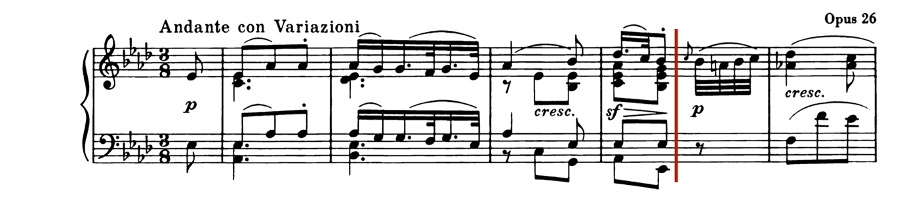
It begins in A-flat major, 3/8, with an eighth-note anacrusis. Section A consists of two 8-bar sentences, each subdividing into regular 4-bar phrases. In the opening two bars, one finds (1) an ascending leap in eighth notes and (2) a dotted-rhythm descending stepwise motion; the contrast between the two bars is clear. The next two bars reveal more explicit part-writing while maintaining the one-bar-versus-one-bar contrast. The first phrase closes with a half cadence on V—a textbook move.
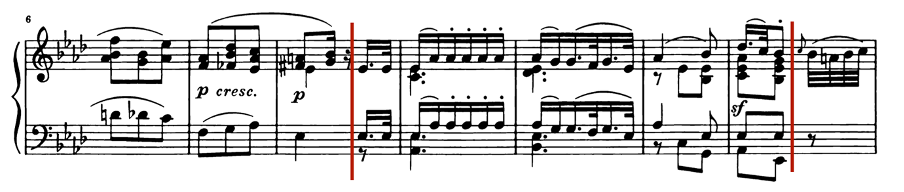
The second 4 bars form the next phrase, contrasting with the first. The right hand plays chords but retains a melodic profile, while the left hand supplies a stepwise monodic bass. A half cadence appears in the fourth bar. Having closed the first 8-bar sentence with a half cadence, the music repeats the same sentence in slightly developed form.
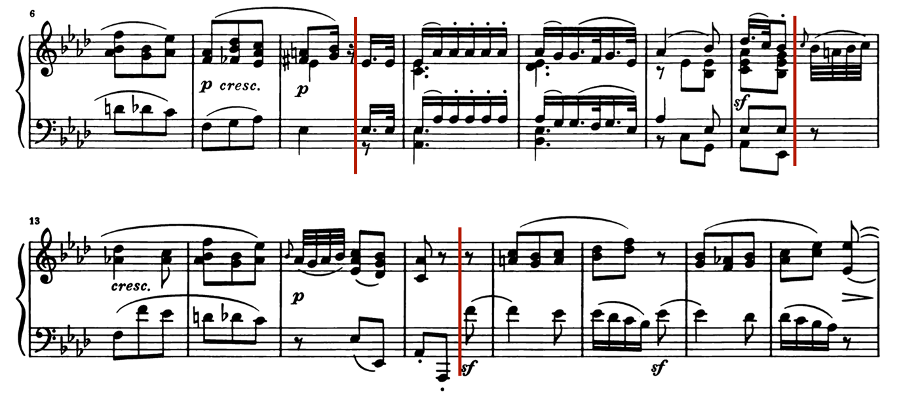
The sentence that continues from the second half of the 8th bar develops mm. 1–8. The opening eighth-note figure is now in 16th-note staccato. At m. 16 the sentence ends not with a half cadence but with a PAC in A-flat major, after which the music proceeds to B.
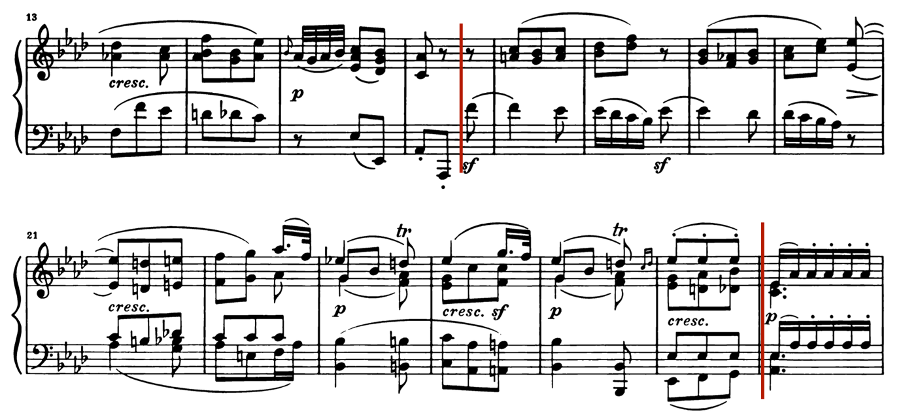
Section B introduces new material. It begins on V of B-flat minor and shows V–I, then again V–I in A-flat major; within this process, two-bar sequences appear. At mm. 21–22 the progression moves through f minor and soon modulates to E-flat major. Two-bar phrases continue; at m. 26 I in E-flat is reinterpreted as V of the home key (A-flat), returning to the tonic and leading to A′.
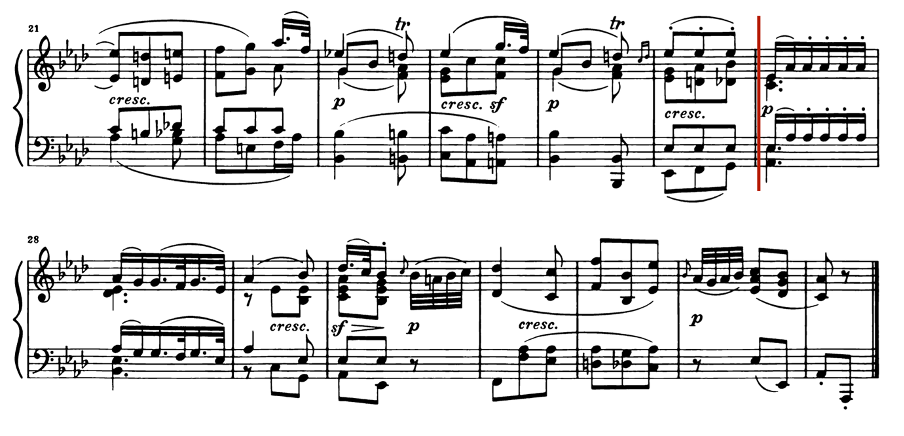
Section A′ is a reduced version of A, consisting of two phrases that reprise the latter sentence of A. At m. 34, as in A, a PAC in A-flat closes the theme.
Variation I
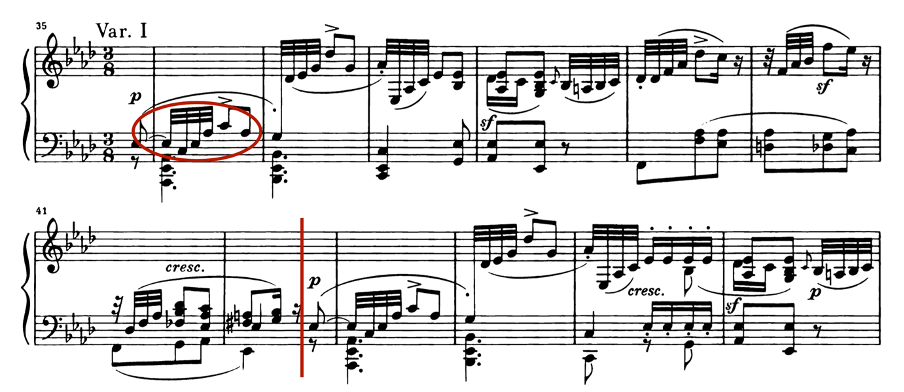
Var. I keeps the theme’s structure and makes the direction of intervals especially clear. Its overarching concept is a rising 32nd-note arpeggio figure that pervades the entire variation, yielding greater unity at the phrase and sentence levels than in the theme. The bass is reinforced in the left hand, thereby highlighting the harmony.
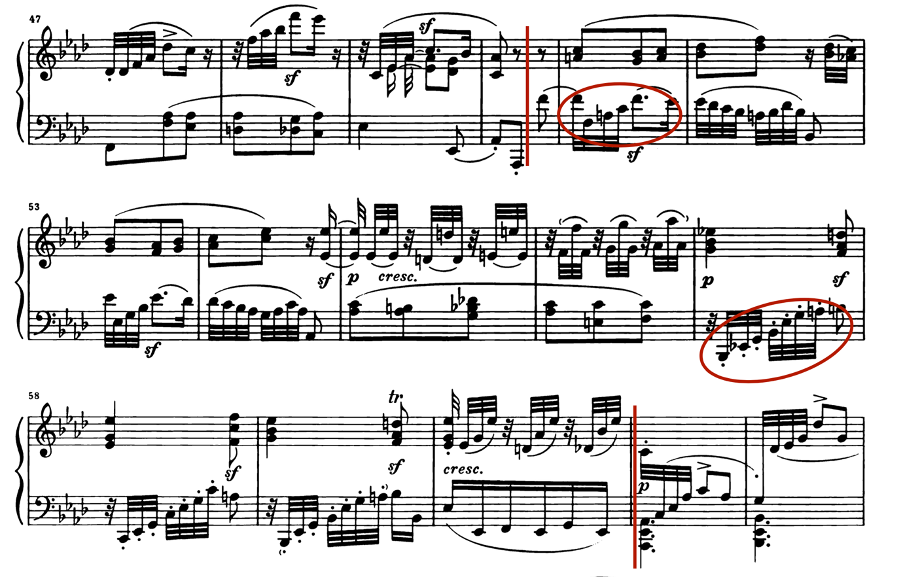
At m. 50 there is a cadence in A-flat mirroring the theme’s structure; the music then proceeds to B. In B, the right-hand figuration remains nearly identical to the theme’s, while the left-hand accompaniment now adds arpeggios. At m. 55 the right-hand figure moves to the left, and the right hand introduces rapid octave leaps beginning after a 32nd-rest. The key scheme matches the theme. In the final phrase starting m. 57, the left-hand arpeggios gain staccatos; after a cadence in E-flat at m. 60, the harmony shifts to V7 of A-flat through arpeggiated revoicings.
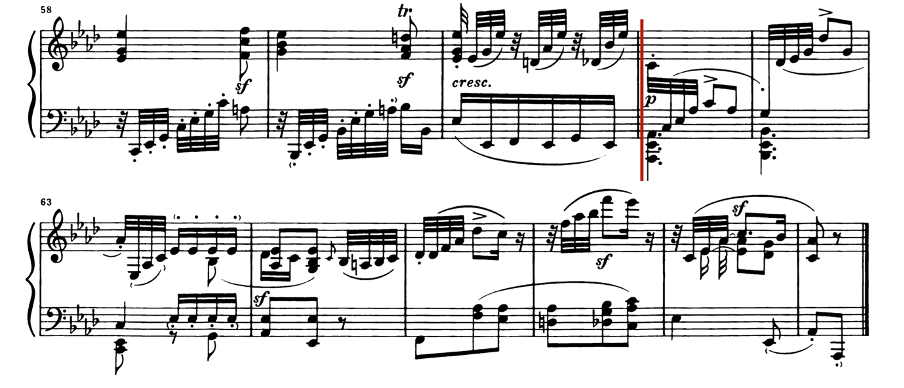
Section A′ of Var. I follows, reprising the second sentence of A verbatim; a PAC in A-flat at m. 68 closes Var. I.
Variation II
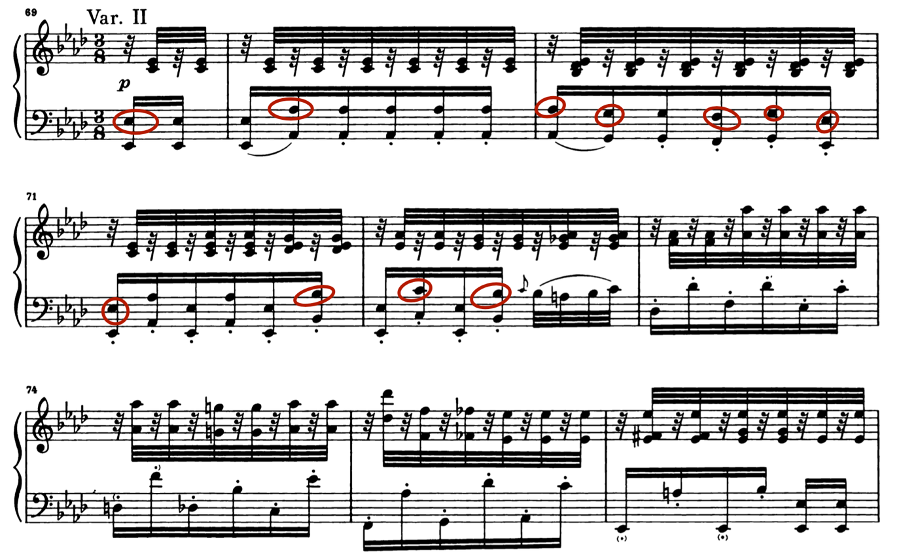
Var. II likewise retains key, meter, and structure. Its concept is a hand-crossing 32nd-note pattern, developed by repeated octaves and chord strokes. Examining the repeated tones reveals the theme’s melody re-cast in the bass at the octave. After the first phrase, from m. 74 the left hand abandons repeated octaves and instead leaps through the bass line.
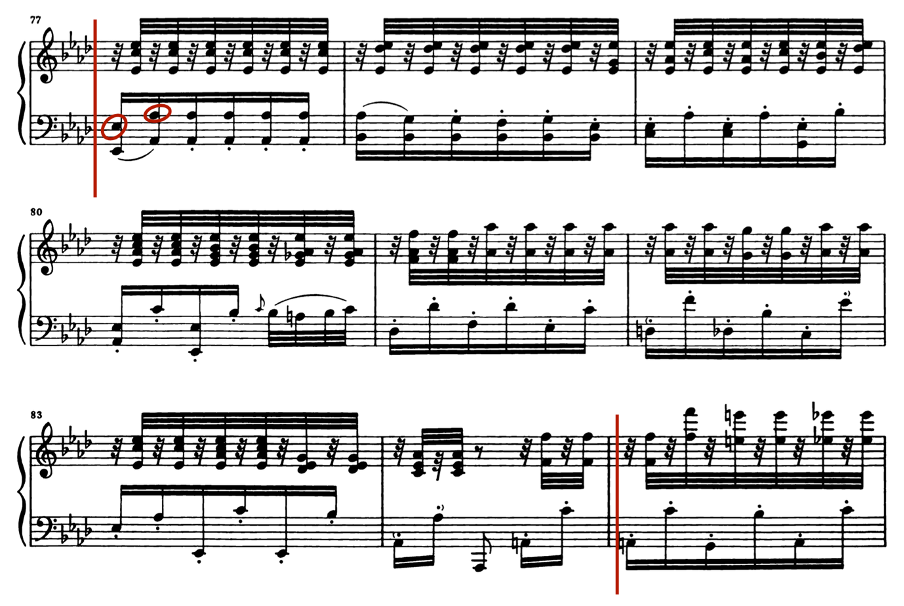
The next sentence (from m. 77) develops the immediately preceding material exactly as in the theme. In Var. II the left hand remains largely unchanged, while the right-hand chordal repeats are thickened with added tones, emphasizing harmony.
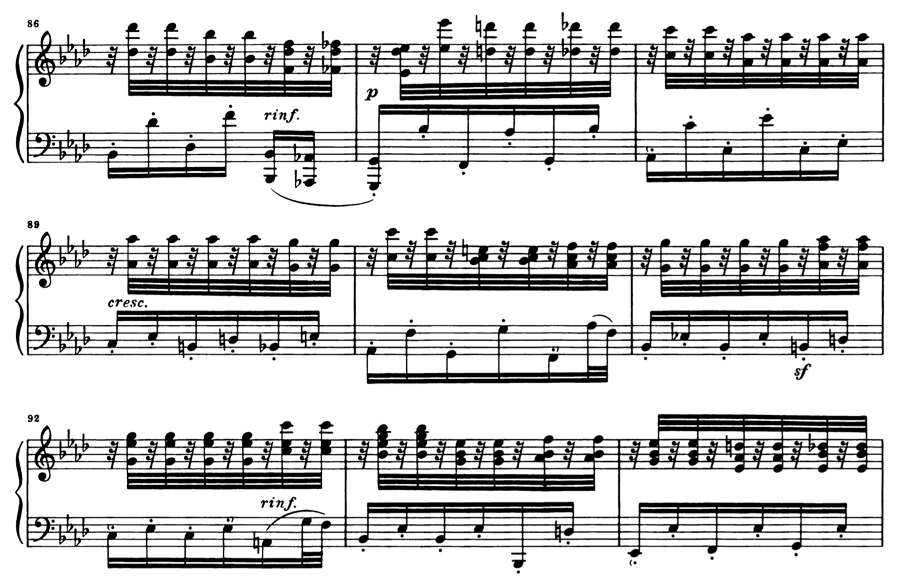
From m. 85 the music enters B. Intervals from the theme are split and redistributed. Unlike the theme—where both hands’ melodic motion was foregrounded—Var. II reduces the left hand to a light rhythmic role, keeping the variation’s core concept and a spare texture overall.
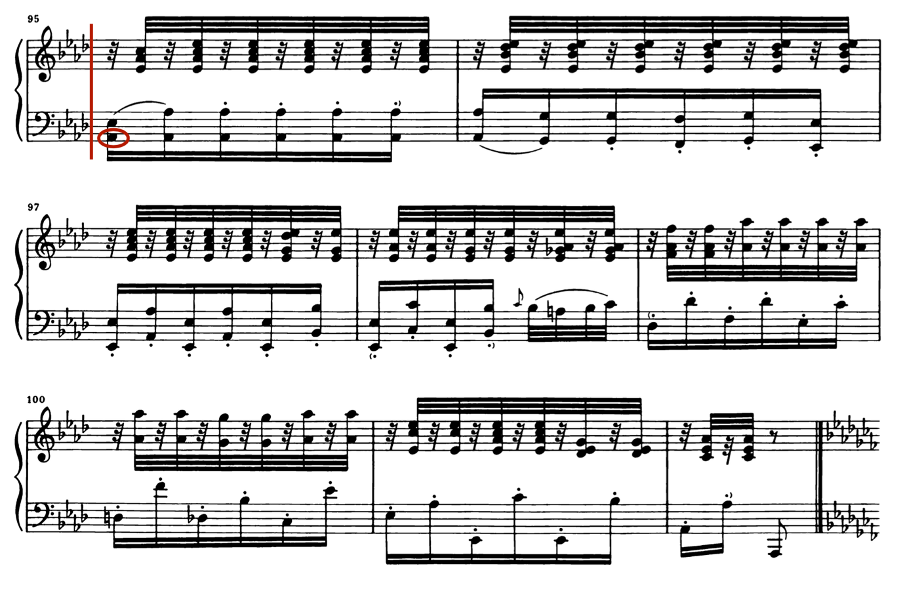
Section A′ follows. Here, A’s latter sentence is again reproduced, but with small changes: at the start, an A-flat is added in the bass to stress the tonic, and the right-hand repeated chords are further thickened, giving a stronger impression. A cadence in A-flat at m. 102 closes Var. II.
Variation III
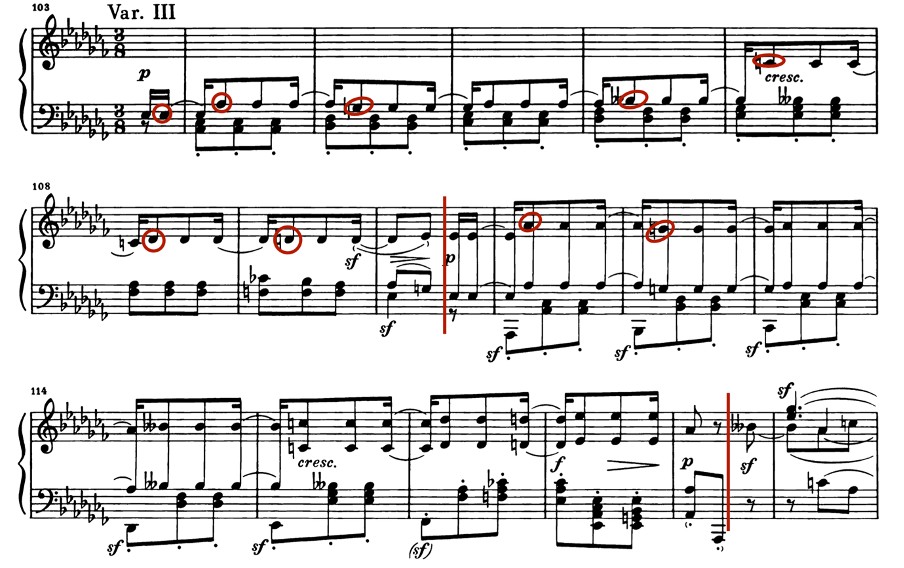
Var. III preserves Var. II’s syncopated ethos, but trades staccato and rests for a more legato flow. Here Beethoven changes the key: the variation begins in A-flat minor (the parallel minor of the theme) while keeping 3/8.
In A’s first phrase both hands start low: over a left-hand staccato ascent in 3rds, the right-hand melody enters off the beat in 16ths, so the rhythms cross. The melodic direction is a pared-down version of the theme’s. Chromatic motion abounds; through augmented-sixth chords a half cadence on V arrives at m. 110.
In the second phrase (from m. 111) the bass drops lower and sforzandi reinforce it. After a cadence at m. 118, the music proceeds to B.
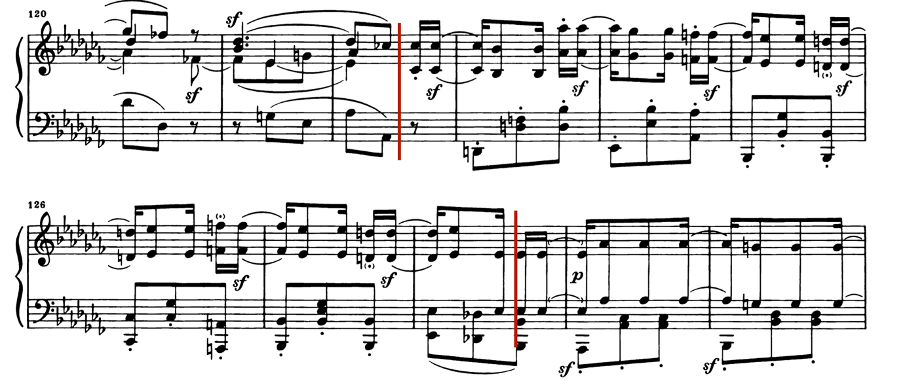
B opens in eighth-note motion with three independent voices. The first phrase sequences the same pattern; from the end of m. 122 the syncopations that recall A return. At m. 128 I in E-flat moves to V of A-flat, ushering in A′.
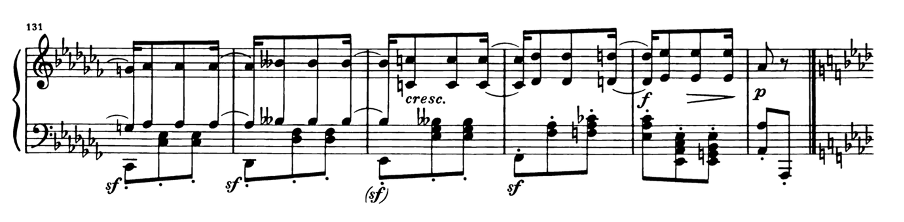
A′ reproduces A’s latter sentence as in the theme.
Variation IV
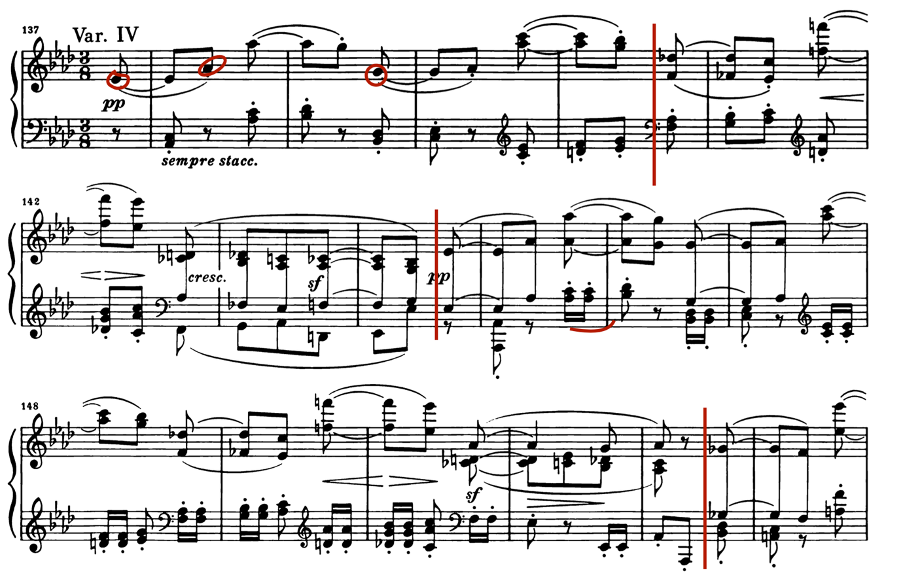
Var. IV appears to simplify the theme further: the piece moves largely in eighth-note values. The key returns to A-flat major. The syncopated ties on strong beats—so characteristic thus far—continue here and blur the metric feel. The melody leaps across registers, at times suggesting two slow-moving voices; the melodic direction remains clear.
From the latter part of m. 144, the second phrase brings a small change: in the left-hand accompaniment, the eighth-note chords become 16ths only at bar-ends. A cadence at m. 151 leads to B.
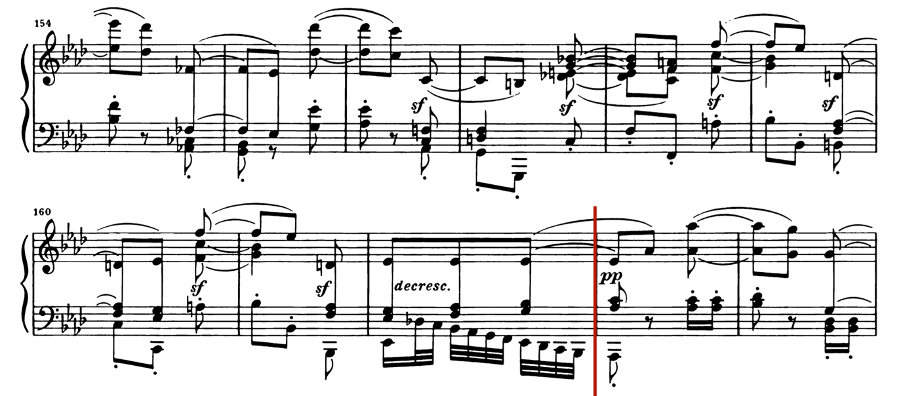
B keeps the theme’s layout while intensifying Var. IV’s concept. Motion between registers is now articulated in octaves for greater clarity. Repeated sforzandi on beat three further destabilize the meter. After a cadence in E-flat at m. 162, the left hand runs a descending 32nd-note scale, which leads directly to A′.
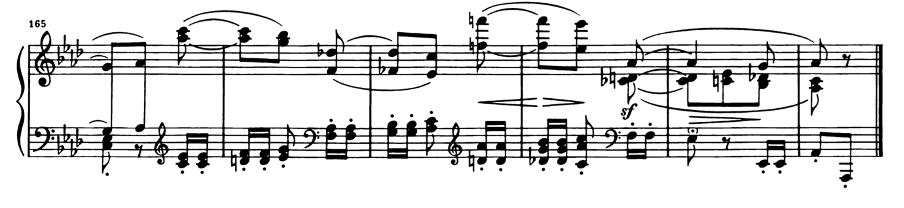
A′ once again repeats A’s second sentence.
Variation V
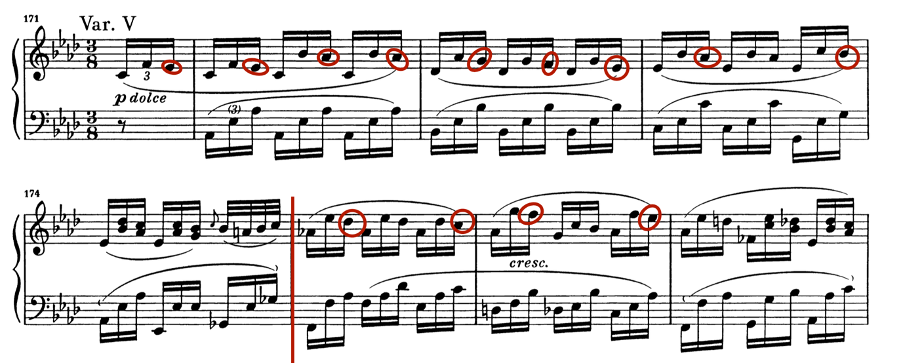
Var. V launches with a 16th-note triplet rhythm, later compressed into 32nds. It keeps the theme’s structure and adds a coda. At the outset, the **theme’s melody is placed on the third note of each triplet, while the left hand supplies triplet arpeggios—an unobtrusive accompaniment without intricate figuration.
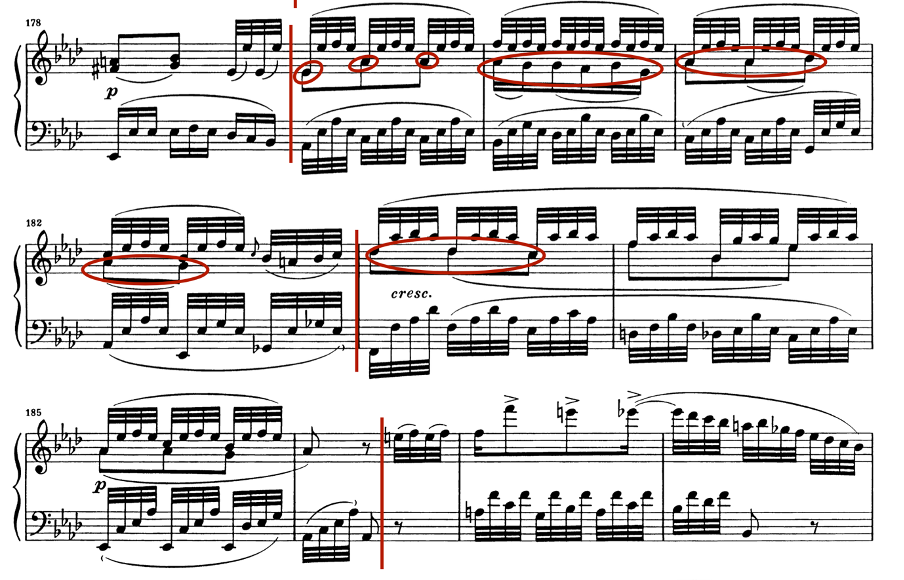
In the second phrase, the triplet rhythm is converted to 32nds, increasing drive. The figure heard just before now moves to the right-hand outer voice, while the inner voice keeps the theme melody intact; the left-hand accompaniment adapts to 32nds. After a cadence at m. 185, the music proceeds to B.
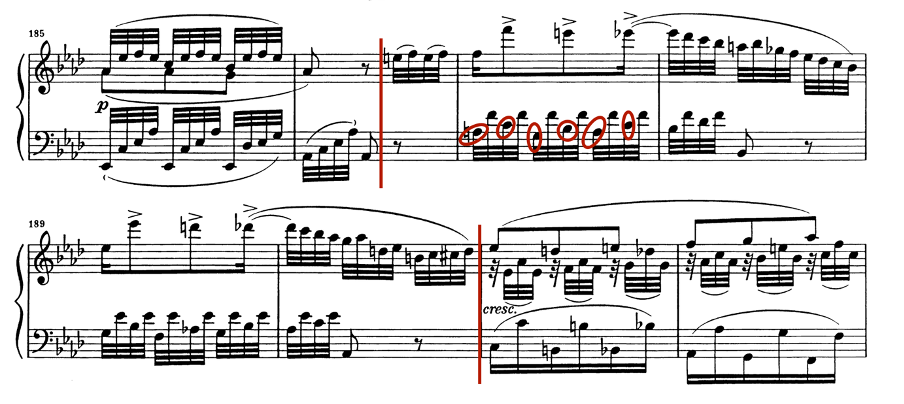
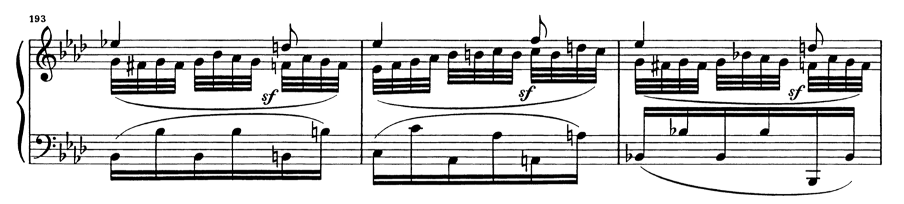
With the rhythmic profile intact, B carries on. At the start of m. 187, the descending left-hand line that opened B in the theme is now handed to the right hand, still descending but over a wider register and with syncopations; the range traversed by the 32nds is broader. Conversely, the right-hand 3rds that began B in the theme now unfold as left-hand arpeggios. The second phrase of B proceeds with a right-hand upper-voice melody, supported by inner-voice figuration and left-hand accompaniment; the theme’s melody is clearly audible. After a cadence in E-flat at m. 196, the music returns to the tonic and goes to A′.
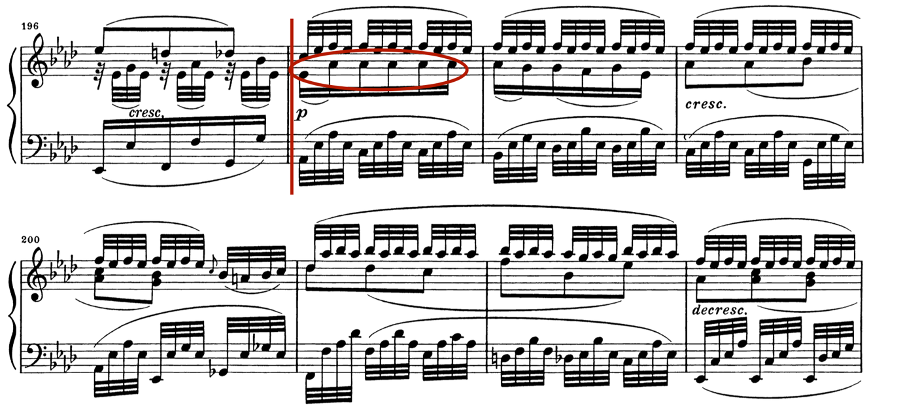
Unlike the theme, A′ does not reproduce A’s second sentence literally: the melody remains in an inner voice, but now in 16ths rather than eighths, clarifying the theme. A PAC in A-flat at mm. 203–204 leads to the Coda.
Coda
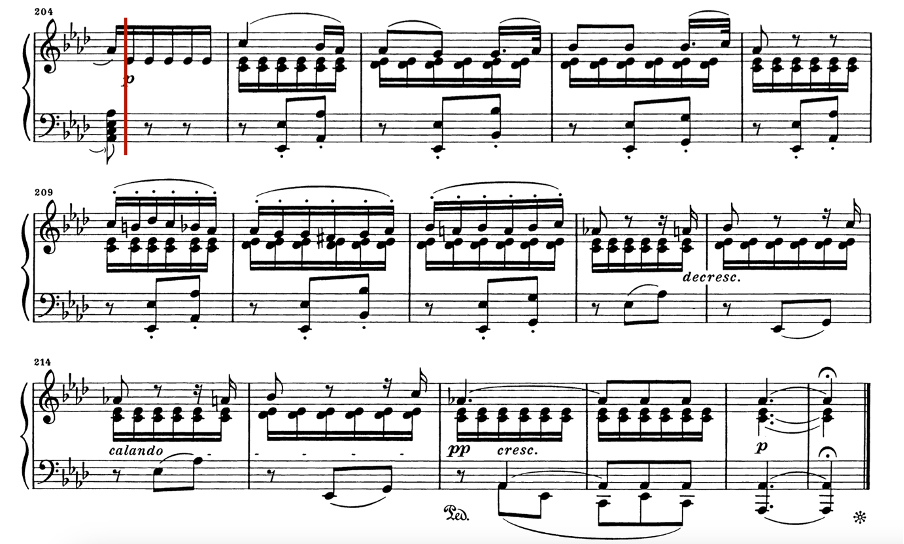
The coda begins piano. In the inner voice, 2nd- and 3rd-interval chords are repeated in 16ths, while the right hand carries the melody. The left-hand accompaniment enters on beat two, softening the downbeat. At m. 216 another A-flat cadence appears; over the next four bars the tonic is prolonged, and the movement subsides to a gentle close.





Beethoven’s Piano Sonata No. 12 is the first among his middle-period piano sonatas and has four movements. Unusually, the first movement is slow and its form is not sonata form: it is a theme with five variations.
Theme
The theme spans 34 measures and follows A (mm. 1–16) – B (mm. 17–26) – A′ (mm. 26–34). As befits a variation theme, the writing is straightforward and modular in four-bar units.
It begins in A-flat major, 3/8, with an eighth-note anacrusis. Section A consists of two 8-bar sentences, each subdividing into regular 4-bar phrases. In the opening two bars, one finds (1) an ascending leap in eighth notes and (2) a dotted-rhythm descending stepwise motion; the contrast between the two bars is clear. The next two bars reveal more explicit part-writing while maintaining the one-bar-versus-one-bar contrast. The first phrase closes with a half cadence on V—a textbook move.
The second 4 bars form the next phrase, contrasting with the first. The right hand plays chords but retains a melodic profile, while the left hand supplies a stepwise monodic bass. A half cadence appears in the fourth bar. Having closed the first 8-bar sentence with a half cadence, the music repeats the same sentence in slightly developed form.
The sentence that continues from the second half of the 8th bar develops mm. 1–8. The opening eighth-note figure is now in 16th-note staccato. At m. 16 the sentence ends not with a half cadence but with a PAC in A-flat major, after which the music proceeds to B.
Section B introduces new material. It begins on V of B-flat minor and shows V–I, then again V–I in A-flat major; within this process, two-bar sequences appear. At mm. 21–22 the progression moves through f minor and soon modulates to E-flat major. Two-bar phrases continue; at m. 26 I in E-flat is reinterpreted as V of the home key (A-flat), returning to the tonic and leading to A′.
Section A′ is a reduced version of A, consisting of two phrases that reprise the latter sentence of A. At m. 34, as in A, a PAC in A-flat closes the theme.
Variation I
Var. I keeps the theme’s structure and makes the direction of intervals especially clear. Its overarching concept is a rising 32nd-note arpeggio figure that pervades the entire variation, yielding greater unity at the phrase and sentence levels than in the theme. The bass is reinforced in the left hand, thereby highlighting the harmony.
At m. 50 there is a cadence in A-flat mirroring the theme’s structure; the music then proceeds to B. In B, the right-hand figuration remains nearly identical to the theme’s, while the left-hand accompaniment now adds arpeggios. At m. 55 the right-hand figure moves to the left, and the right hand introduces rapid octave leaps beginning after a 32nd-rest. The key scheme matches the theme. In the final phrase starting m. 57, the left-hand arpeggios gain staccatos; after a cadence in E-flat at m. 60, the harmony shifts to V7 of A-flat through arpeggiated revoicings.
Section A′ of Var. I follows, reprising the second sentence of A verbatim; a PAC in A-flat at m. 68 closes Var. I.
Variation II
Var. II likewise retains key, meter, and structure. Its concept is a hand-crossing 32nd-note pattern, developed by repeated octaves and chord strokes. Examining the repeated tones reveals the theme’s melody re-cast in the bass at the octave. After the first phrase, from m. 74 the left hand abandons repeated octaves and instead leaps through the bass line.
The next sentence (from m. 77) develops the immediately preceding material exactly as in the theme. In Var. II the left hand remains largely unchanged, while the right-hand chordal repeats are thickened with added tones, emphasizing harmony.
From m. 85 the music enters B. Intervals from the theme are split and redistributed. Unlike the theme—where both hands’ melodic motion was foregrounded—Var. II reduces the left hand to a light rhythmic role, keeping the variation’s core concept and a spare texture overall.
Section A′ follows. Here, A’s latter sentence is again reproduced, but with small changes: at the start, an A-flat is added in the bass to stress the tonic, and the right-hand repeated chords are further thickened, giving a stronger impression. A cadence in A-flat at m. 102 closes Var. II.
Variation III
Var. III preserves Var. II’s syncopated ethos, but trades staccato and rests for a more legato flow. Here Beethoven changes the key: the variation begins in A-flat minor (the parallel minor of the theme) while keeping 3/8.
In A’s first phrase both hands start low: over a left-hand staccato ascent in 3rds, the right-hand melody enters off the beat in 16ths, so the rhythms cross. The melodic direction is a pared-down version of the theme’s. Chromatic motion abounds; through augmented-sixth chords a half cadence on V arrives at m. 110.
In the second phrase (from m. 111) the bass drops lower and sforzandi reinforce it. After a cadence at m. 118, the music proceeds to B.
B opens in eighth-note motion with three independent voices. The first phrase sequences the same pattern; from the end of m. 122 the syncopations that recall A return. At m. 128 I in E-flat moves to V of A-flat, ushering in A′.
A′ reproduces A’s latter sentence as in the theme.
Variation IV
Var. IV appears to simplify the theme further: the piece moves largely in eighth-note values. The key returns to A-flat major. The syncopated ties on strong beats—so characteristic thus far—continue here and blur the metric feel. The melody leaps across registers, at times suggesting two slow-moving voices; the melodic direction remains clear.
From the latter part of m. 144, the second phrase brings a small change: in the left-hand accompaniment, the eighth-note chords become 16ths only at bar-ends. A cadence at m. 151 leads to B.
B keeps the theme’s layout while intensifying Var. IV’s concept. Motion between registers is now articulated in octaves for greater clarity. Repeated sforzandi on beat three further destabilize the meter. After a cadence in E-flat at m. 162, the left hand runs a descending 32nd-note scale, which leads directly to A′.
A′ once again repeats A’s second sentence.
Variation V
Var. V launches with a 16th-note triplet rhythm, later compressed into 32nds. It keeps the theme’s structure and adds a coda. At the outset, the **theme’s melody is placed on the third note of each triplet, while the left hand supplies triplet arpeggios—an unobtrusive accompaniment without intricate figuration.
In the second phrase, the triplet rhythm is converted to 32nds, increasing drive. The figure heard just before now moves to the right-hand outer voice, while the inner voice keeps the theme melody intact; the left-hand accompaniment adapts to 32nds. After a cadence at m. 185, the music proceeds to B.
With the rhythmic profile intact, B carries on. At the start of m. 187, the descending left-hand line that opened B in the theme is now handed to the right hand, still descending but over a wider register and with syncopations; the range traversed by the 32nds is broader. Conversely, the right-hand 3rds that began B in the theme now unfold as left-hand arpeggios. The second phrase of B proceeds with a right-hand upper-voice melody, supported by inner-voice figuration and left-hand accompaniment; the theme’s melody is clearly audible. After a cadence in E-flat at m. 196, the music returns to the tonic and goes to A′.
Unlike the theme, A′ does not reproduce A’s second sentence literally: the melody remains in an inner voice, but now in 16ths rather than eighths, clarifying the theme. A PAC in A-flat at mm. 203–204 leads to the Coda.
Coda
The coda begins piano. In the inner voice, 2nd- and 3rd-interval chords are repeated in 16ths, while the right hand carries the melody. The left-hand accompaniment enters on beat two, softening the downbeat. At m. 216 another A-flat cadence appears; over the next four bars the tonic is prolonged, and the movement subsides to a gentle close.