The fourth movement is an allegretto in B-flat major, 2/4, laid out as a sonata-rondo: A–B–A–C–A–B–A.
Exposition
A (First Theme)
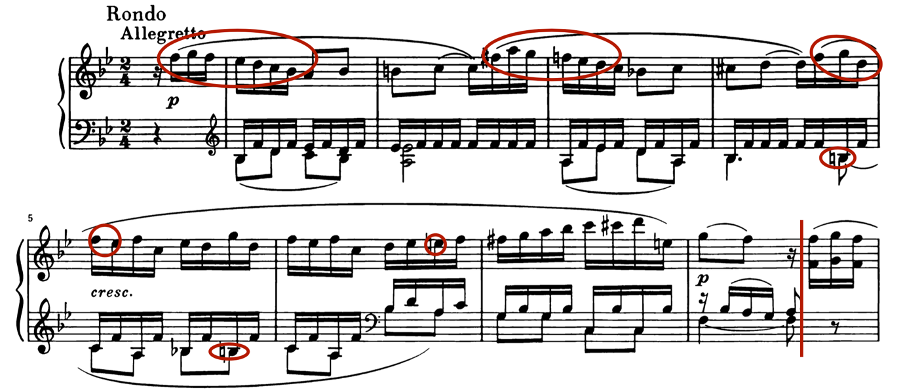
The A section (first theme) consists of an eight-bar phrase repeated. The right-hand motive drives the section by constant repetition. Beginning with an upbeat (incomplete bar), the motive stated through m. 1 reappears in mm. 2–3; from the latter half of m. 4 only fragments of the motive are used to add forward motion. In the left hand, a repeated-note inner voice is characteristic. The section starts in B-flat major; in the bass at m. 4, the chromatic Bb–B moves to C. That C functions as the dominant of F major (the dominant key of the home key), and together with the right hand’s E♭–E chromatic motion the music briefly modulates to F major, where at m. 8 a PAC in F is heard; this is received as V of the home key, bringing us back to B-flat.
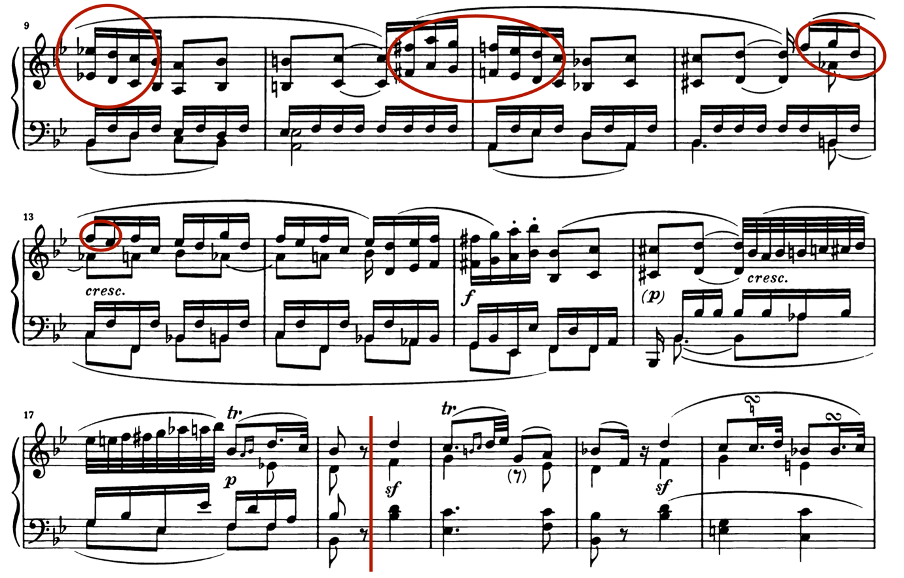
Back in B-flat, the earlier phrase is repeated; now the right-hand melody is expanded in octaves. The left hand keeps the same bass motion and repeated-note inner voice with little change. Unlike before, the music does not move to F but stays in B-flat, underlining the key with several cadences. At m. 16 a chromatic line appears as thirty-second notes, adding brilliance; with trills and other ornaments the cadence in B-flat is reiterated at m. 18, closing A (first theme).
Transition
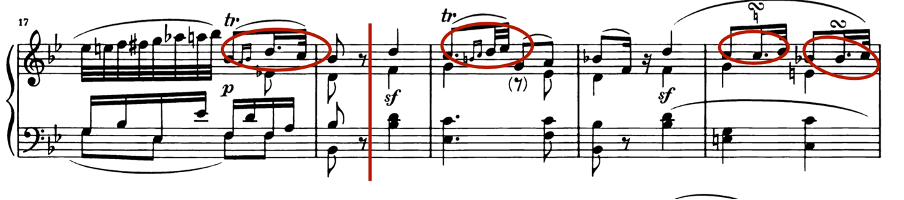
A four-bar transition follows, built from the ornamental figure that closed the first theme. At m. 20 another cadence in B-flat appears; immediately the music modulates to F major, where a cadence at m. 22 confirms the key, leading into B (second theme).
B (Second Theme)
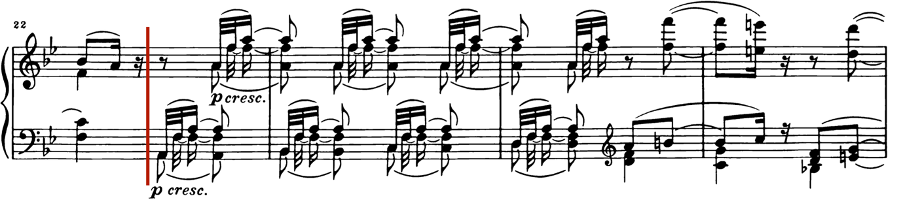
B continues in F major out of the transition. It starts with thirty-second-note arpeggios. Meanwhile the left-hand bass ascends by seconds A–B♭–C–D, while the left-hand inner voice and the right hand hold common tones, thereby highlighting the bass motion. From the latter half of m. 24 the left-hand accompaniment shifts to eighth-note units, and the right hand presents a descending octave line.
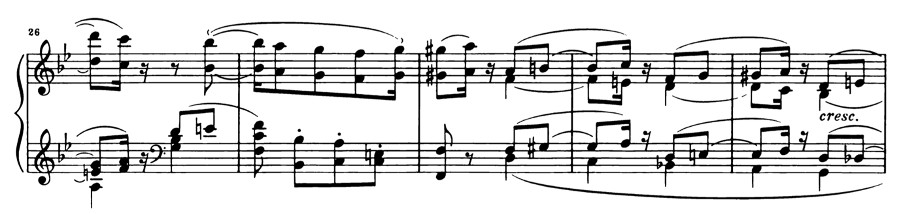
From m. 27 the descending right-hand line gains a syncopated character and crosses with the left hand. V–I cadences occur at mm. 27–28, after which a continuing phrase renews the cadential drive. Beginning on the second beat of the latter half of m. 28, both hands proceed through sequences of contrary-motion V–I; the bass descends stepwise D–C–B♭–A–G–F, and another V–I in F closes the span.
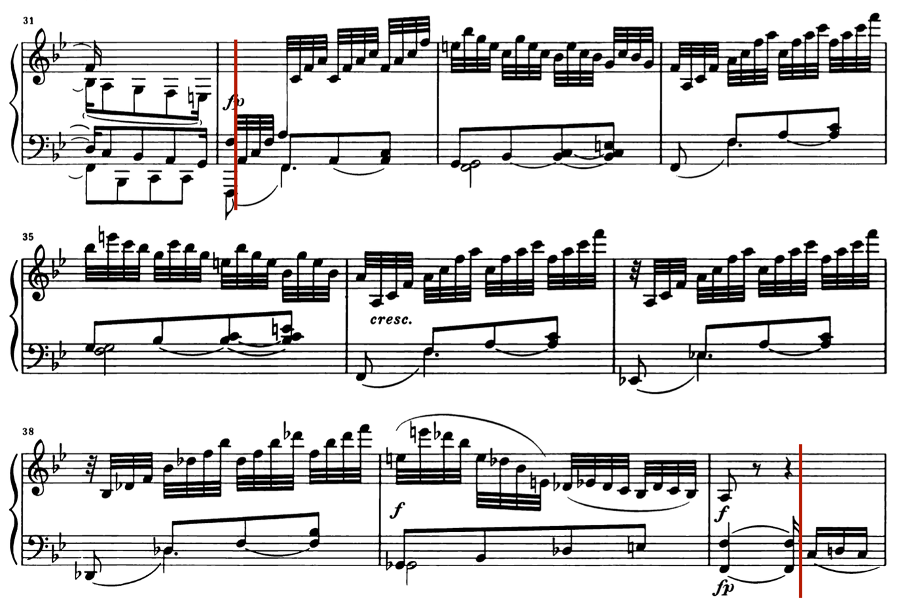
The second part of B follows. Both hands present arpeggiation: the left more slowly in eighths, the right in fast thirty-seconds. The bass descends G–F–E♭–D♭ by whole steps, touches G♭, and then cadences in F.
Transition
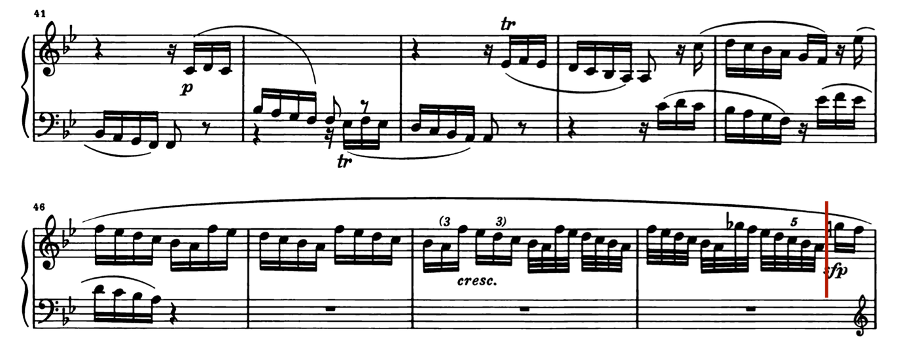
A transition preparing the return of A follows. Here the first motive of A is traded between the hands. In mm. 44–46 both hands proceed in parallel thirds before the right hand continues alone, staying in the same register while the descending phrase accelerates rhythmically—adding drive and leading to A′.
A′ (First Theme)
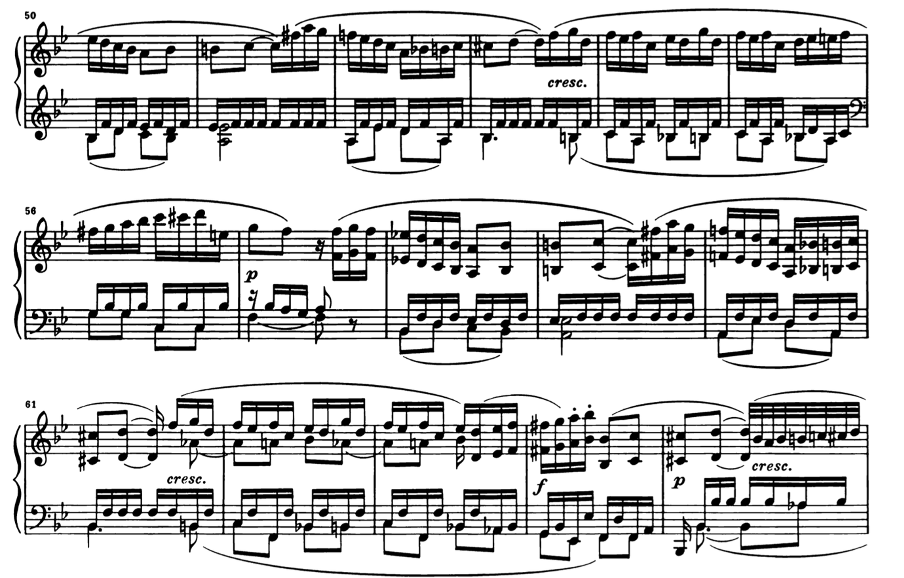
A′ returns exactly as before in B-flat, with a PAC at mm. 66–67; the music then proceeds to C (development).
C (Development)
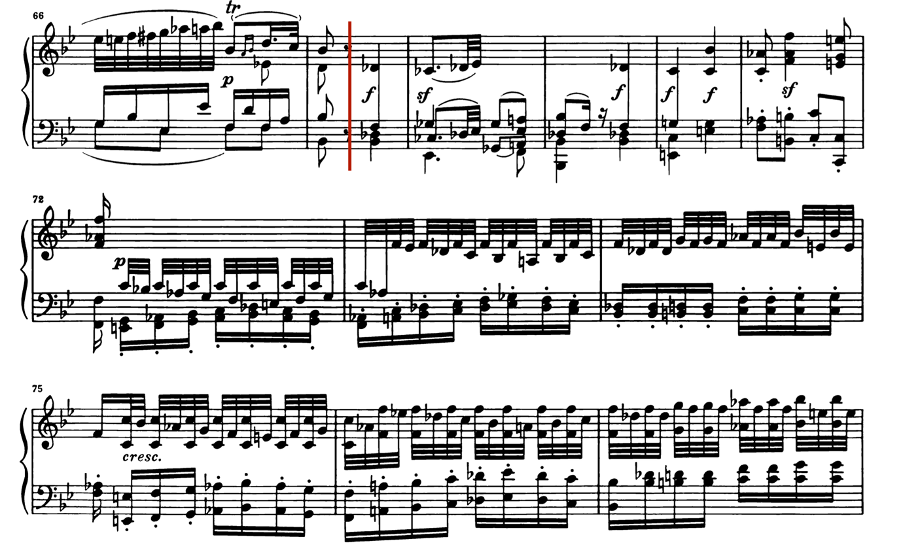
The development opens by reusing material from the earlier transition (heard between A and B). In B-flat minor it shows a VI⁶–V–i cadence, then moves to f minor. Through mm. 69–71 strong quarter-note chords drive the music; at m. 71 a sforzando on the weak beat underscores the syncopation and ushers in the main development.
From m. 72 a thirty-second-note basic rhythm takes over. The repeated-note accompaniment formerly in the left hand of A now appears in the right hand; in the left hand one sees sequential progressions in 3rds. The C section can be heard as three-part; this is C–a.
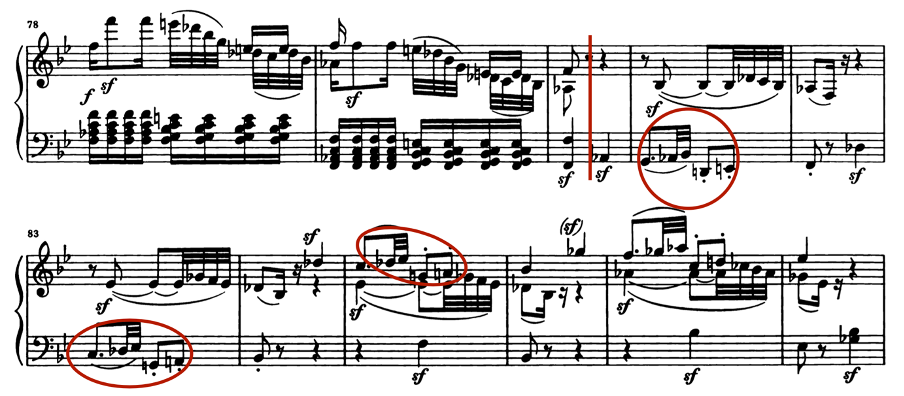
Dynamics, register, and the number of chord tones all increase, building to the strongest climax at m. 78. Syncopated figures appear, and at the end of the phrase a PAC in f minor is heard—marking C–b. The new span again uses transition-derived motives: contrapuntal writing leads both hands in melodic strands that enter on different beats, keeping both lines audible. From m. 85 an inner voice is added, yielding three independent parts; sequence of V–I appears in B-flat minor and E-flat minor.
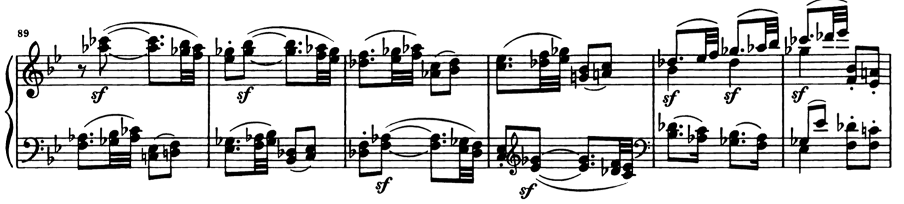
A more developed form of the transition motive follows, carrying the music to m. 94. The same rhythm is repeated with third-chord doublings; at mm. 93–94 the hands move in contrary motion to form a strong cadence in B-flat minor.
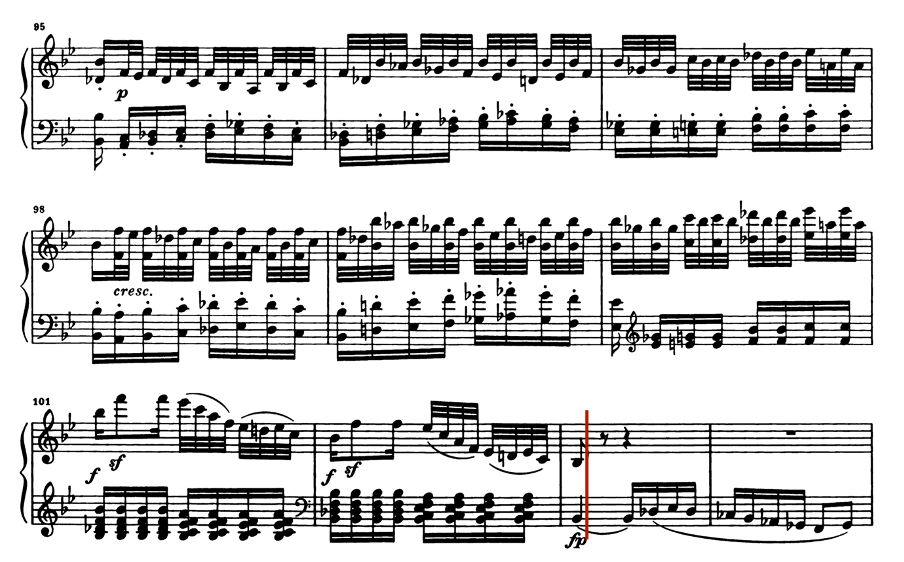
Then comes C–a′, matching C–a in design; unlike C–a, which closed in f minor, C–a′ ends in B-flat minor (the parallel tonic letter of the home key), smoothing the way for the return of A.
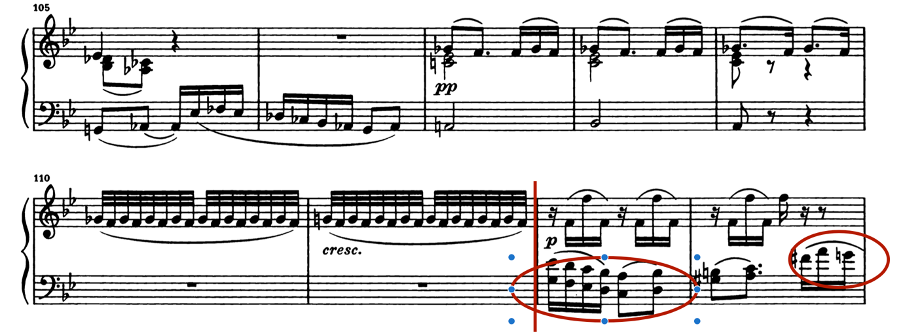
A link from C to A″ follows: A’s motive is restated twice in the left hand; the right-hand figure that follows also derives from A’s motive. Through trilled thirty-seconds at mm. 110–111 the music passes to A″; the trill’s pitch F is the dominant of the home key.
Recapitulation
A″ (First Theme)
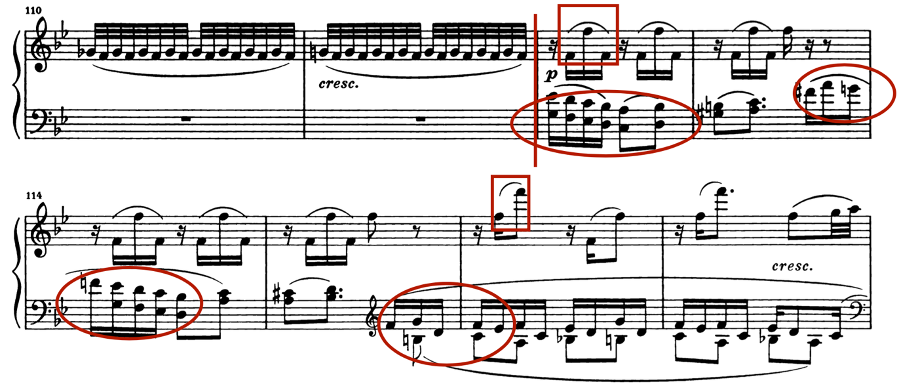
From m. 113 the recapitulation begins. While it follows A’s motive and layout, much is transformed: the motive formerly in the right hand now appears in the left as sixth-interval chords; in the right hand an octave-leap figure enters after a sixteenth-rest. From m. 115 a motive-based descending line unfolds in the left hand in two independent voices, with syncopation; the right hand emphasizes the octave-leap figure over a wide range.
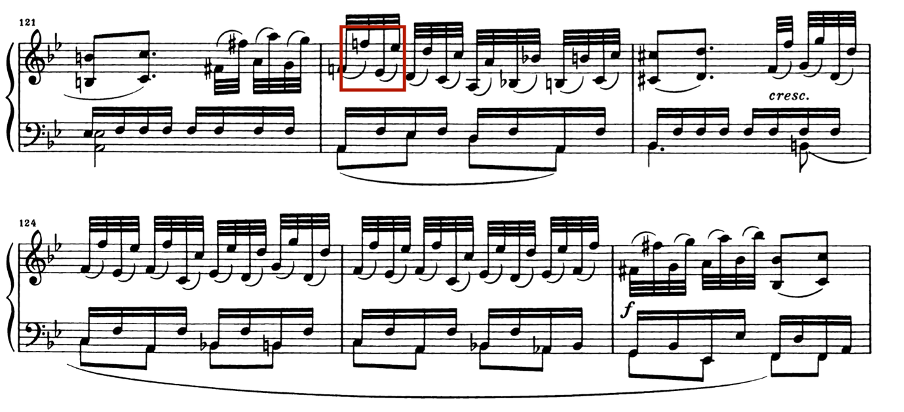
The left-hand texture resembles A of the exposition; the right hand carries long phrases built from the octave-leap motive that guides A″.
B′ (Second Theme)
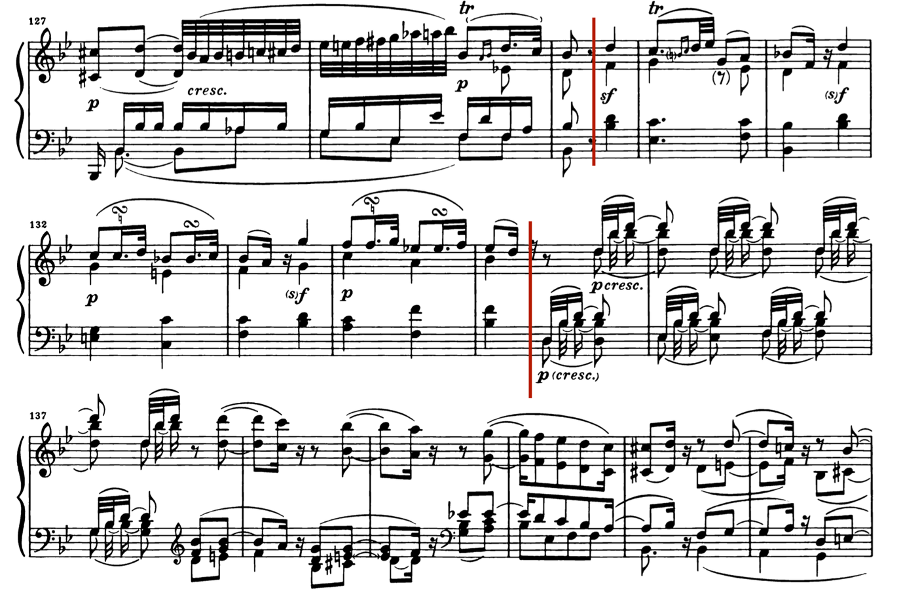
The transition and B return almost unchanged, with the key scheme adjusted for sonata-rondo practice: the cadence that in the exposition was not in the home key now arrives in B-flat at m. 135, and B′ proceeds in B-flat rather than F.
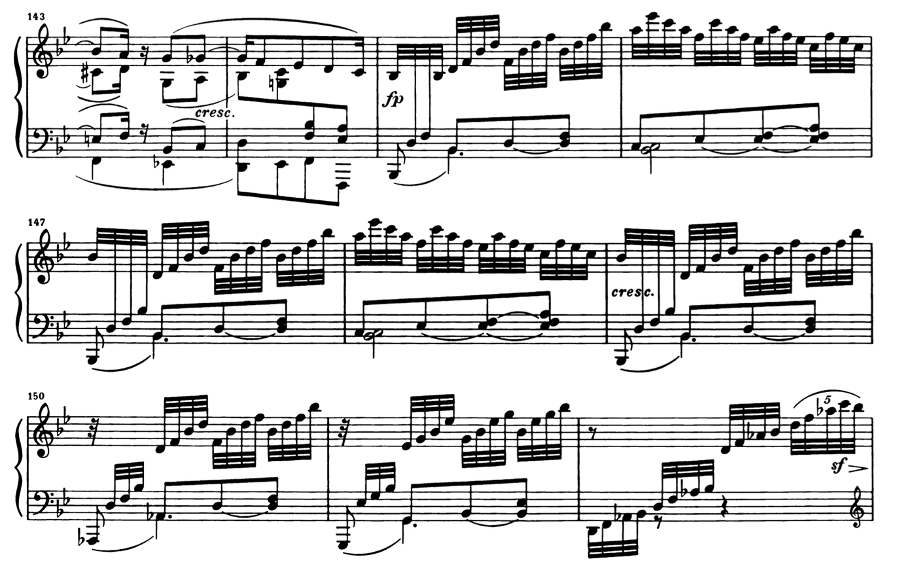
From here the course matches the exposition.
Transition (to final A)
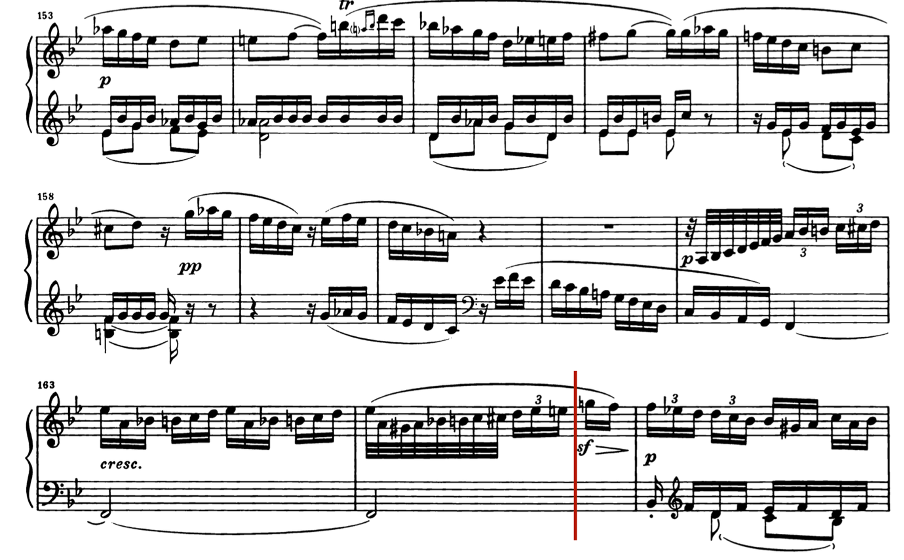
The last transition heading to A is expanded relative to the exposition—slightly longer in span.
A″′ (Final A)
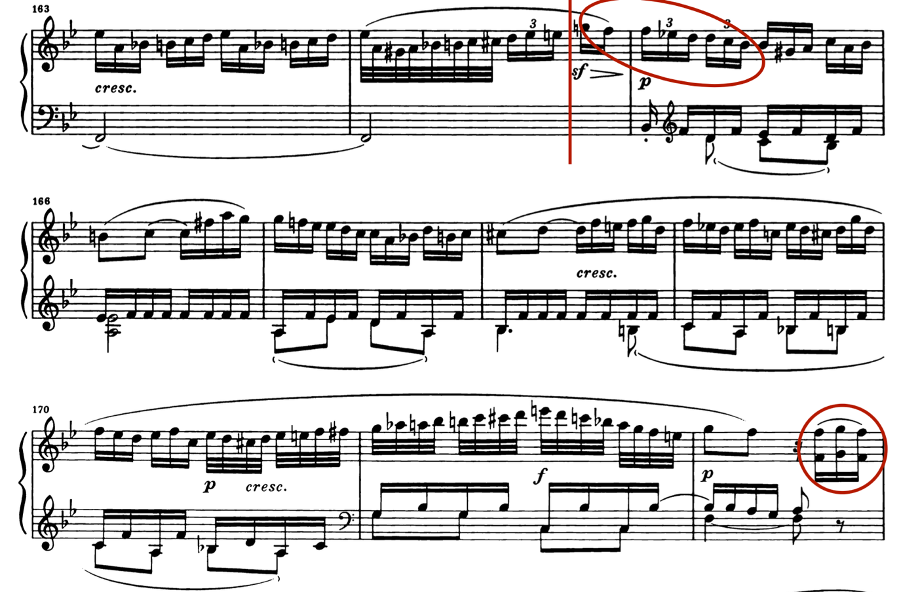
This is the final reprise of A. As in the previous return, motive transformation is conspicuous. In the first phrase, the right hand keeps the same melodic direction but in triplets; the left hand continues in sixteenth-notes, so the hands cross rhythms, making the motive’s transformation especially clear.
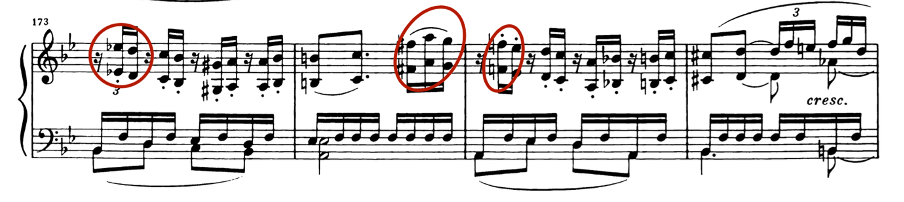
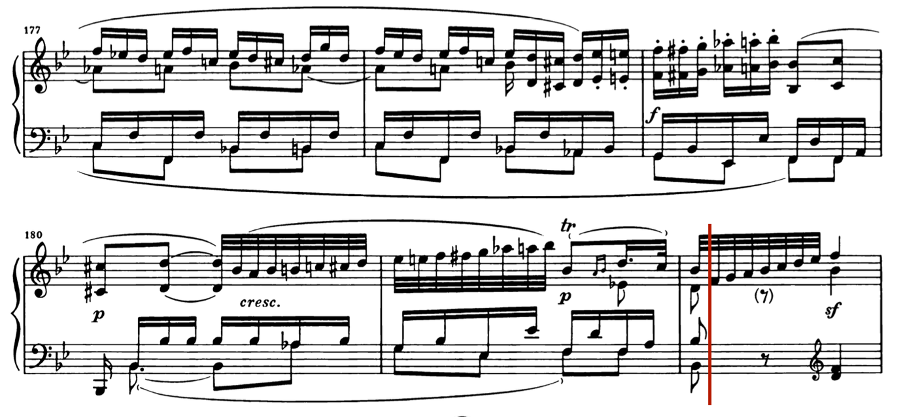
From m. 173 the phrase alters A’s motive once more: the melodic direction remains, but the rhythm changes—octave sixteenths in the right hand with rests every two notes. Elements used earlier—syncopation and staccato—combine into a new variant of A’s motive. From m. 176 the triplet rhythm returns and the phrase drives toward cadence; at m. 182 a PAC in B-flat closes the section.
Coda
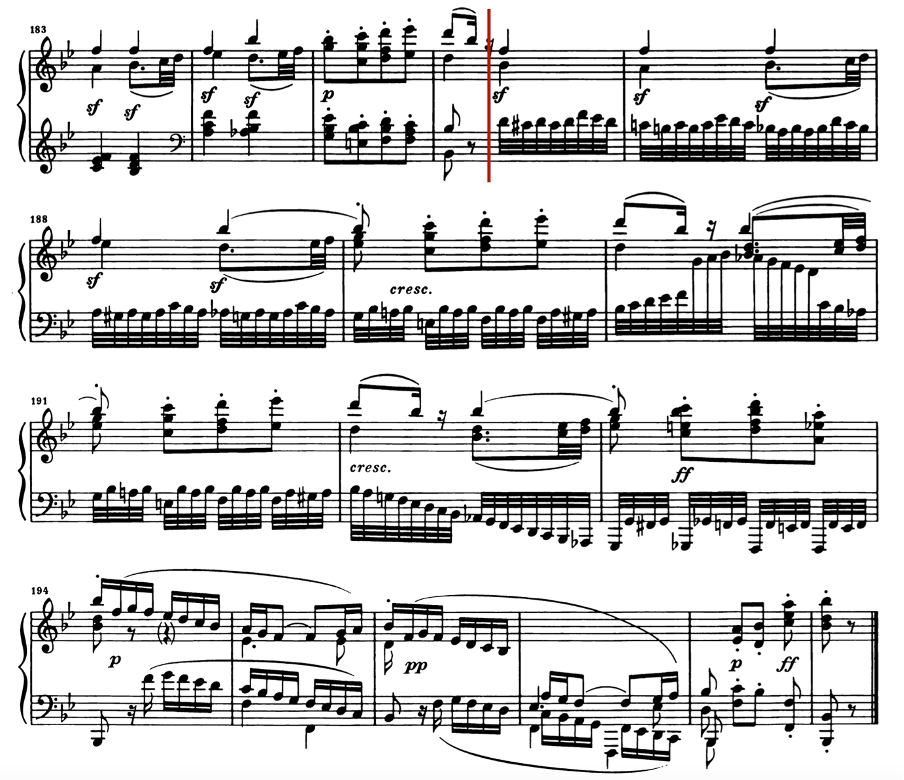
From mm. 182–186 the previously flowing thirty-second-note motion slows into quarters and eighths, re-articulating the cadence; then the coda proper begins.
The coda sets a steadfast left-hand thirty-second-note motion under a comparatively slower chordal melody in the right hand. The left-hand figuration reuses A’s motive, repeating it and fashioning an accompanimental pattern. At mm. 193–194 another B-flat-major cadence occurs; a sudden piano dynamic introduces a descending phrase. At m. 198 a pp cadence in the low register is followed by an abrupt fortissimo, and the work ends forcefully.





The fourth movement is an allegretto in B-flat major, 2/4, laid out as a sonata-rondo: A–B–A–C–A–B–A.
Exposition
A (First Theme)
The A section (first theme) consists of an eight-bar phrase repeated. The right-hand motive drives the section by constant repetition. Beginning with an upbeat (incomplete bar), the motive stated through m. 1 reappears in mm. 2–3; from the latter half of m. 4 only fragments of the motive are used to add forward motion. In the left hand, a repeated-note inner voice is characteristic. The section starts in B-flat major; in the bass at m. 4, the chromatic Bb–B moves to C. That C functions as the dominant of F major (the dominant key of the home key), and together with the right hand’s E♭–E chromatic motion the music briefly modulates to F major, where at m. 8 a PAC in F is heard; this is received as V of the home key, bringing us back to B-flat.
Back in B-flat, the earlier phrase is repeated; now the right-hand melody is expanded in octaves. The left hand keeps the same bass motion and repeated-note inner voice with little change. Unlike before, the music does not move to F but stays in B-flat, underlining the key with several cadences. At m. 16 a chromatic line appears as thirty-second notes, adding brilliance; with trills and other ornaments the cadence in B-flat is reiterated at m. 18, closing A (first theme).
Transition
A four-bar transition follows, built from the ornamental figure that closed the first theme. At m. 20 another cadence in B-flat appears; immediately the music modulates to F major, where a cadence at m. 22 confirms the key, leading into B (second theme).
B (Second Theme)
B continues in F major out of the transition. It starts with thirty-second-note arpeggios. Meanwhile the left-hand bass ascends by seconds A–B♭–C–D, while the left-hand inner voice and the right hand hold common tones, thereby highlighting the bass motion. From the latter half of m. 24 the left-hand accompaniment shifts to eighth-note units, and the right hand presents a descending octave line.
From m. 27 the descending right-hand line gains a syncopated character and crosses with the left hand. V–I cadences occur at mm. 27–28, after which a continuing phrase renews the cadential drive. Beginning on the second beat of the latter half of m. 28, both hands proceed through sequences of contrary-motion V–I; the bass descends stepwise D–C–B♭–A–G–F, and another V–I in F closes the span.
The second part of B follows. Both hands present arpeggiation: the left more slowly in eighths, the right in fast thirty-seconds. The bass descends G–F–E♭–D♭ by whole steps, touches G♭, and then cadences in F.
Transition
A transition preparing the return of A follows. Here the first motive of A is traded between the hands. In mm. 44–46 both hands proceed in parallel thirds before the right hand continues alone, staying in the same register while the descending phrase accelerates rhythmically—adding drive and leading to A′.
A′ (First Theme)
A′ returns exactly as before in B-flat, with a PAC at mm. 66–67; the music then proceeds to C (development).
C (Development)
The development opens by reusing material from the earlier transition (heard between A and B). In B-flat minor it shows a VI⁶–V–i cadence, then moves to f minor. Through mm. 69–71 strong quarter-note chords drive the music; at m. 71 a sforzando on the weak beat underscores the syncopation and ushers in the main development.
From m. 72 a thirty-second-note basic rhythm takes over. The repeated-note accompaniment formerly in the left hand of A now appears in the right hand; in the left hand one sees sequential progressions in 3rds. The C section can be heard as three-part; this is C–a.
Dynamics, register, and the number of chord tones all increase, building to the strongest climax at m. 78. Syncopated figures appear, and at the end of the phrase a PAC in f minor is heard—marking C–b. The new span again uses transition-derived motives: contrapuntal writing leads both hands in melodic strands that enter on different beats, keeping both lines audible. From m. 85 an inner voice is added, yielding three independent parts; sequence of V–I appears in B-flat minor and E-flat minor.
A more developed form of the transition motive follows, carrying the music to m. 94. The same rhythm is repeated with third-chord doublings; at mm. 93–94 the hands move in contrary motion to form a strong cadence in B-flat minor.
Then comes C–a′, matching C–a in design; unlike C–a, which closed in f minor, C–a′ ends in B-flat minor (the parallel tonic letter of the home key), smoothing the way for the return of A.
A link from C to A″ follows: A’s motive is restated twice in the left hand; the right-hand figure that follows also derives from A’s motive. Through trilled thirty-seconds at mm. 110–111 the music passes to A″; the trill’s pitch F is the dominant of the home key.
Recapitulation
A″ (First Theme)
From m. 113 the recapitulation begins. While it follows A’s motive and layout, much is transformed: the motive formerly in the right hand now appears in the left as sixth-interval chords; in the right hand an octave-leap figure enters after a sixteenth-rest. From m. 115 a motive-based descending line unfolds in the left hand in two independent voices, with syncopation; the right hand emphasizes the octave-leap figure over a wide range.
The left-hand texture resembles A of the exposition; the right hand carries long phrases built from the octave-leap motive that guides A″.
B′ (Second Theme)
The transition and B return almost unchanged, with the key scheme adjusted for sonata-rondo practice: the cadence that in the exposition was not in the home key now arrives in B-flat at m. 135, and B′ proceeds in B-flat rather than F.
From here the course matches the exposition.
Transition (to final A)
The last transition heading to A is expanded relative to the exposition—slightly longer in span.
A″′ (Final A)
This is the final reprise of A. As in the previous return, motive transformation is conspicuous. In the first phrase, the right hand keeps the same melodic direction but in triplets; the left hand continues in sixteenth-notes, so the hands cross rhythms, making the motive’s transformation especially clear.
From m. 173 the phrase alters A’s motive once more: the melodic direction remains, but the rhythm changes—octave sixteenths in the right hand with rests every two notes. Elements used earlier—syncopation and staccato—combine into a new variant of A’s motive. From m. 176 the triplet rhythm returns and the phrase drives toward cadence; at m. 182 a PAC in B-flat closes the section.
Coda
From mm. 182–186 the previously flowing thirty-second-note motion slows into quarters and eighths, re-articulating the cadence; then the coda proper begins.
The coda sets a steadfast left-hand thirty-second-note motion under a comparatively slower chordal melody in the right hand. The left-hand figuration reuses A’s motive, repeating it and fashioning an accompanimental pattern. At mm. 193–194 another B-flat-major cadence occurs; a sudden piano dynamic introduces a descending phrase. At m. 198 a pp cadence in the low register is followed by an abrupt fortissimo, and the work ends forcefully.