The third movement is a menuetto in B-flat major, 3/4, laid out in a compound ternary form A–B–A, as is typical of the Classical minuet.
Minuetto (A)
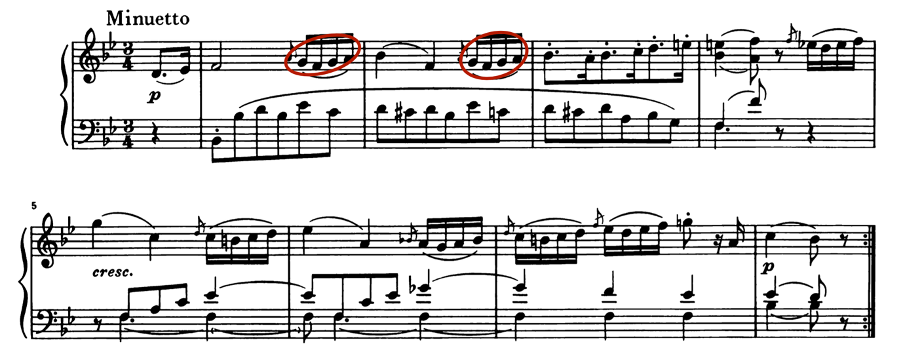
The Minuetto begins with an anacrusis. In keeping with the compound ternary design, this section itself is a three-part form a–b–a′.
 a
The right hand enters with a dotted upbeat rhythm, while the left hand supplies an arpeggiated accompaniment and the right hand carries the principal melody. A 16th-note motive that appears on the back half of bar 1 is used throughout the movement. Bars 1–4 move toward V; bars 5–7 prolong V. Over V, the previously mentioned 16th-note motive ascends and is repeated; bar 8 closes the a subsection with a perfect authentic cadence (PAC) in B-flat major.
b
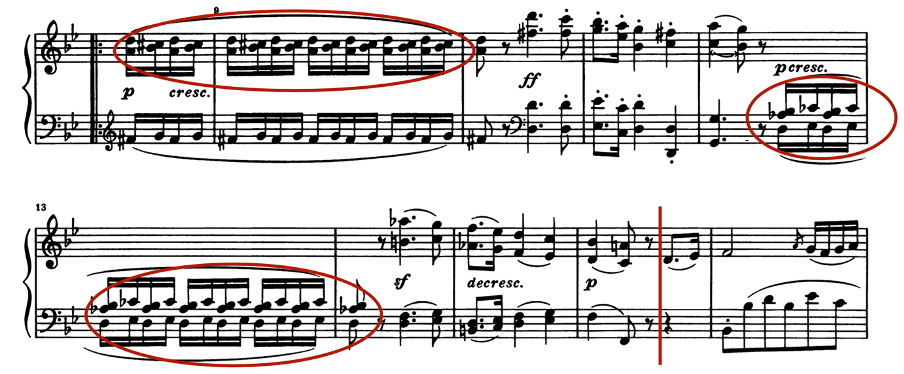
This begins on the dominant of g minor (the relative). Like a, it also starts with an anacrusis, and at the 4th bar it cadences in g minor. The four-bar phrase is then repeated; a point of contrast with the earlier passage is that the 16th-note neighbor-motion motive now appears in the low register. Unlike the first half—which stayed suspended on V of g minor—this span introduces more harmonic change and ends with a half cadence on V of the home key (B-flat), closing b.
a'
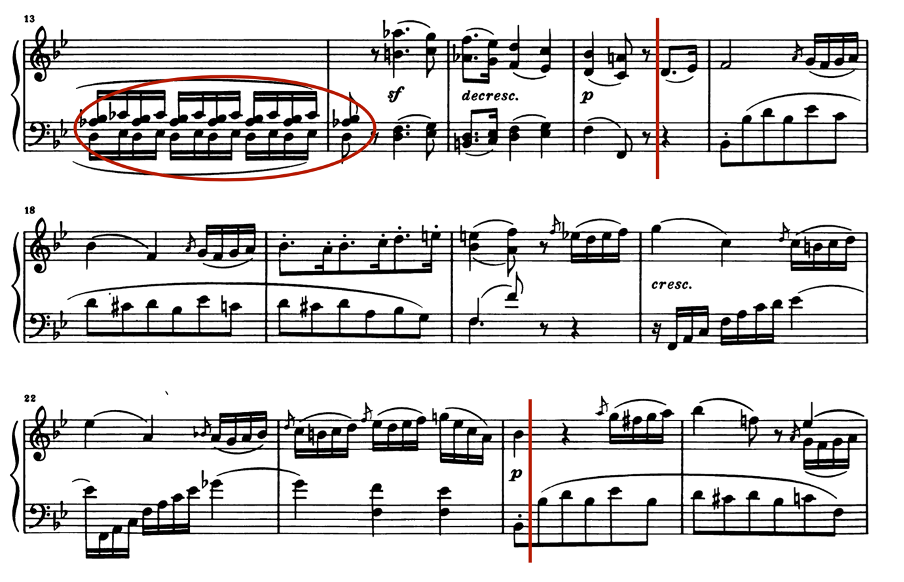
The first four bars proceed identically to a. From bar 21, however, the left-hand arpeggios—previously in eighth notes—return as 16th-notes spanning a wider register. At bar 23 the use of the opening motive in the approach to the cadence is slightly varied; with the cadence at bar 25 the music moves into the codetta.
Codetta (7 bars).
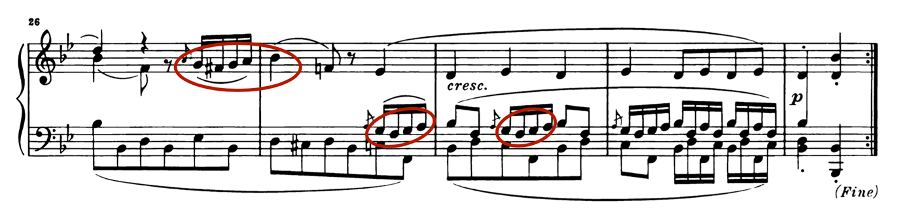 The opening motive continues to drive the close. It first appears in the right-hand outer voice, then shifts to the right-hand inner voice, and finally to the left-hand inner voice, persisting up to the end. Over the tonic, there is slight harmonic motion, and the section ends piano.
Minore (B)
This part contrasts with the Minuetto and is cast in a binary design a–a–b–a′.
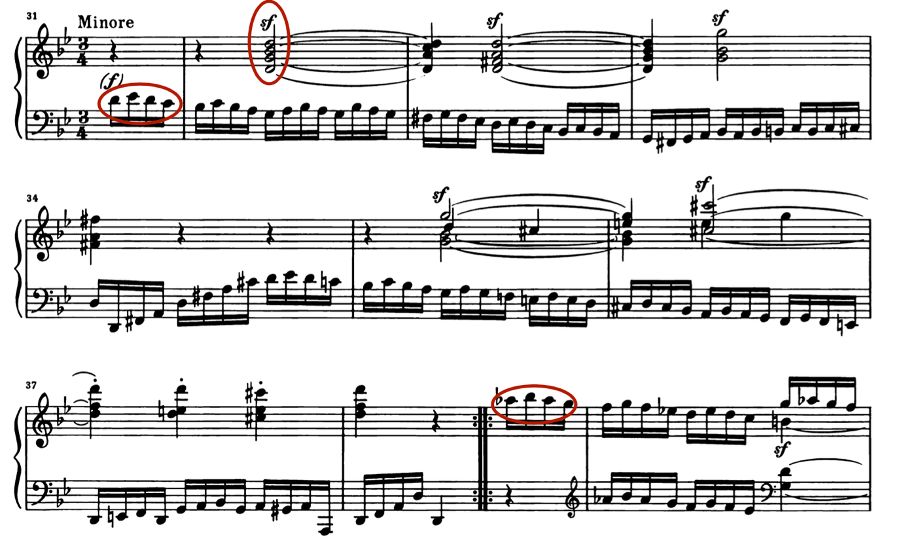
As in the Minuetto, it begins with an anacrusis and unfolds in g minor (the relative of the home key). The left-hand opening figure is an inverted form of the motive used persistently in the Minuetto. The 16th-note motive stated at the start exerts large-scale influence across the movement and is again the engine here. Above the unceasing left-hand motion, the right hand strikes vertical chords on weak beats with sforzandi, creating syncopated character. Tonally, it starts in g minor; over four bars the music presents tonic and dominant, establishing the key, then modulates to d minor. After a further four bars it closes the first part of the Minore with a PAC in d minor.
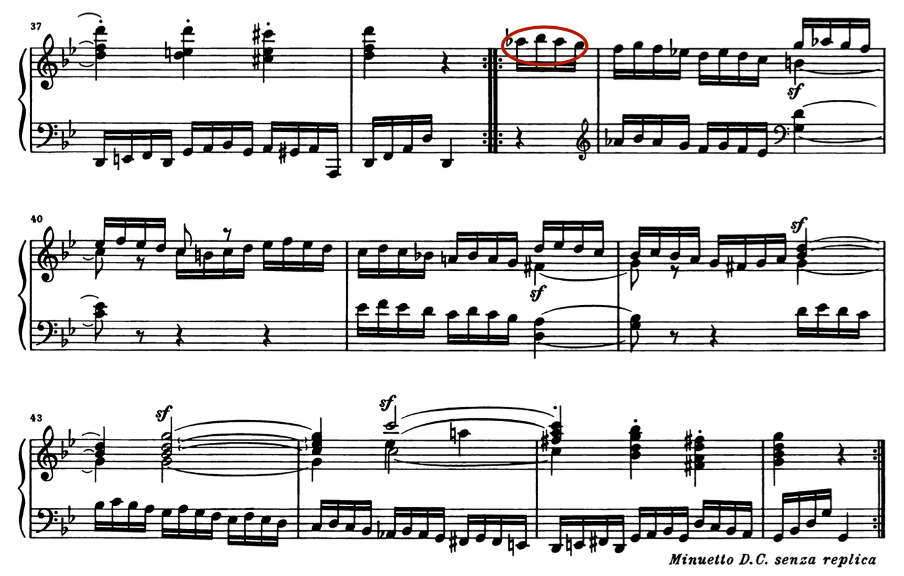
The second part adds A-flat, beginning in c minor. The use of the 16th-note motive is intensified here: both hands move together, repeating the motive more emphatically. Passing through c minor back to g minor, at bar 43 the first theme of the Minore is restated over g minor. At bar 46 a PAC in g minor closes the Minore, and the music returns Da Capo to the Minuetto.





The third movement is a menuetto in B-flat major, 3/4, laid out in a compound ternary form A–B–A, as is typical of the Classical minuet.
Minuetto (A)
The Minuetto begins with an anacrusis. In keeping with the compound ternary design, this section itself is a three-part form a–b–a′.
The right hand enters with a dotted upbeat rhythm, while the left hand supplies an arpeggiated accompaniment and the right hand carries the principal melody. A 16th-note motive that appears on the back half of bar 1 is used throughout the movement. Bars 1–4 move toward V; bars 5–7 prolong V. Over V, the previously mentioned 16th-note motive ascends and is repeated; bar 8 closes the a subsection with a perfect authentic cadence (PAC) in B-flat major.
b
This begins on the dominant of g minor (the relative). Like a, it also starts with an anacrusis, and at the 4th bar it cadences in g minor. The four-bar phrase is then repeated; a point of contrast with the earlier passage is that the 16th-note neighbor-motion motive now appears in the low register. Unlike the first half—which stayed suspended on V of g minor—this span introduces more harmonic change and ends with a half cadence on V of the home key (B-flat), closing b.
a'
The first four bars proceed identically to a. From bar 21, however, the left-hand arpeggios—previously in eighth notes—return as 16th-notes spanning a wider register. At bar 23 the use of the opening motive in the approach to the cadence is slightly varied; with the cadence at bar 25 the music moves into the codetta.
Codetta (7 bars).
Minore (B)
This part contrasts with the Minuetto and is cast in a binary design a–a–b–a′.
As in the Minuetto, it begins with an anacrusis and unfolds in g minor (the relative of the home key). The left-hand opening figure is an inverted form of the motive used persistently in the Minuetto. The 16th-note motive stated at the start exerts large-scale influence across the movement and is again the engine here. Above the unceasing left-hand motion, the right hand strikes vertical chords on weak beats with sforzandi, creating syncopated character. Tonally, it starts in g minor; over four bars the music presents tonic and dominant, establishing the key, then modulates to d minor. After a further four bars it closes the first part of the Minore with a PAC in d minor.
The second part adds A-flat, beginning in c minor. The use of the 16th-note motive is intensified here: both hands move together, repeating the motive more emphatically. Passing through c minor back to g minor, at bar 43 the first theme of the Minore is restated over g minor. At bar 46 a PAC in g minor closes the Minore, and the music returns Da Capo to the Minuetto.