The second movement is an Adagio in E-flat major, 9/8, laid out in sonata form. As with many of Beethoven’s slow movements, it begins and ends softly (piano or pianissimo).
Exposition
First Theme
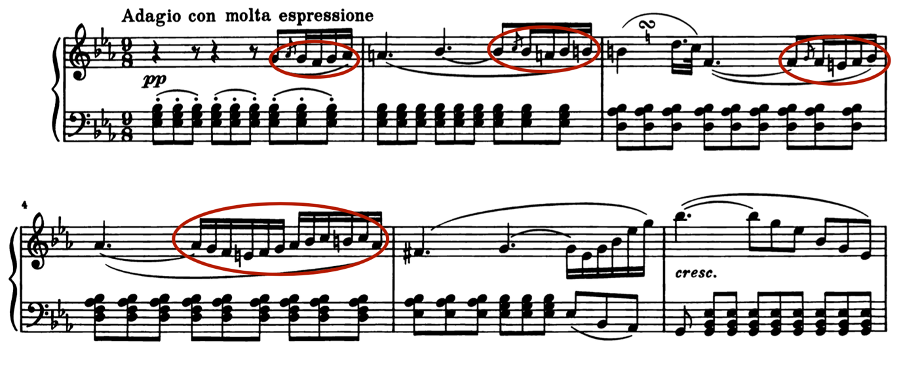
The first theme quietly begins in E-flat major at pp. The left hand supplies an accompaniment built from repeated chords, while the right hand carries the melody. The initial right-hand motive spans four bars and is continually reused and developed. Apart from the ties in the left-hand accompaniment over strong beats, the successive phrases do not share strong surface similarities and avoid a full cadence, giving the impression of ongoing continuation.
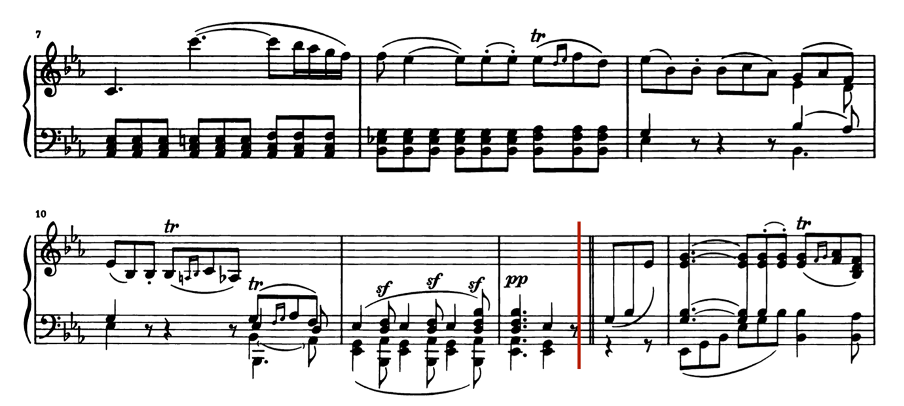
mm. 6–9: the bass ascends stepwise G–A♭–B♭–E♭ to V, then cadences on I. The staccato figure used at the cadence is repeated an octave lower, prolonging the close and ending the first theme.
Transition
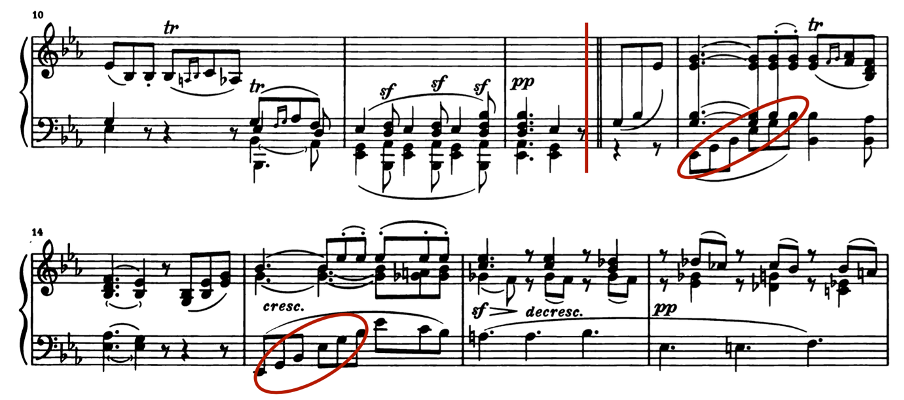
After the first theme, a transition follows. In the left hand, the rising arpeggio can be heard as a retrograde of the right hand’s descending arpeggio from m. 6 of the first theme. A two-bar phrase is repeated twice; from m. 16 the music changes. The E♭ chord in m. 15 is reinterpreted as IV of B-flat major (the dominant key), and chromatic motion leads to V. In mm. 17–18 there is a PAC in B-flat, and with the left-hand inner-voice rhythm carried over, the second theme begins.
Second Theme
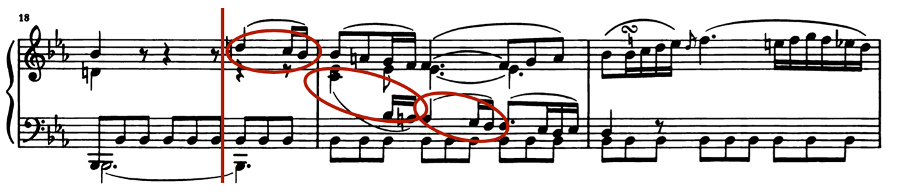

Continuing out of the transition, the second theme starts—in keeping with Classical practice—in the dominant key, B-flat major. The first right-hand motive shifts to an inner voice and is reused (cf. mm. 19 & 21). The bass consists of eighth-note repeated notes, prolonging the tonic. From m. 22 the figuration resembles patterns previously used in the transition.
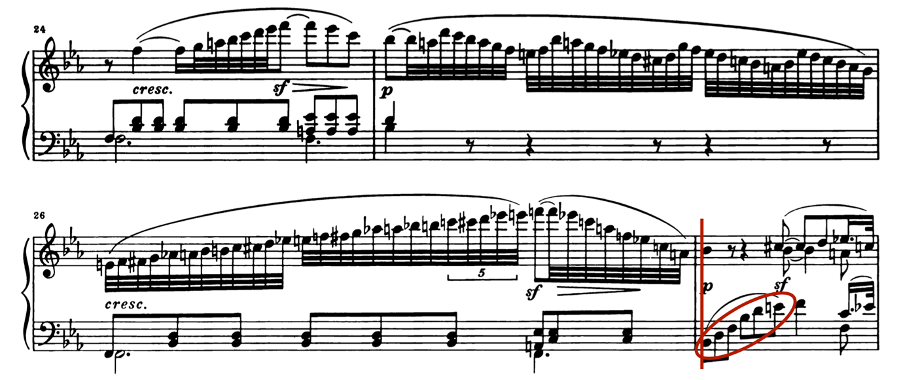
From m. 24 a passage appears in which the right-hand melody comes to the fore. After thirty-second-note passagework, a cadence in m. 27 leads into the codetta.
Codetta
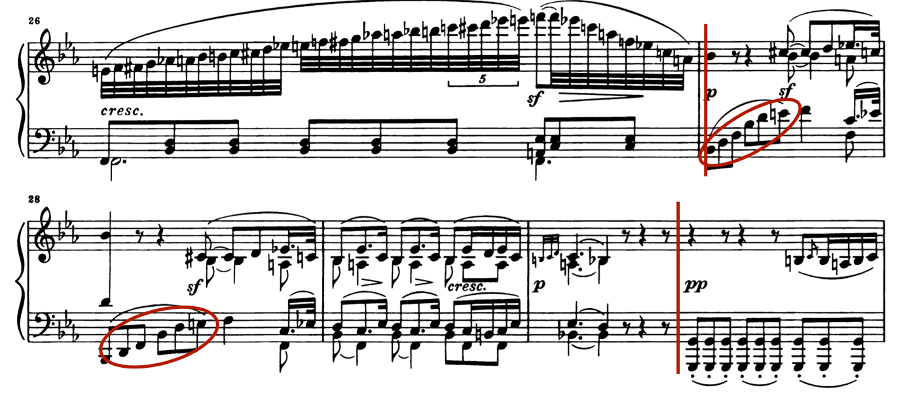
At the start of the codetta, the rising arpeggio figure heard in the earlier transition returns. The dotted rhythm used at the end of the right hand is repeated in m. 29, highlighting the cadence; with the ornamented cadence in m. 30, the exposition ends and the music proceeds to the development.
Development
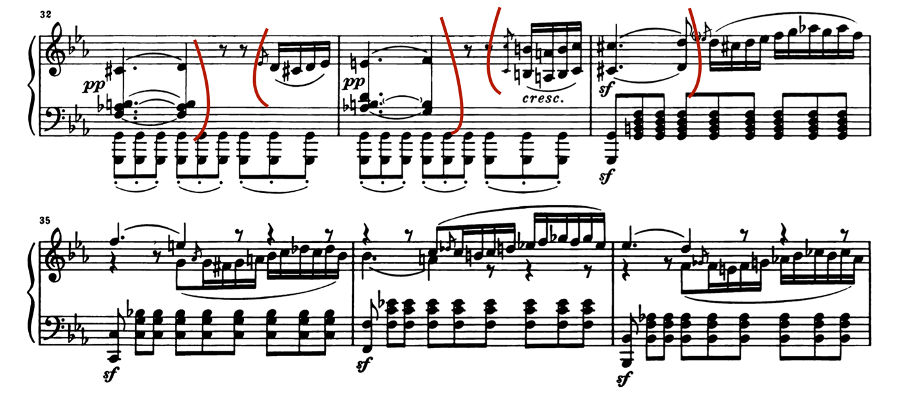
From m. 31 the development begins in C minor. The first four bars unfold over a dominant pedal. Motives of the first theme are worked to drive the development. The sequential pattern in mm. 31–32 is repeated three times, each time expanded. From m. 34 the expanded figure launches a new phrase; modulations proceed by dominant relations—V7/C → V7/F → V7/B-flat → V7/E-flat → V7/A-flat.
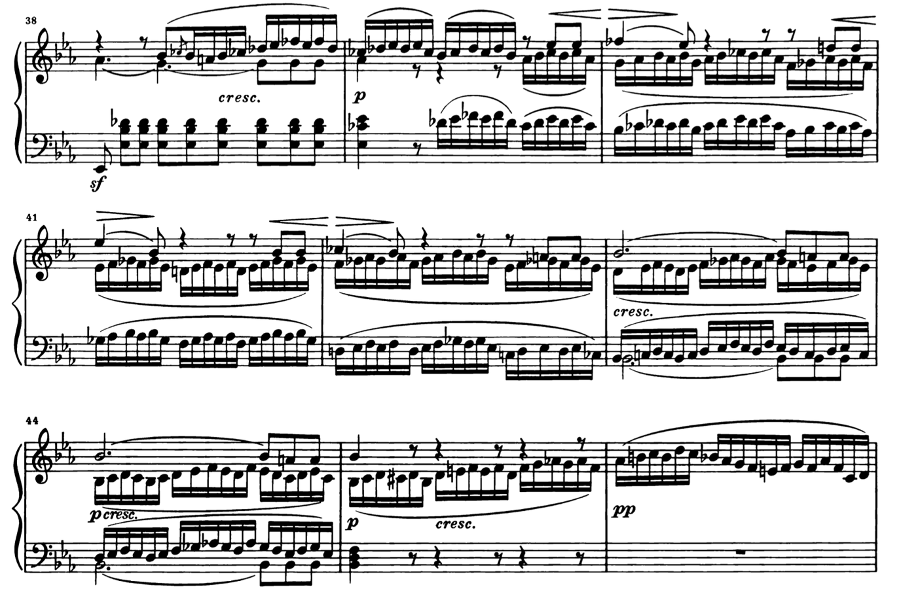
From m. 39 another first-theme motive is taken up and developed. As before, the key changes frequently: A-flat minor → E-flat minor, arriving at B-flat major in m. 44. The inner voices carry much of the motivic work, giving the passage a polyphonic cast. In m. 45 a B-flat chord is used as V of the tonic E-flat, and after a two-bar transitional passage the music moves to the recapitulation.
Recapitulation
First Theme
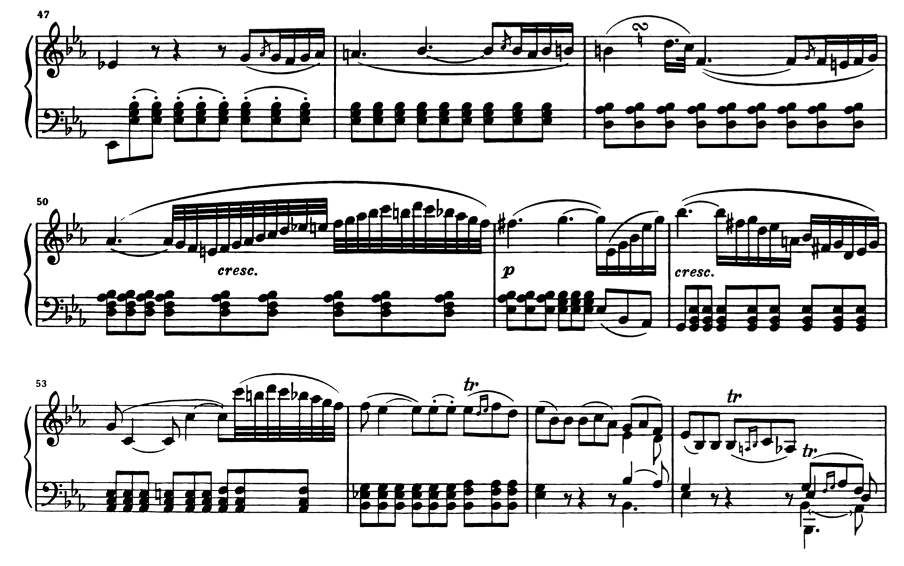
The recapitulation restates the first theme in the tonic essentially as before, though two bars are shortened, so the reprise appears in a slightly compressed form.
Transition
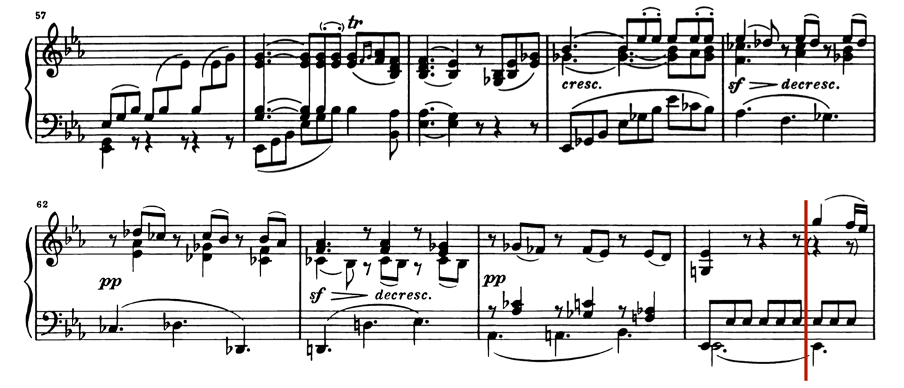
By contrast, the transition is extended by two bars. To restate the second theme in the tonic, there is no modulation to B-flat; however, at m. 60 the music touches E-flat minor, recalling earlier figures, then extends them. Chromatic motion provides varied color within E-flat. At m. 62 the music returns to I of E-flat, closing the transition and leading to the second theme.
Second Theme and Coda
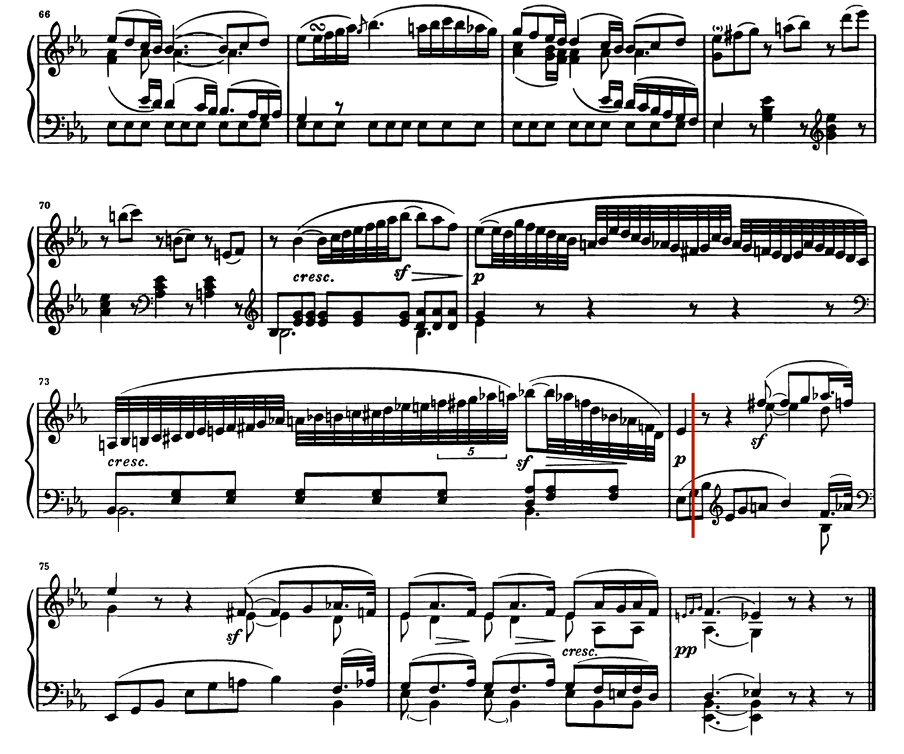
The second theme is restated in E-flat major and is otherwise the same as in the exposition. After the cadence at m. 74, a codetta follows, and—with no expanded coda—the movement concludes.





The second movement is an Adagio in E-flat major, 9/8, laid out in sonata form. As with many of Beethoven’s slow movements, it begins and ends softly (piano or pianissimo).
Exposition
First Theme
The first theme quietly begins in E-flat major at pp. The left hand supplies an accompaniment built from repeated chords, while the right hand carries the melody. The initial right-hand motive spans four bars and is continually reused and developed. Apart from the ties in the left-hand accompaniment over strong beats, the successive phrases do not share strong surface similarities and avoid a full cadence, giving the impression of ongoing continuation.
mm. 6–9: the bass ascends stepwise G–A♭–B♭–E♭ to V, then cadences on I. The staccato figure used at the cadence is repeated an octave lower, prolonging the close and ending the first theme.
Transition
After the first theme, a transition follows. In the left hand, the rising arpeggio can be heard as a retrograde of the right hand’s descending arpeggio from m. 6 of the first theme. A two-bar phrase is repeated twice; from m. 16 the music changes. The E♭ chord in m. 15 is reinterpreted as IV of B-flat major (the dominant key), and chromatic motion leads to V. In mm. 17–18 there is a PAC in B-flat, and with the left-hand inner-voice rhythm carried over, the second theme begins.
Second Theme
Continuing out of the transition, the second theme starts—in keeping with Classical practice—in the dominant key, B-flat major. The first right-hand motive shifts to an inner voice and is reused (cf. mm. 19 & 21). The bass consists of eighth-note repeated notes, prolonging the tonic. From m. 22 the figuration resembles patterns previously used in the transition.
From m. 24 a passage appears in which the right-hand melody comes to the fore. After thirty-second-note passagework, a cadence in m. 27 leads into the codetta.
Codetta
At the start of the codetta, the rising arpeggio figure heard in the earlier transition returns. The dotted rhythm used at the end of the right hand is repeated in m. 29, highlighting the cadence; with the ornamented cadence in m. 30, the exposition ends and the music proceeds to the development.
Development
From m. 31 the development begins in C minor. The first four bars unfold over a dominant pedal. Motives of the first theme are worked to drive the development. The sequential pattern in mm. 31–32 is repeated three times, each time expanded. From m. 34 the expanded figure launches a new phrase; modulations proceed by dominant relations—V7/C → V7/F → V7/B-flat → V7/E-flat → V7/A-flat.
From m. 39 another first-theme motive is taken up and developed. As before, the key changes frequently: A-flat minor → E-flat minor, arriving at B-flat major in m. 44. The inner voices carry much of the motivic work, giving the passage a polyphonic cast. In m. 45 a B-flat chord is used as V of the tonic E-flat, and after a two-bar transitional passage the music moves to the recapitulation.
Recapitulation
First Theme
The recapitulation restates the first theme in the tonic essentially as before, though two bars are shortened, so the reprise appears in a slightly compressed form.
Transition
By contrast, the transition is extended by two bars. To restate the second theme in the tonic, there is no modulation to B-flat; however, at m. 60 the music touches E-flat minor, recalling earlier figures, then extends them. Chromatic motion provides varied color within E-flat. At m. 62 the music returns to I of E-flat, closing the transition and leading to the second theme.
Second Theme and Coda
The second theme is restated in E-flat major and is otherwise the same as in the exposition. After the cadence at m. 74, a codetta follows, and—with no expanded coda—the movement concludes.