The first movement is in sonata form with well-balanced exposition–development–recapitulation. There is no additional coda; the exposition’s layout reappears essentially intact in the recapitulation. Composed in 1800 and published in 1802; Beethoven is said to have regarded this sonata as the finest among his early piano sonatas.
Exposition
First Theme
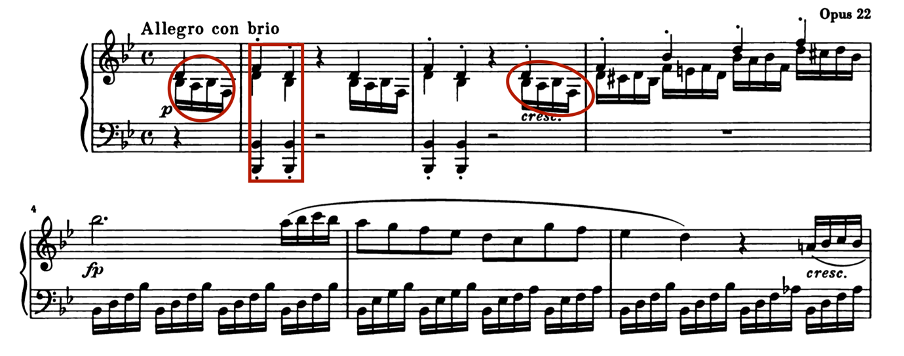
The first theme begins in B-flat major. Over I, the music grows by crescendo and develops. The initial motive divides into two components: (1) in an inner voice, a sixteenth-note figure with a neighbor note, and (2) a third-leaping chordal shape. The front fragment of this motive is seized on and developed. From m. 4 the flowing music is presented in earnest: the left hand offers a sixteenth-note arpeggiated accompaniment, while the right hand states a clear melody. The bass remains on B-flat, i.e., a sustained tonic pedal.

From m. 8 the two hands merge. Material heard before now appears varied and developed; phrases that had moved in two-bar units shrink to half-bar spans, creating acceleration. The partial hand-to-hand unison of mm. 8–9 becomes a full octave unison at m. 10, rises to F, and closes the first theme. I is maintained through m. 10; only at m. 11 does V appear.
Transition
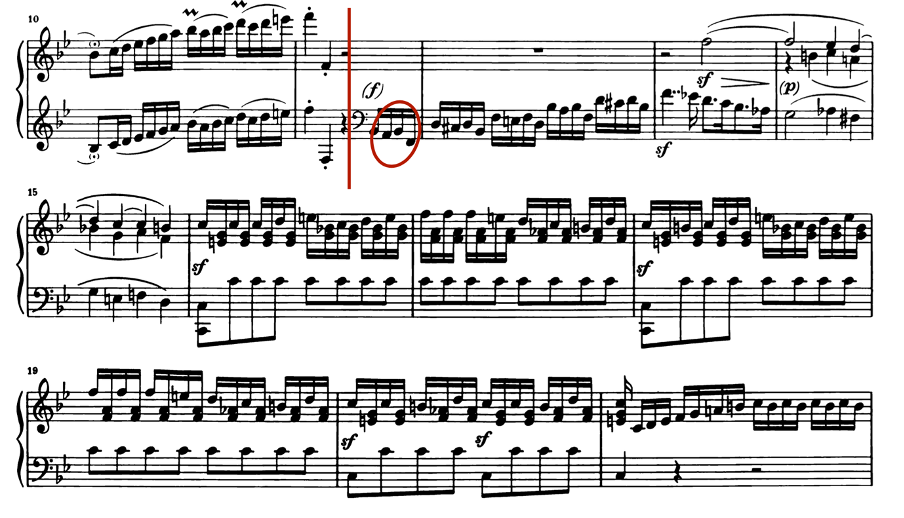
From the latter half of m. 11 the transition starts. Its opening left-hand sixteenth-note line—a neighbor followed by a leap—is the same shape as the first theme’s opening motive. The note values then broaden to m. 15 in a more static phrase; at m. 16 the music tips back into a faster motion. From here the transition’s function—leading to the second theme—is more strongly profiled. The harmony moves to F major, the dominant of the home key and the second-theme key, and V is continually stressed. From mm. 16–21 the music sits on V of F with repeated rapid motion. At m. 21 a right-hand single-line figure appears; this becomes a chief motive for the left hand in the second theme.
Second Theme
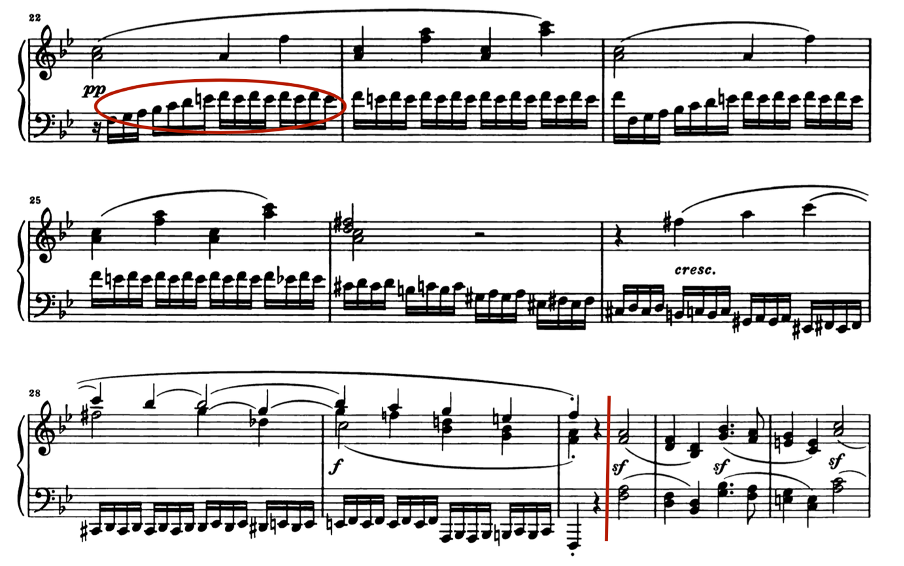
Following directly from the transition, the second theme begins in F major. The right-hand figure at the end of the transition reappears unchanged in the left hand. Points of kinship with the first theme are audible: the neighbor tones that keep returning in the left-hand accompaniment, and the third-chord texture and third-leaping intervals in the right hand. The right-hand melody unfolds in half- and quarter-note values with two-bar phrases. There is scant conjunct motion; leaps predominate—thus forming a contrast with the first theme. Mm. 25–26 use F–F♯ chromatic motion to suggest g minor; without ever asserting i plainly, the music proceeds chromatically and then, with a clear V–I in F major, closes the first part of the second theme.
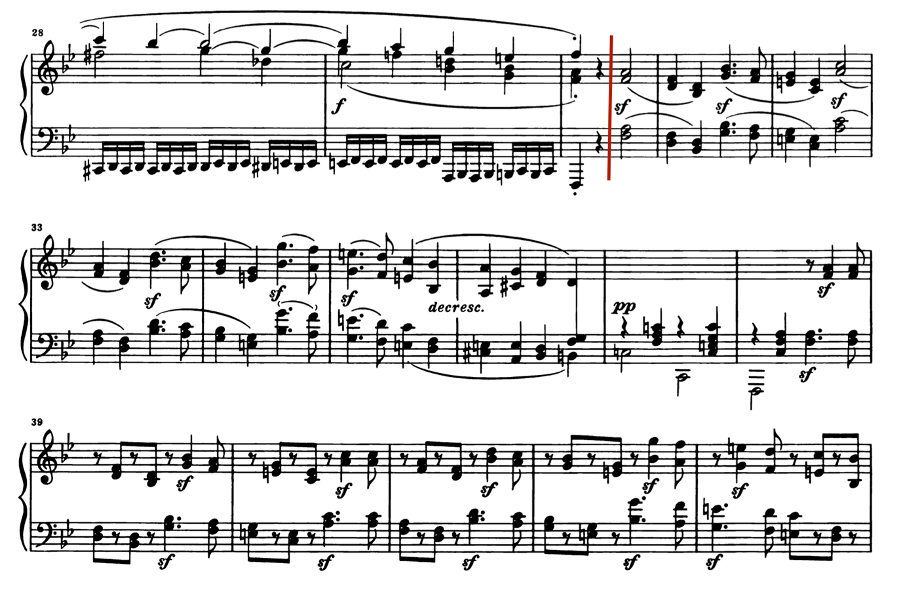
The second part of the second theme is a chain of third-chords. Phrases are noticeably shorter than before, and with the sixteenth-note accompaniment gone, the sense of pace changes. Hands in unison are another hallmark. By placing sforzandi on the middle beat, Beethoven deliberately shifts phrase onsets; from m. 35 the sforzandi move to the downbeat to form a closing phrase. The phrase that starts at m. 37 repeats the previous one but alternates the hands in eighth-notes, heightening acceleration.
Transition
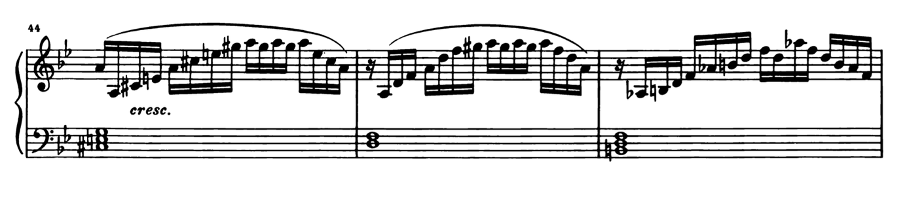
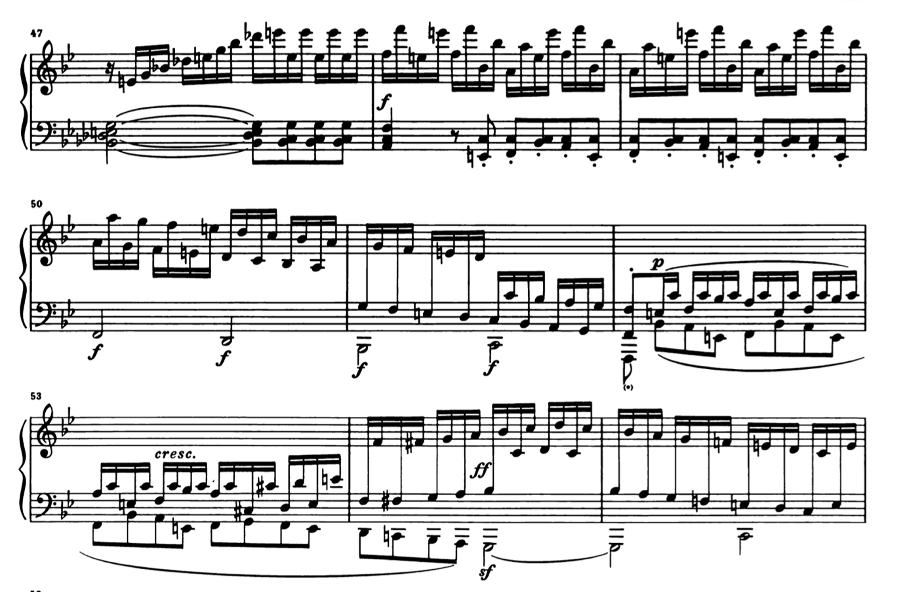
From m. 44 a transition unfolds in arpeggiated diminished-seventh chords. The repeated motion of mm. 44–46 is varied at m. 47. The right hand now features octave leaps with increasing frequency, heightening tension; the left hand presents eighth-note figures (with staccato), aiding acceleration. What had been descending at mm. 50–51 becomes the start of an ascending phrase at m. 52; from mm. 52–55 the developed figures rush toward a cadence.
Codetta
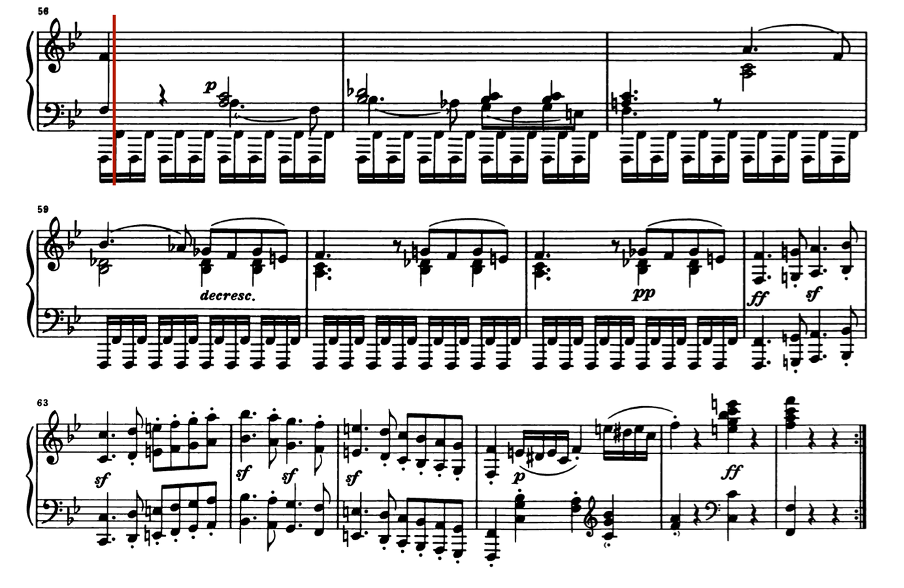
After the cadence at m. 56 a codetta follows. The right-hand octave-leap pattern heard just before is now taken up by the left hand; an F pedal sustains the sense of tonic (in F major). In the right hand, motives from the first theme appear in transformed guise. The eighth-note motion beginning at m. 59 can be heard as a variant of the first theme’s sixteenth-note opening motive. From m. 62 both hands proceed in octave unison; the phrase ascends then descends through m. 66, briefly states the first-theme motive, and, with a PAC, closes the exposition.
Development
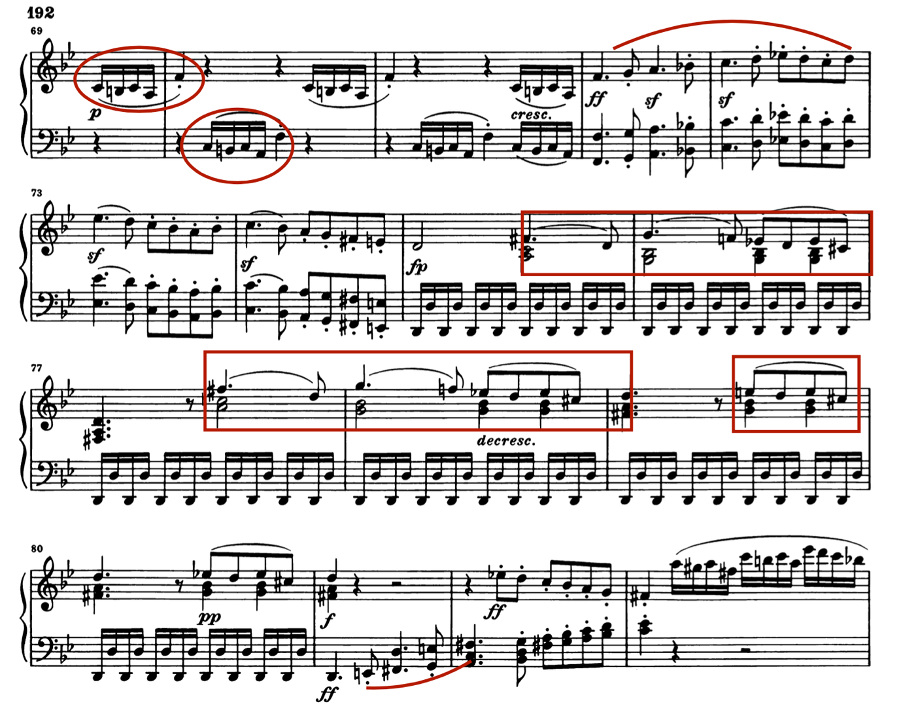
The development divides into four large parts. It opens by recalling the first theme’s motive: after four alternations between the hands, it appears in unison, then proceeds with the octave-unison writing heard in the codetta. F-major harmony is used as V of B-flat, and the development begins in B-flat major. In m. 75 the line that spans mm. 72–75 arrives on D; this is reinterpreted as V of g minor, effecting a modulation. Over a D-pedal the right-hand melody continues. The shapes at mm. 75–76 reappear an octave higher at mm. 77–78; through m. 80 the music remains on V with no stable tonic. At m. 81 a new ascending left-hand figure ushers in the next section. Mm. 69–81 thus develop the first-theme motive and the second theme’s rhythmic profile, with codetta elements added.
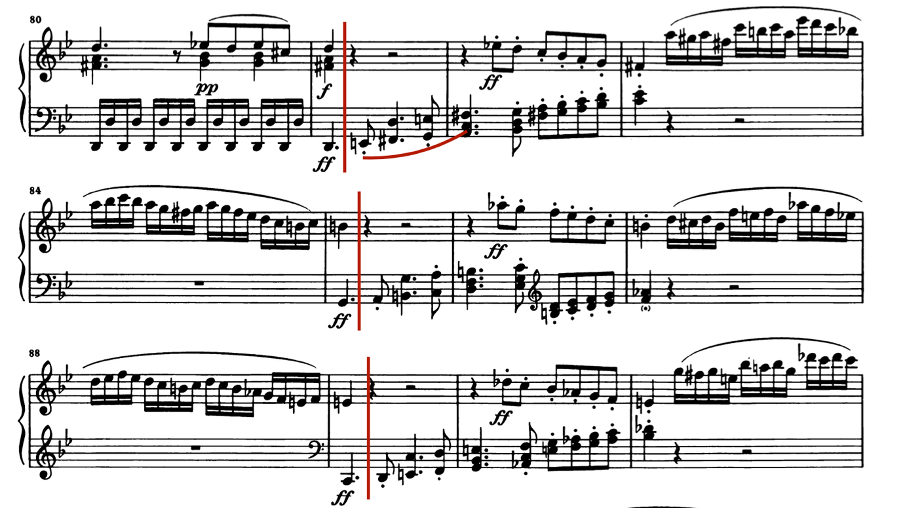
A left-hand rhythm derived from the codetta—already heard earlier in the development—now launches the span. Three parallel phrases appear in turn, each starting in a new key: the music sequences by keys related through V: g minor → c minor → f minor.

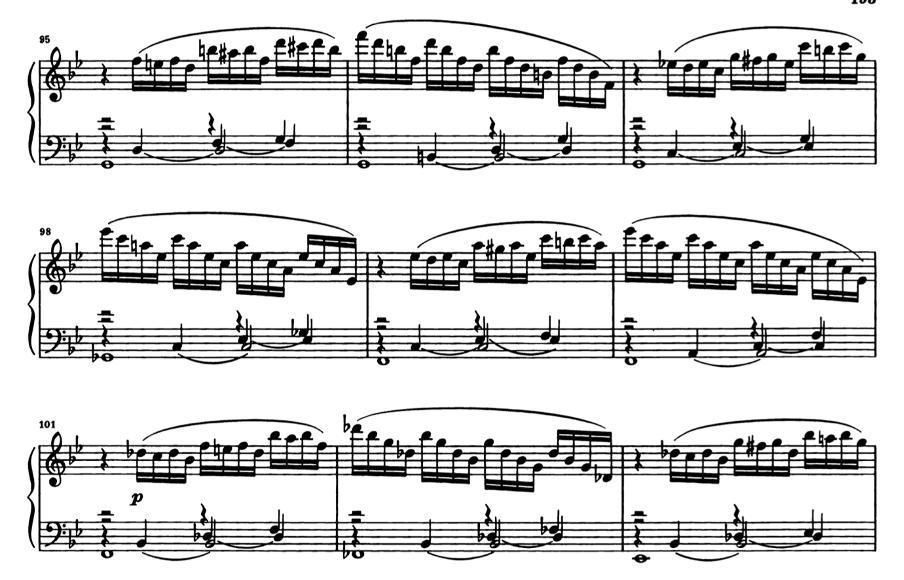
Next, over a bass descending by seconds, arpeggiated figures are laid in. Using the first-theme motive, the line ascends; with a more generic arpeggio it descends—a pattern repeated multiple times. In the inner voices, leaps by thirds and fourths appear continually—again connected with the leaping idea of the first theme. The keys shift phrase by phrase: f minor → c minor → B-flat major.
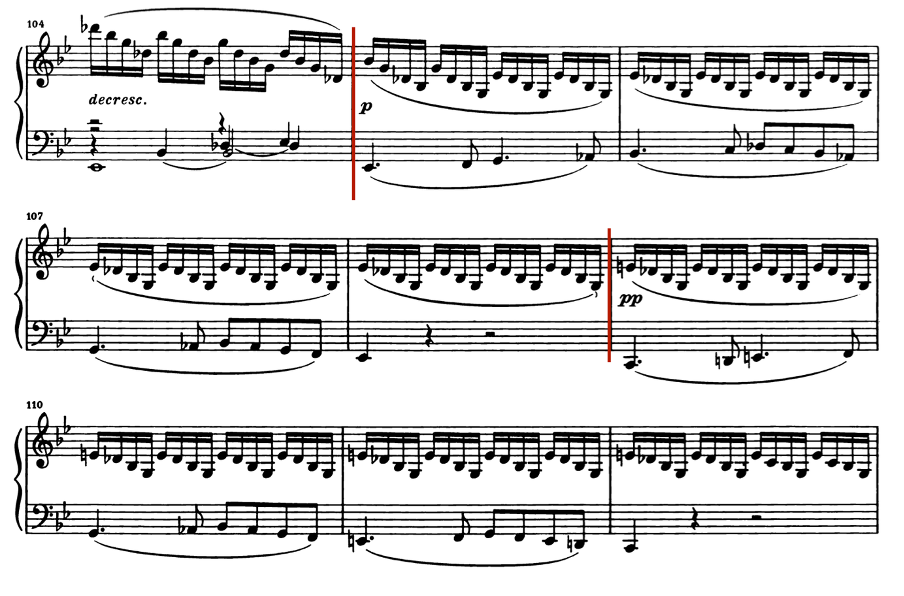
The right hand’s sixteenth-note arpeggios continue in the fourth part as well; the left hand now sings a more legato, emphasized line. Four-bar units are the basic building block; Beethoven varies and develops them. Harmonically the section starts as V of A-flat major and naturally slips to the relative f minor. The chromatic move E-flat → E is also noteworthy.

The left hand drops to the low register for its melody. The music modulates back to B-flat major and V is stressed. The left-hand pattern undergoes small changes. Beginning with the long hold on F at m. 116, only fragments of the melody remain; these recur and accelerate, preparing the end of the development. Over a dominant pedal the sequence repeats; at m. 125 a pp half-cadential pause with fermata stands out and leads to the recapitulation.
Recapitulation
First Theme
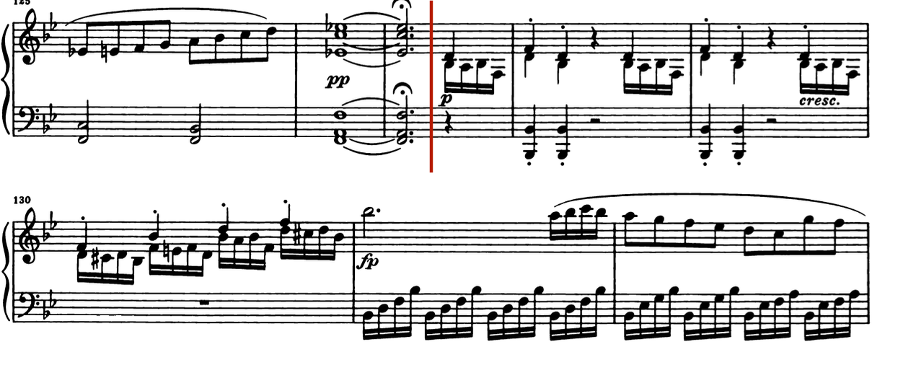
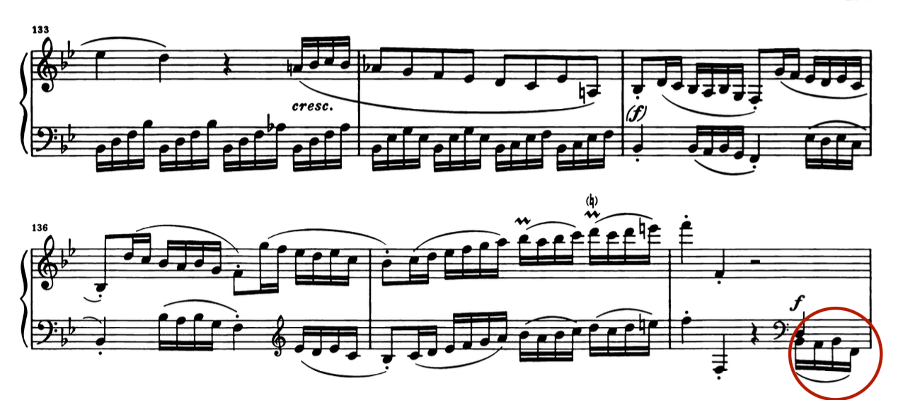
The first theme in the recapitulation returns essentially unchanged from the exposition.
Transition
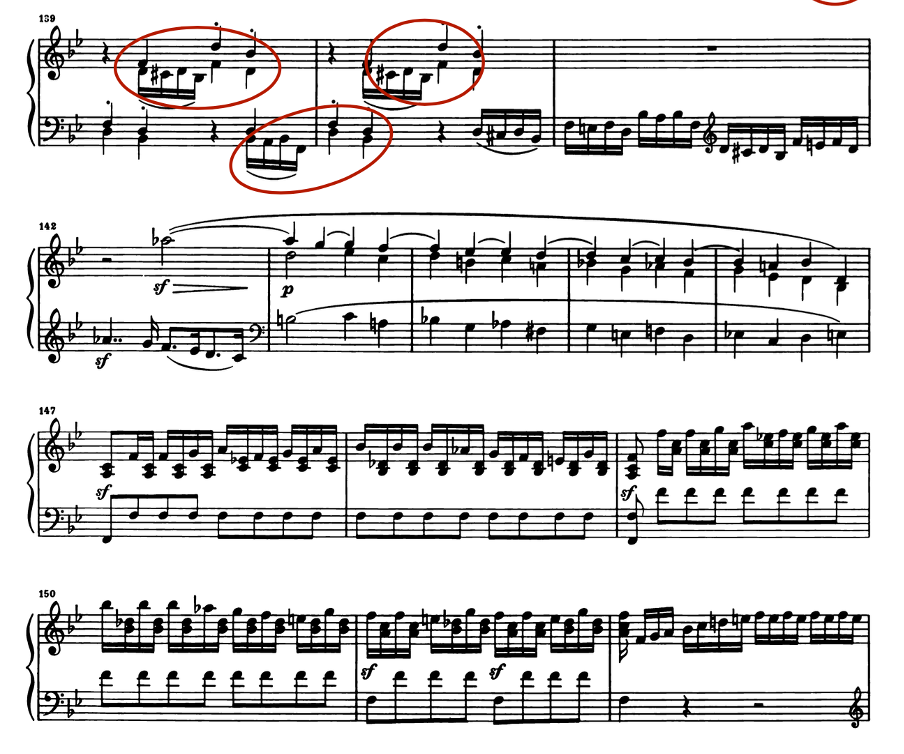
Elements absent in the exposition are added here. The first-theme motive is passed antiphonally between the hands, stamping the theme more firmly on the ear. Subsequent transition spans expand figures already heard in the exposition. The sequence that resolves repeated V motions at mm. 143–146 is more strongly emphasized. To ensure the second theme will now be in the home key, the harmony moves toward F, the dominant of B-flat; at m. 147 V is made fully explicit and is prolonged.
Second Theme
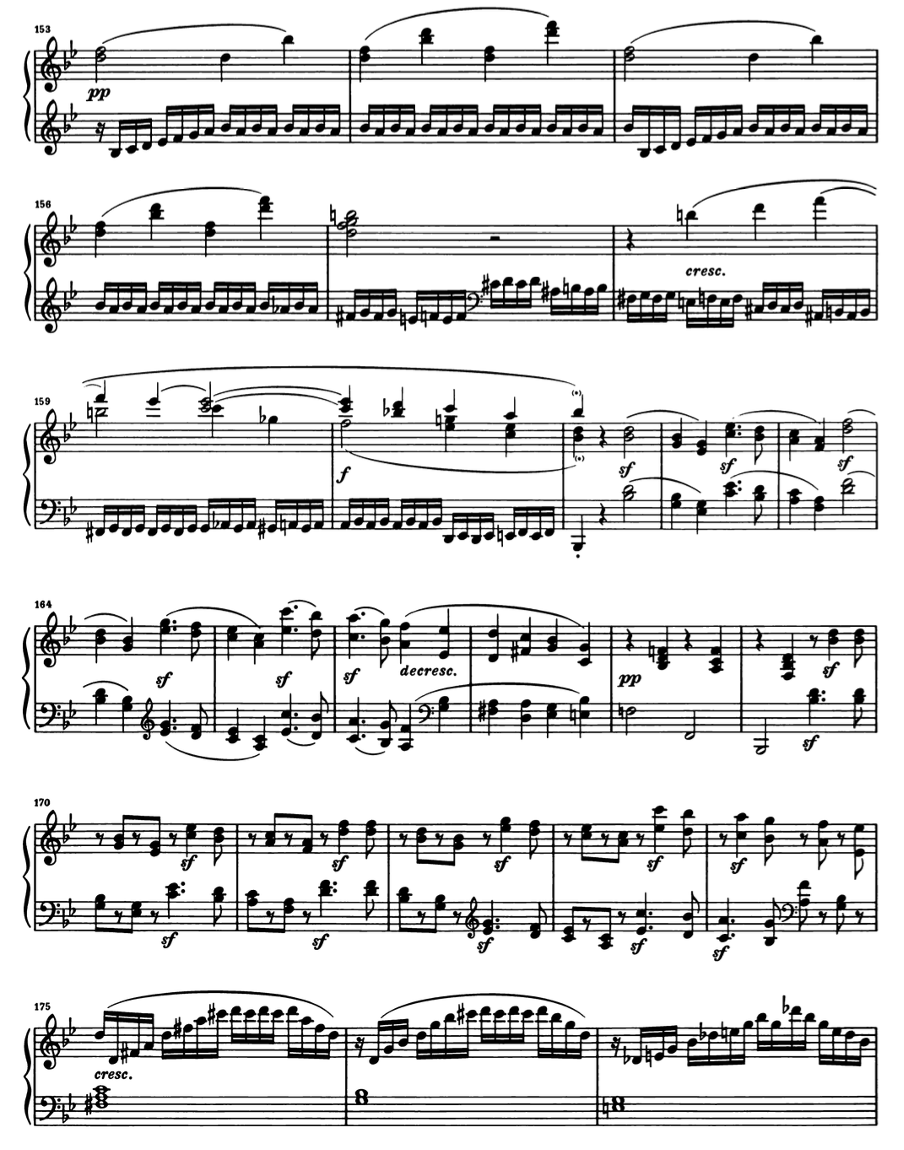
Apart from now being restated in the tonic (B-flat), the second theme is identical to its expositional form.
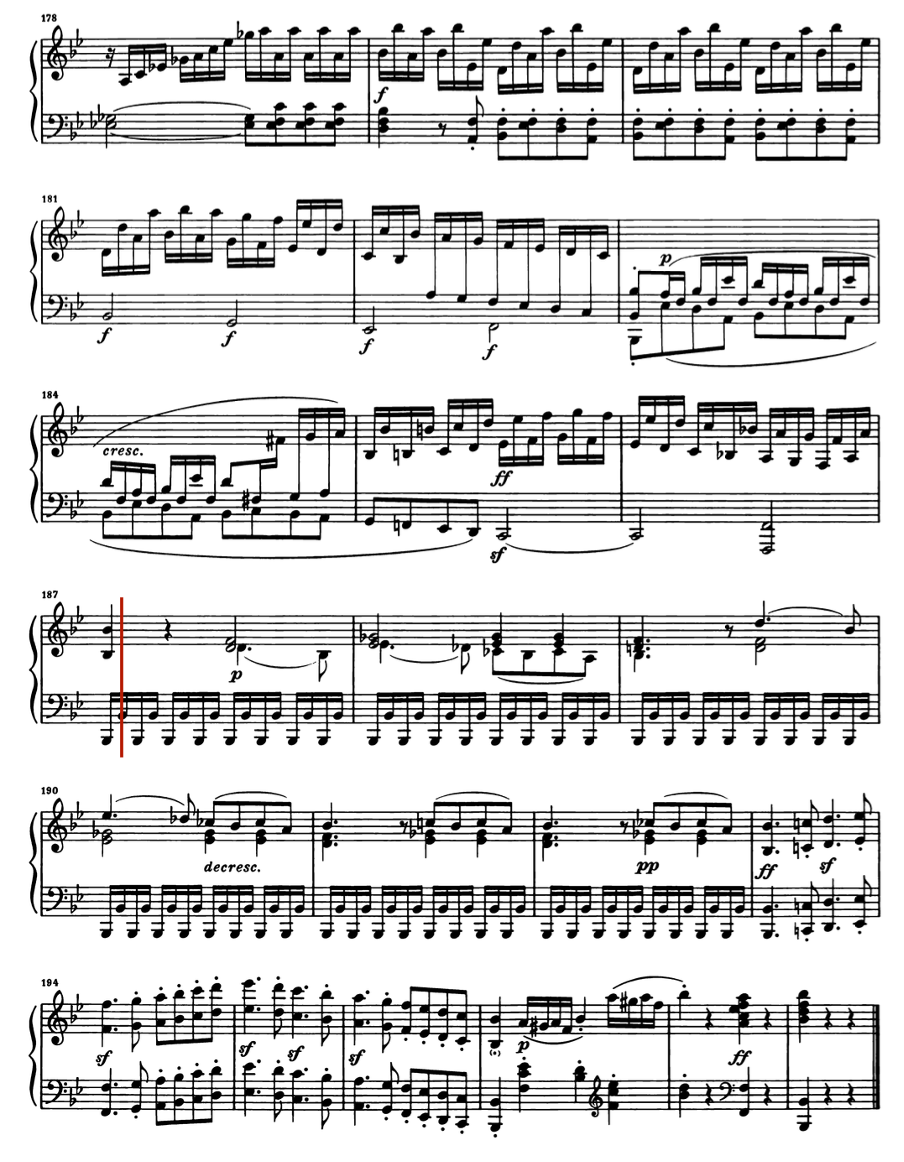
The final spans, including the codetta after the cadence at m. 187, likewise mirror the exposition exactly in design, key aside. With no expanded coda, the movement ends on approximately the same scale as the exposition.





The first movement is in sonata form with well-balanced exposition–development–recapitulation. There is no additional coda; the exposition’s layout reappears essentially intact in the recapitulation. Composed in 1800 and published in 1802; Beethoven is said to have regarded this sonata as the finest among his early piano sonatas.
Exposition
First Theme
The first theme begins in B-flat major. Over I, the music grows by crescendo and develops. The initial motive divides into two components: (1) in an inner voice, a sixteenth-note figure with a neighbor note, and (2) a third-leaping chordal shape. The front fragment of this motive is seized on and developed. From m. 4 the flowing music is presented in earnest: the left hand offers a sixteenth-note arpeggiated accompaniment, while the right hand states a clear melody. The bass remains on B-flat, i.e., a sustained tonic pedal.
From m. 8 the two hands merge. Material heard before now appears varied and developed; phrases that had moved in two-bar units shrink to half-bar spans, creating acceleration. The partial hand-to-hand unison of mm. 8–9 becomes a full octave unison at m. 10, rises to F, and closes the first theme. I is maintained through m. 10; only at m. 11 does V appear.
Transition
From the latter half of m. 11 the transition starts. Its opening left-hand sixteenth-note line—a neighbor followed by a leap—is the same shape as the first theme’s opening motive. The note values then broaden to m. 15 in a more static phrase; at m. 16 the music tips back into a faster motion. From here the transition’s function—leading to the second theme—is more strongly profiled. The harmony moves to F major, the dominant of the home key and the second-theme key, and V is continually stressed. From mm. 16–21 the music sits on V of F with repeated rapid motion. At m. 21 a right-hand single-line figure appears; this becomes a chief motive for the left hand in the second theme.
Second Theme
Following directly from the transition, the second theme begins in F major. The right-hand figure at the end of the transition reappears unchanged in the left hand. Points of kinship with the first theme are audible: the neighbor tones that keep returning in the left-hand accompaniment, and the third-chord texture and third-leaping intervals in the right hand. The right-hand melody unfolds in half- and quarter-note values with two-bar phrases. There is scant conjunct motion; leaps predominate—thus forming a contrast with the first theme. Mm. 25–26 use F–F♯ chromatic motion to suggest g minor; without ever asserting i plainly, the music proceeds chromatically and then, with a clear V–I in F major, closes the first part of the second theme.
The second part of the second theme is a chain of third-chords. Phrases are noticeably shorter than before, and with the sixteenth-note accompaniment gone, the sense of pace changes. Hands in unison are another hallmark. By placing sforzandi on the middle beat, Beethoven deliberately shifts phrase onsets; from m. 35 the sforzandi move to the downbeat to form a closing phrase. The phrase that starts at m. 37 repeats the previous one but alternates the hands in eighth-notes, heightening acceleration.
Transition
From m. 44 a transition unfolds in arpeggiated diminished-seventh chords. The repeated motion of mm. 44–46 is varied at m. 47. The right hand now features octave leaps with increasing frequency, heightening tension; the left hand presents eighth-note figures (with staccato), aiding acceleration. What had been descending at mm. 50–51 becomes the start of an ascending phrase at m. 52; from mm. 52–55 the developed figures rush toward a cadence.
Codetta
After the cadence at m. 56 a codetta follows. The right-hand octave-leap pattern heard just before is now taken up by the left hand; an F pedal sustains the sense of tonic (in F major). In the right hand, motives from the first theme appear in transformed guise. The eighth-note motion beginning at m. 59 can be heard as a variant of the first theme’s sixteenth-note opening motive. From m. 62 both hands proceed in octave unison; the phrase ascends then descends through m. 66, briefly states the first-theme motive, and, with a PAC, closes the exposition.
Development
The development divides into four large parts. It opens by recalling the first theme’s motive: after four alternations between the hands, it appears in unison, then proceeds with the octave-unison writing heard in the codetta. F-major harmony is used as V of B-flat, and the development begins in B-flat major. In m. 75 the line that spans mm. 72–75 arrives on D; this is reinterpreted as V of g minor, effecting a modulation. Over a D-pedal the right-hand melody continues. The shapes at mm. 75–76 reappear an octave higher at mm. 77–78; through m. 80 the music remains on V with no stable tonic. At m. 81 a new ascending left-hand figure ushers in the next section. Mm. 69–81 thus develop the first-theme motive and the second theme’s rhythmic profile, with codetta elements added.
A left-hand rhythm derived from the codetta—already heard earlier in the development—now launches the span. Three parallel phrases appear in turn, each starting in a new key: the music sequences by keys related through V: g minor → c minor → f minor.
Next, over a bass descending by seconds, arpeggiated figures are laid in. Using the first-theme motive, the line ascends; with a more generic arpeggio it descends—a pattern repeated multiple times. In the inner voices, leaps by thirds and fourths appear continually—again connected with the leaping idea of the first theme. The keys shift phrase by phrase: f minor → c minor → B-flat major.
The right hand’s sixteenth-note arpeggios continue in the fourth part as well; the left hand now sings a more legato, emphasized line. Four-bar units are the basic building block; Beethoven varies and develops them. Harmonically the section starts as V of A-flat major and naturally slips to the relative f minor. The chromatic move E-flat → E is also noteworthy.
The left hand drops to the low register for its melody. The music modulates back to B-flat major and V is stressed. The left-hand pattern undergoes small changes. Beginning with the long hold on F at m. 116, only fragments of the melody remain; these recur and accelerate, preparing the end of the development. Over a dominant pedal the sequence repeats; at m. 125 a pp half-cadential pause with fermata stands out and leads to the recapitulation.
Recapitulation
First Theme
The first theme in the recapitulation returns essentially unchanged from the exposition.
Transition
Elements absent in the exposition are added here. The first-theme motive is passed antiphonally between the hands, stamping the theme more firmly on the ear. Subsequent transition spans expand figures already heard in the exposition. The sequence that resolves repeated V motions at mm. 143–146 is more strongly emphasized. To ensure the second theme will now be in the home key, the harmony moves toward F, the dominant of B-flat; at m. 147 V is made fully explicit and is prolonged.
Second Theme
Apart from now being restated in the tonic (B-flat), the second theme is identical to its expositional form.
The final spans, including the codetta after the cadence at m. 187, likewise mirror the exposition exactly in design, key aside. With no expanded coda, the movement ends on approximately the same scale as the exposition.